

This economics question tests your understanding of economic models and analysis. The step-by-step answer below applies the relevant framework and explains the reasoning.
ScanSolve AI Answer
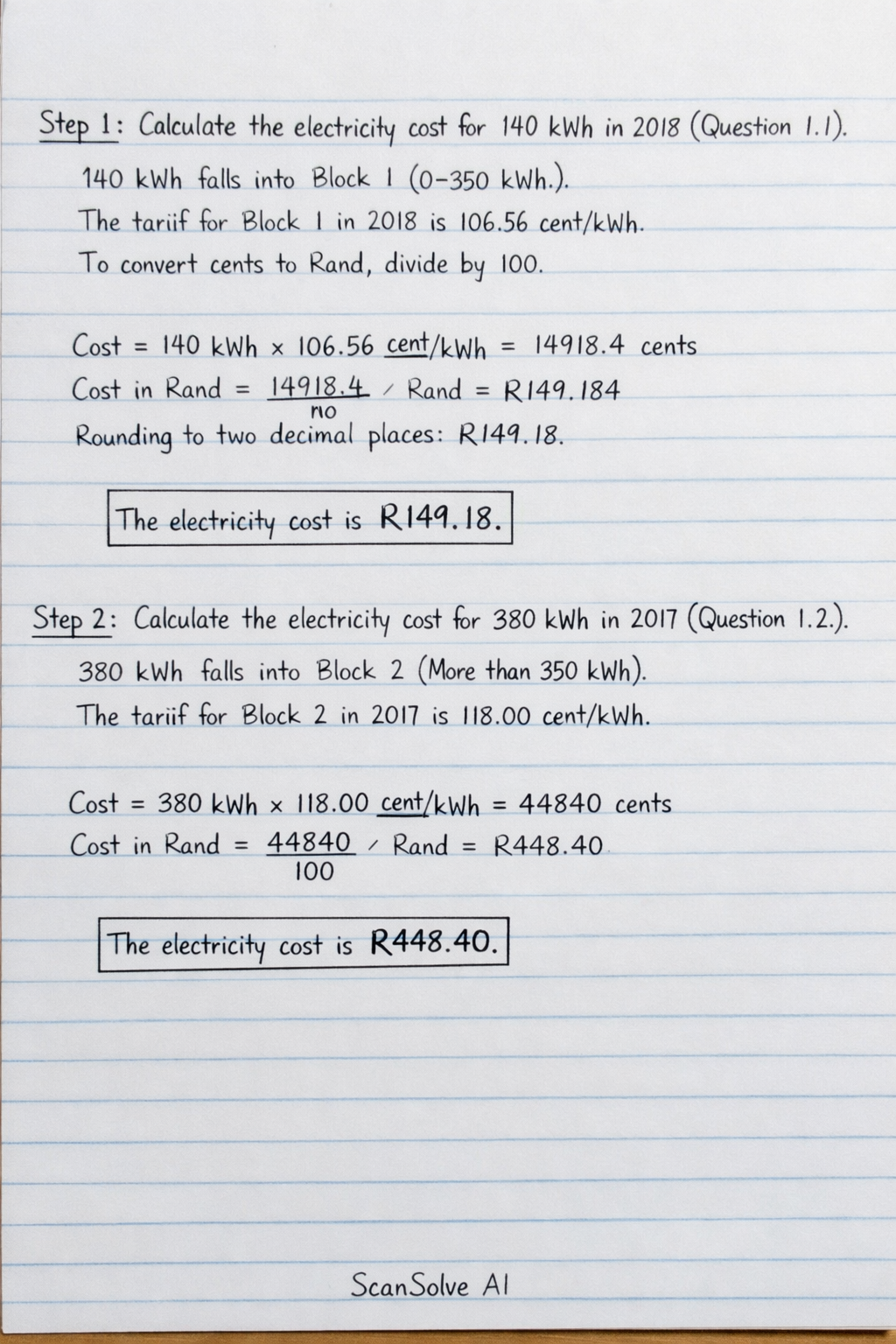
Step 1: Calculate the electricity cost for 140 kWh in 2018 (Question 1.1). 140 kWh falls into Block 1 (0-350 kWh). The tariff for Block 1 in 2018 is 106.56 cent/kWh. To convert cents to Rand, divide by 100. Cost = 140 kWh × 106.56 centkWh = 14918.4 cents Cost in Rand = (14918.4)/(100) Rand = R149.184 Rounding to two decimal places: R149.18. The electricity cost is R149.18. Step 2: Calculate the electricity cost for 380 kWh in 2017 (Question 1.2). 380 kWh falls into Block 2 (More than 350 kWh). The tariff for Block 2 in 2017 is 118.00 cent/kWh. Cost = 380 kWh × 118.00 centkWh = 44840 cents Cost in Rand = (44840)/(100) Rand = R448.40 The electricity cost is R448.40. Step 3: Calculate the percentage increase in electricity charges for Block 2 tariffs from 2017 to 2018 (Question 1.3). Tariff for Block 2 in 2017 = 118.00 cent/kWh. Tariff for Block 2 in 2018 = 120.60 cent/kWh. Percentage increase = New Tariff - Old TariffOld Tariff × 100\% Percentage increase = (120.60 - 118.00)/(118.00) × 100\% Percentage increase = (2.60)/(118.00) × 100\% Percentage increase = 0.022033... × 100\% = 2.2033...\% Rounding to two decimal places: 2.20%. The percentage increase is 2.20\%. Step 4: Calculate how many units in kWh a household will get if R500 of pre-paid electricity is purchased (Question 2). The municipality charges 124.56 cent/kWh (VAT inclusive). Amount purchased = R500. Convert R500 to cents: R500 × 100 = 50000 cents. Units in kWh = Total amount in centsCost per kWh in cents Units in kWh = 50000 cents124.56 centkWh = 401.4129... kWh Rounding to two decimal places: 401.41 kWh. A household will get 401.41 kWh. Step 5: Calculate the VAT inclusive amount to be paid for the consumption of 400 kWh (Question 3). 400 kWh falls into Block 3 (351-600 kWh). The tariff for Block 3 is R1.3594 per kWh (VAT exclusive). VAT rate is 15%. Cost (VAT exclusive) = 400 kWh × R1.3594/kWh = R543.76 VAT inclusive amount = Cost (VAT exclusive) × (1 + VAT rate) VAT inclusive amount = R543.76 × (1 + 0.15) VAT inclusive amount = R543.76 × 1.15 = R625.324 Rounding to two decimal places: R625.32. The VAT inclusive amount to be paid is R625.32. Last free one today — make it count tomorrow, or type /upgrade for unlimited.