
We read your photo as:
Explain Four (4) functions of the Entrepreneur as a factor of production and any Four (4) of the following concepts: Circulating Capital, Fixed Capital, Variable cost.
Economics
ScanSolve AI Answer
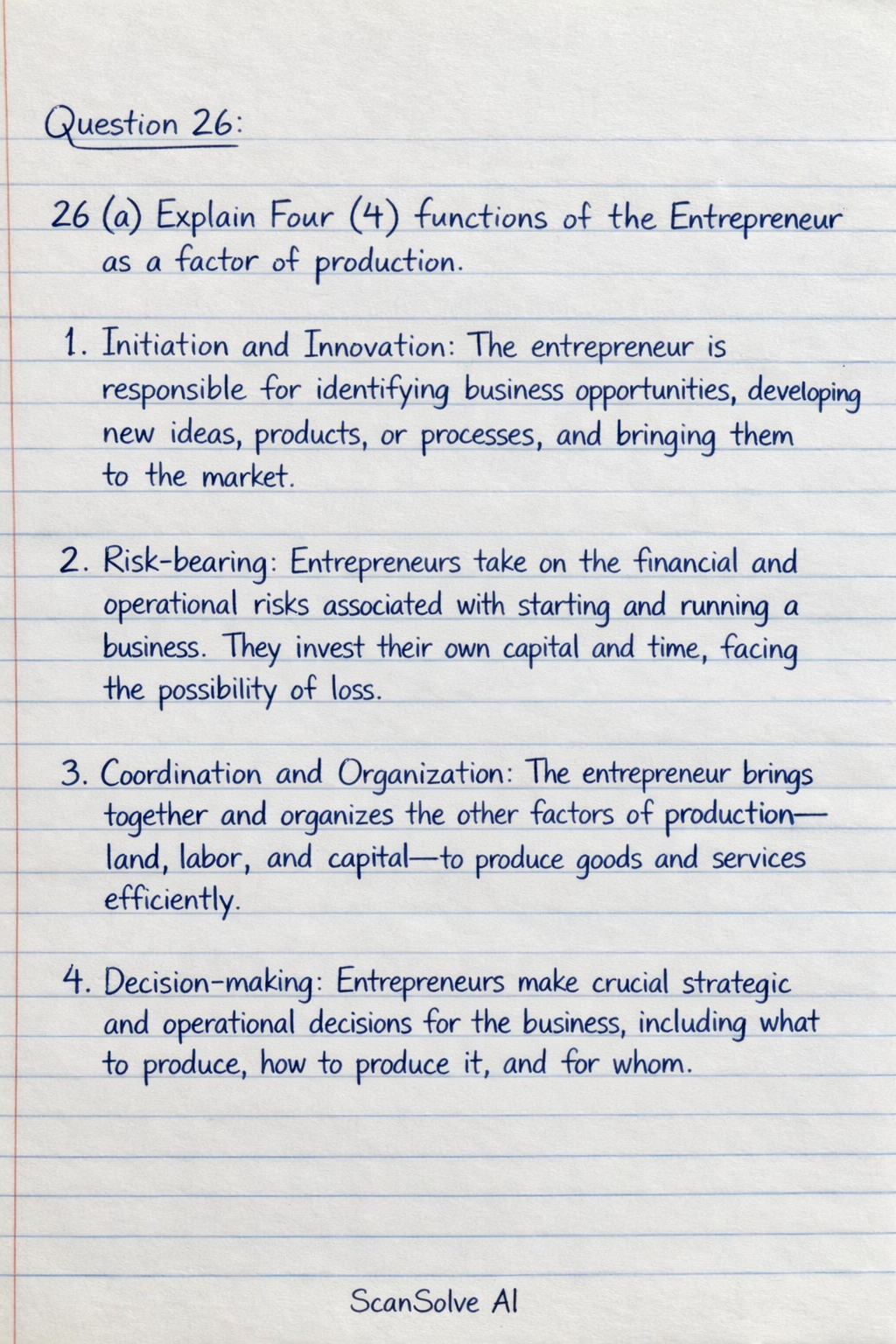
Question 26:
-
26 (a) Explain Four (4) functions of the Entrepreneur as a factor of production.
- Initiation and Innovation: The entrepreneur is responsible for identifying business opportunities, developing new ideas, products, or processes, and bringing them to the market.
- Risk-bearing: Entrepreneurs take on the financial and operational risks associated with starting and running a business. They invest their own capital and time, facing the possibility of loss.
- Coordination and Organization: The entrepreneur brings together and organizes the other factors of production—land, labor, and capital—to produce goods and services efficiently.
- Decision-making: Entrepreneurs make crucial strategic and operational decisions for the business, including what to produce, how to produce it, and for whom.
-
26 (b) Explain any Four (4) of the following concepts:
- (i) Circulating Capital: This refers to capital that is used up or transformed entirely in a single production cycle. Examples include raw materials, fuel, and semi-finished goods.
- (iii) Fixed Capital: This consists of durable capital goods that are used repeatedly over a long period in the production process and are not consumed in a single use. Examples include machinery, buildings, and tools.
- (iv) Variable cost: These are costs that change in direct proportion to the level of output. As production increases, variable costs increase, and as production decreases, they fall. Examples include raw material costs and direct labor wages.
- (v) Marginal cost: This is the additional cost incurred by a firm when it produces one more unit of output. It is calculated as the change in total cost divided by the change in quantity.
Question 27:
-
27 (a) Explain Four (4) ways by which trade between countries is restricted:
- Tariffs: These are taxes or duties imposed on imported goods and services, making them more expensive and less competitive than domestic products.
- Quotas: These are quantitative limits on the amount of specific goods that can be imported into a country over a given period, restricting the volume of foreign competition.
- Subsidies: Governments provide financial assistance to domestic producers, which lowers their production costs and allows them to sell their goods at lower prices, making them more competitive against imports.
- Embargoes: These are complete bans on trade with a particular country or on specific goods, often imposed for political or security reasons.
-
27 (b) (i) Explain Three (3) reasons why a country will impose restrictions on international trade.
- Protection of Infant Industries: To shield newly established domestic industries from intense competition from more mature and efficient foreign firms, allowing them time to grow and become competitive.
- National Security: To ensure self-sufficiency in strategically important goods (e.g., defense equipment, essential food items) and reduce reliance on potentially unreliable foreign suppliers.
- Protection of Domestic Employment: To
Was this helpful?
Still stuck on this one?
Ask a follow-up, and the answer starts from this question.
Got a different question?Ask your own question
More Economics Questions
QExplain five functions performed by an Entrepreneur.QDescribe four types of entrepreneurship.QA) Define Entrepreneurship. b) State and explain four (4) types of Entrepreneurship. c) List four…QDescribe four types of entrepreneurs and four processes of entrepreneurship.QDefine and identify the rewards for the four factors of production: land, labour, capital, and…
Handwritten Step-by-Step Solution
Get this as a handwritten image on WhatsApp — like a tutor wrote it for you.
Try on WhatsApp