
We read your photo as:
From Table 2.2, calculate the elasticity of supply between these points: I. A and B II. D and E. State the nature of elasticity in (a)i above. Briefly explain any four types of elasticity of demand.
Economics
ScanSolve AI Answer
Step-by-step solution
4 stepsCalculate the elasticity of supply between A and B.
The midpoint formula for price elasticity of supply (PES) is:
For points A () and B ():
Percentage change in quantity supplied:Percentage change in price:
Now, calculate PES:
The elasticity of supply between A and B is .
Calculate the elasticity of supply between D and E.
For points D () and E ():
Percentage change in quantity supplied:Percentage change in price:
Now, calculate PES:
The elasticity of supply between D and E is .
State the nature of elasticity in (a)(i).
For (a)(i), the elasticity of supply is . Since this value is greater than 1, the supply is elastic.
Briefly explain any four types of elasticity of demand.
- Price Elasticity of Demand (PED) measures how much the quantity demanded of a good responds to a change in its price.
- Income Elasticity of Demand (YED) measures how much the quantity demanded of a good responds to a change in consumers' income.
- Cross-Price Elasticity of Demand (XED) measures how much the quantity demanded of one good responds to a change in the price of another good.
- Advertising Elasticity of Demand (AED) measures how much the quantity demanded of a good responds to a change in advertising expenditure.
Was this helpful?
Still stuck on this one?
Ask a follow-up, and the answer starts from this question.
Got a different question?Ask your own question
More Economics Questions
QFrom Table 2.1, Calculate: i. co-efficient of income. ii. what type of goods is garri to Mr…QCalculate the price elasticity of demand at points A and B given the demand schedule. Explain the…QGiven a table showing price and quantity demanded, calculate the price elasticity of demand using…QFind the elasticity of demand given Q k where k and n are positive constants.(A) Does the elasticity…QCalculate the price elasticity of demand for a product given a demand schedule with two points.
Browse by topic:Microeconomics
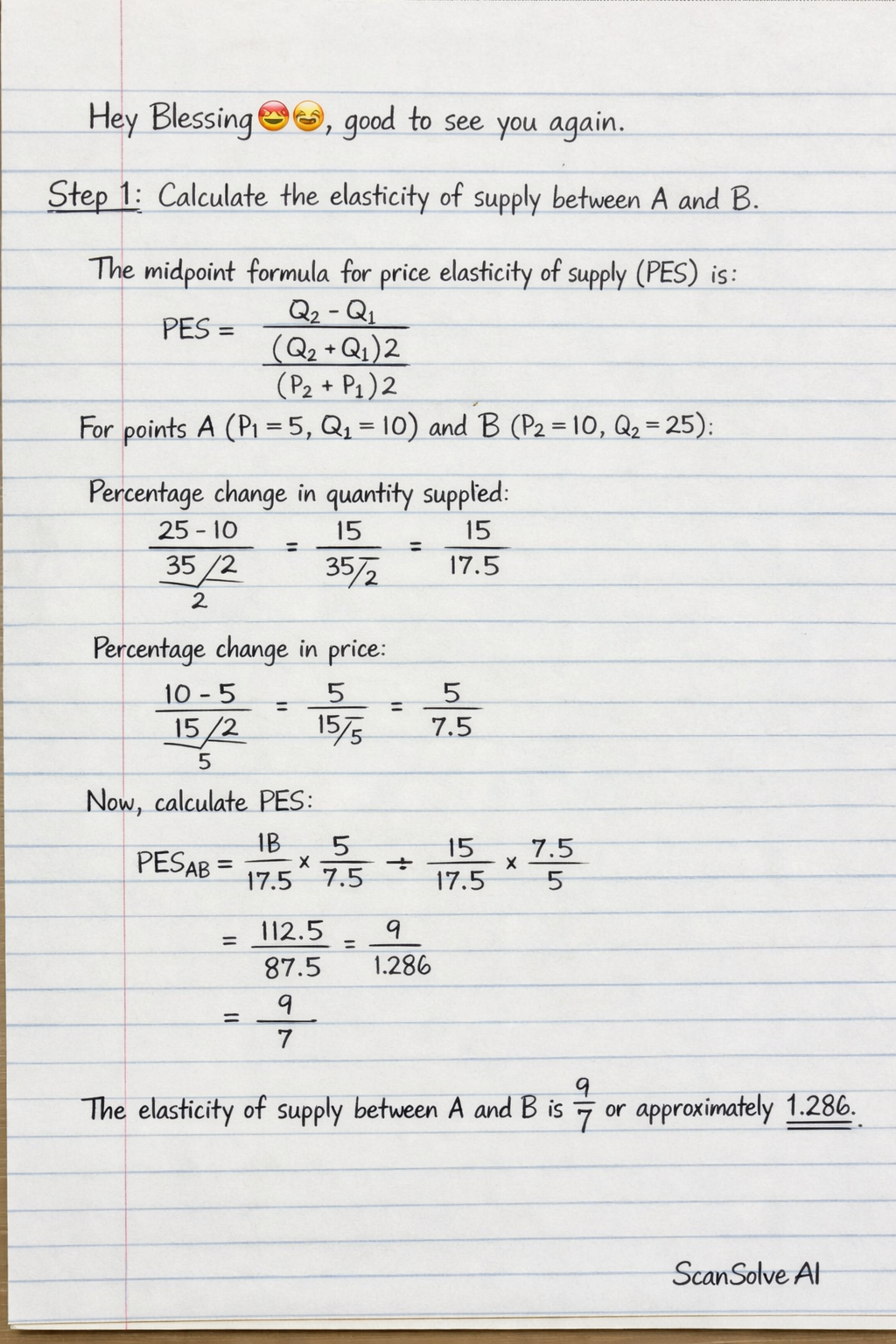
Handwritten Step-by-Step Solution
Get this as a handwritten image on WhatsApp — like a tutor wrote it for you.
Try on WhatsApp