From your answers in 1(c), is the demand for the commodity elastic or inelastic? Explain your answer. Figure 2 below represents the budget estimates for Country X in the year 2018. Use the chart to answer the questions that follow.

Economics
From your answers in 1(c), is the demand for the commodity elastic or inelastic? Explain your answer. Figure 2 below represents the budget estimates for Country X in the year 2018. Use the chart to answer the questions that follow.

ScanSolve AI Answer

Answer

$495 \text{ million}

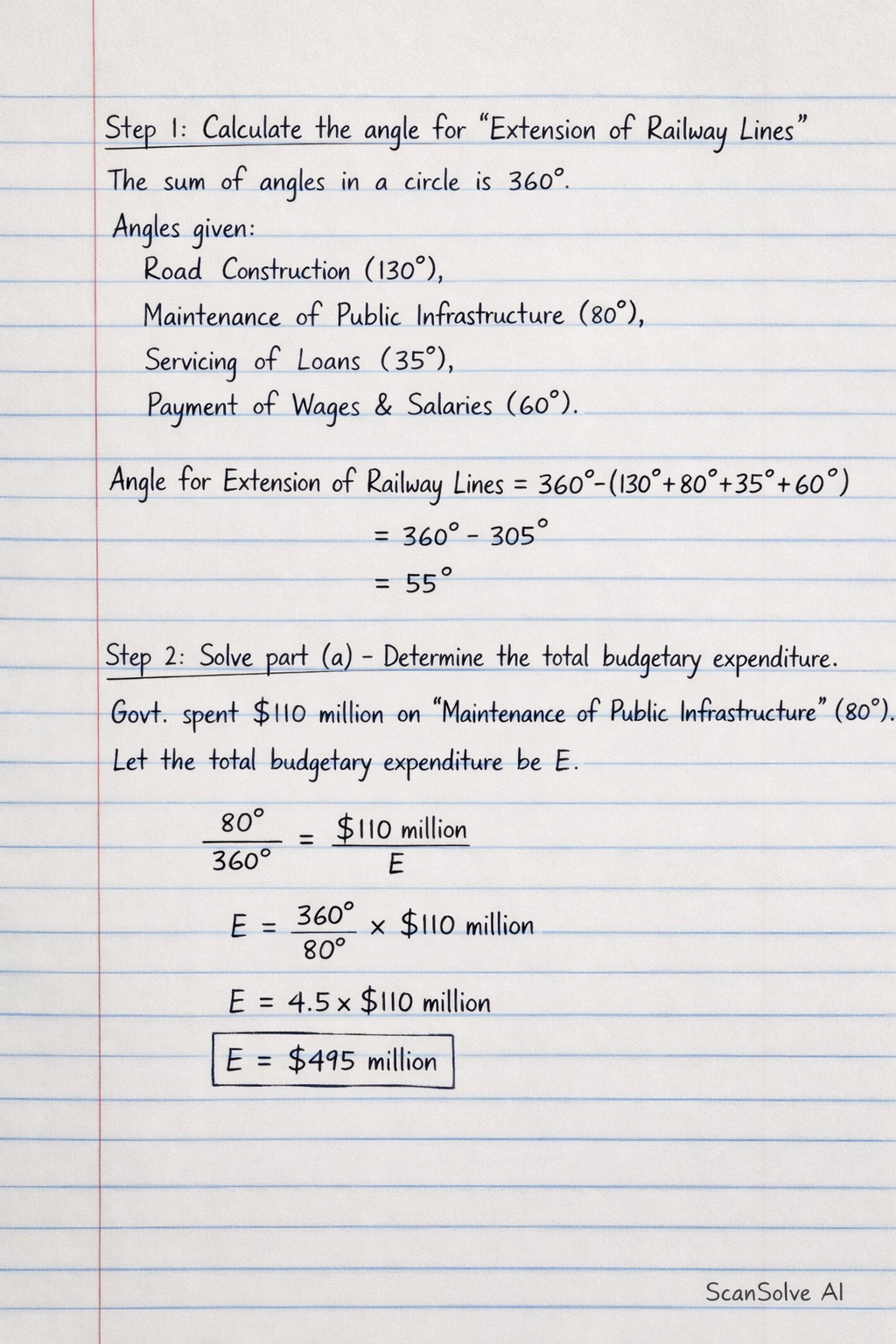
Step 1: Calculate the angle for "Extension of Railway Lines". The sum of angles in a circle is 360360^\circ. The given angles are for Road Construction (130130^\circ), Maintenance of Public Infrastructure (8080^\circ), Servicing of Loans (3535^\circ), and Payment of Wages and Salaries (6060^\circ). AngleforExtensionofRailwayLines=360(130+80+35+60)Angle for Extension of Railway Lines = 360^\circ - (130^\circ + 80^\circ + 35^\circ + 60^\circ) =360305= 360^\circ - 305^\circ =55= 55^\circ

Step 2: Solve part (a) - Determine the total budgetary expenditure. The government spent \110millionon"MaintenanceofPublicInfrastructure",whichcorrespondstoanangleofmillion on "Maintenance of Public Infrastructure", which corresponds to an angle of80^\circ.Letthetotalbudgetaryexpenditurebe. Let the total budgetary expenditure be E. $$ \frac{80^\circ}{360^\circ} = \frac{\110 million}{E} E = \frac{360^\circ}{80^\circ} \times $110 million E = 4.5 \times $110 million E = \mathbf{$495 \text{ million}} $$

Step 3: Solve part (b)(i) - Calculate capital expenditure. Capital expenditure includes "Road Construction" (130130^\circ) and "Extension of Railway Lines" (5555^\circ). Total angle for capital expenditure =130+55=185= 130^\circ + 55^\circ = 185^\circ. CapitalExpenditure=185360×$495millionCapital Expenditure = \frac{185^\circ}{360^\circ} \times \$495 million =185360×$495million= \frac{185}{360} \times \$495 million =$254.375 million= \mathbf{\$254.375 \text{ million}}

Step 4: Solve part (b)(ii) - Calculate recurrent expenditure. Recurrent expenditure includes "Maintenance of Public Infrastructure" (8080^\circ), "Servicing of Loans" (3535^\circ), and "Payment of Wages and Salaries" (6060^\circ). Total angle for recurrent expenditure =80+35+60=175= 80^\circ + 35^\circ + 60^\circ = 175^\circ. RecurrentExpenditure=175360×$495millionRecurrent Expenditure = \frac{175^\circ}{360^\circ} \times \$495 million =175360×$495million= \frac{175}{360} \times \$495 million =$240.625 million= \mathbf{\$240.625 \text{ million}}

Step 5: Solve part (c)(i) - Calculate total expected revenue. First, calculate the expenditure on "Payment of Wages and Salaries". WagesandSalariesExpenditure=60360×$495millionWages and Salaries Expenditure = \frac{60^\circ}{360^\circ} \times \$495 million =16×$495million= \frac{1}{6} \times \$495 million =$82.5million= \$82.5 million The total expected revenue is 525%525\% of this expenditure. TotalExpectedRevenue=5.25×$82.5millionTotal Expected Revenue = 5.25 \times \$82.5 million =$433.125 million= \mathbf{\$433.125 \text{ million}}

Step 6: Solve part (c)(ii) - Determine whether the budget was in surplus or deficit. Total expected revenue = \433.125million.Totalbudgetaryexpenditure=million. Total budgetary expenditure =$495 million. Since the total expected revenue is less than the total budgetary expenditure, the budget was in a *deficit*. $$ Deficit = \495 million - $433.125 million = $61.875 million $$ The budget was a \mathbf{Deficit}.

Step 7: Solve part (d) - State any two likely reasons for the budget type. The government operated a deficit budget. Two likely reasons are: • High government spending: The government might have undertaken significant capital projects (like road construction and railway extension) or increased recurrent spending (like wages and salaries, or loan servicing) without sufficient revenue generation. • Insufficient revenue collection: The government's tax collection or other revenue sources might have been lower than anticipated, possibly due to an economic slowdown or inefficient tax administration, leading to a shortfall compared to its expenditures.

Send me the next one 📸

Was this helpful?

Need help with your own homework?

Get instant step-by-step solutions to any question. Free to start.

Ask Your Question
Handwritten step-by-step solution preview

Handwritten Step-by-Step Solution

Get this as a handwritten image on WhatsApp — like a tutor wrote it for you.

Try on WhatsApp

Still have questions?

Quick Answer

Calculate the angle for "Extension of Railway Lines". The sum of angles in a circle is 360^.

From your answers in 1(c), is the demand for the commodity elastic or inelastic? Explain your answer. Figure 2 below represents the budget estimates for Country X in the year 2018. Use the chart to answer the questions that follow.
Economics

This economics question tests your understanding of economic models and analysis. The step-by-step answer below applies the relevant framework and explains the reasoning.

ScanSolve AI Answer
Step 1: Calculate the angle for "Extension of Railway Lines". The sum of angles in a circle is 360^. The given angles are for Road Construction (130^), Maintenance of Public Infrastructure (80^), Servicing of Loans (35^), and Payment of Wages and Salaries (60^). Angle for Extension of Railway Lines = 360^ - (130^ + 80^ + 35^ + 60^) = 360^ - 305^ = 55^ Step 2: Solve part (a) - Determine the total budgetary expenditure. The government spent \110 million on "Maintenance of Public Infrastructure", which corresponds to an angle of 80^. Let the total budgetary expenditure be E. (80^)/(360^) = \110 millionE E = (360^)/(80^) × \110 million E = 4.5 × \110 million E = \495 million Step 3: Solve part (b)(i) - Calculate capital expenditure. Capital expenditure includes "Road Construction" (130^) and "Extension of Railway Lines" (55^). Total angle for capital expenditure = 130^ + 55^ = 185^. Capital Expenditure = (185^)/(360^) × \495 million = (185)/(360) × \495 million = \254.375 million Step 4: Solve part (b)(ii) - Calculate recurrent expenditure. Recurrent expenditure includes "Maintenance of Public Infrastructure" (80^), "Servicing of Loans" (35^), and "Payment of Wages and Salaries" (60^). Total angle for recurrent expenditure = 80^ + 35^ + 60^ = 175^. Recurrent Expenditure = (175^)/(360^) × \495 million = (175)/(360) × \495 million = \240.625 million Step 5: Solve part (c)(i) - Calculate total expected revenue. First, calculate the expenditure on "Payment of Wages and Salaries". Wages and Salaries Expenditure = (60^)/(360^) × \495 million = (1)/(6) × \495 million = \82.5 million The total expected revenue is 525\% of this expenditure. Total Expected Revenue = 5.25 × \82.5 million = \433.125 million Step 6: Solve part (c)(ii) - Determine whether the budget was in surplus or deficit. Total expected revenue = \433.125 million. Total budgetary expenditure = \495 million. Since the total expected revenue is less than the total budgetary expenditure, the budget was in a deficit. Deficit = \495 million - \433.125 million = \$61.875 million The budget was a Deficit. Step 7: Solve part (d) - State any two likely reasons for the budget type. The government operated a deficit budget. Two likely reasons are: • High government spending: The government might have undertaken significant capital projects (like road construction and railway extension) or increased recurrent spending (like wages and salaries, or loan servicing) without sufficient revenue generation. • Insufficient revenue collection: The government's tax collection or other revenue sources might have been lower than anticipated, possibly due to an economic slowdown or inefficient tax administration, leading to a shortfall compared to its expenditures. Send me the next one 📸