
We read your photo as:
Given the petrol demand and supply data, construct a graph showing the market equilibrium and explain the effect of a maximum price of R23.00.
ScanSolve AI Answer
Step-by-step solution
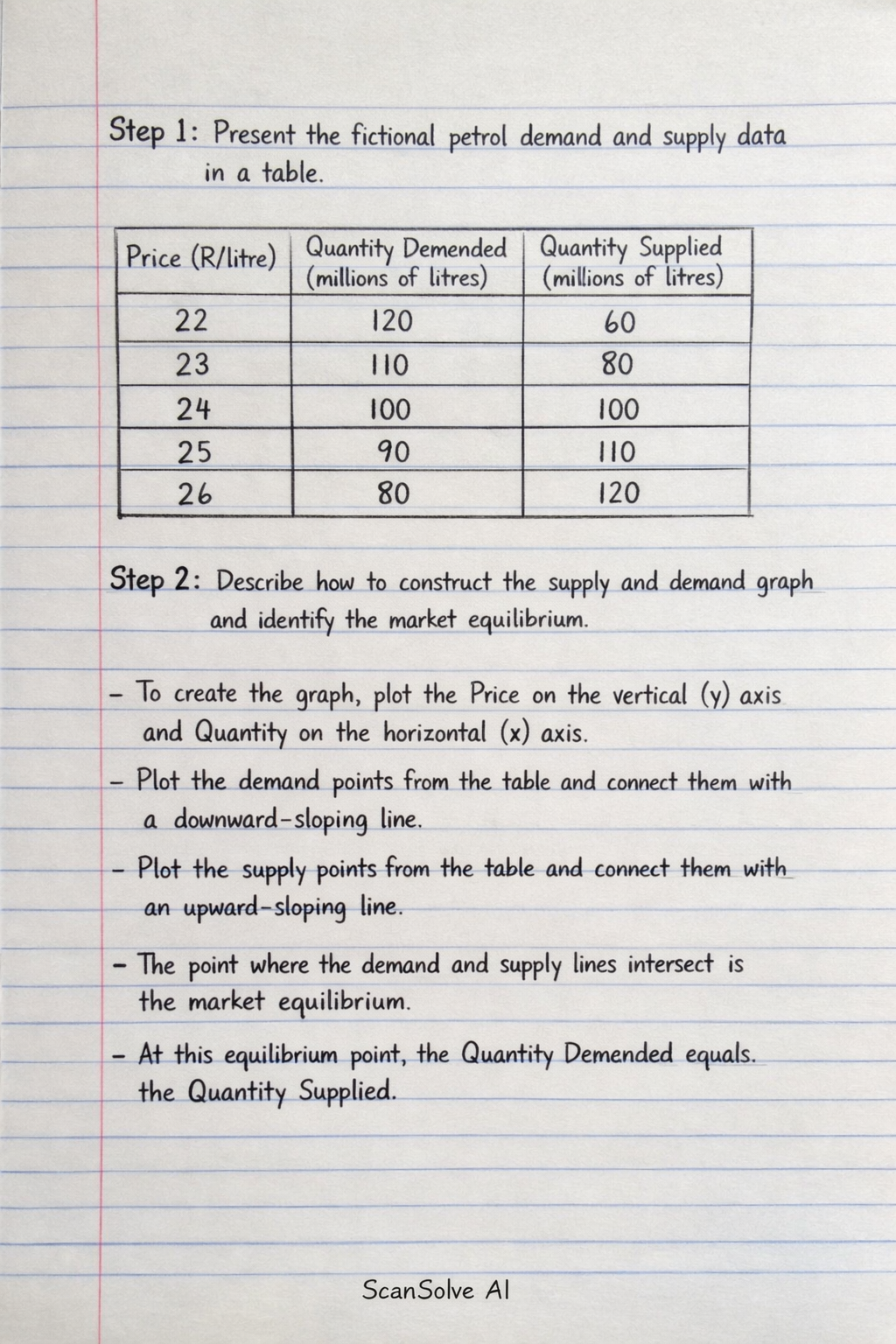
5 stepsPresent the fictional petrol demand and supply data in a table.
Describe how to construct the supply and demand graph and identify the market equilibrium.
To draw the supply and demand graph:
- Horizontal Axis (X-axis): Label this axis "Quantity (millions of litres)". Scale it from 60 to 120.
- Vertical Axis (Y-axis): Label this axis "Price (R/litre)". Scale it from 22 to 26.
- Demand Curve: Plot the points (120, 22), (110, 23), (100, 24), (90, 25), (80, 26) and connect them to form the downward-sloping demand curve.
- Supply Curve: Plot the points (60, 22), (80, 23), (100, 24), (110, 25), (120, 26) and connect them to form the upward-sloping supply curve.
- Market Equilibrium: The point where the demand and supply curves intersect is the market equilibrium. From the table, this occurs at a price of R24 per litre, where both quantity demanded and quantity supplied are 100 million litres.
Explain the effect of the maximum price of R23.00 per litre.
The government sets a maximum price (price ceiling) of R23.00 per litre.
- At this price, the quantity demanded is 110 million litres.
- At this price, the quantity supplied is 80 million litres.
- Since the quantity demanded (110 million litres) is greater than the quantity supplied (80 million litres) at the maximum price, there will be a shortage of petrol. The shortage is million litres.
- This maximum price is below the market equilibrium price of R24.00, which means it is a binding price ceiling and will lead to a shortage.
Evaluate whether setting a maximum price is an effective solution.
Setting a maximum price of R23.00 per litre is generally not an effective solution for making petrol affordable without causing problems. While it might initially lower the price for consumers, it creates a significant shortage (30 million litres in this case). This shortage can lead to:
- Queues and waiting times: Consumers will spend more time trying to find petrol.
- Black markets: Illegal sales of petrol at prices above the maximum price may emerge.
- Reduced quality or service: Suppliers may cut costs in other areas to compensate for lower prices.
- Inefficient allocation: Petrol may not go to those who need it most, but rather to those who are first in line or have connections. Therefore, while aiming to help consumers, it often leads to unintended negative consequences and market inefficiencies.
Suggest strategies the government can use to make petrol more affordable without causing shortages.
To make petrol more affordable without causing shortages, the government could consider strategies that either increase supply or reduce demand in a sustainable way, or directly subsidize consumers.
- Reduce fuel levies and taxes: The government can lower the various taxes and levies (e.g., fuel levy, Road Accident Fund levy) that contribute to the final petrol price. This directly reduces the price without distorting the market supply.
- Subsidize public transport: Investing in and subsidizing efficient public transport systems can reduce the demand for private vehicle use, thereby lowering overall petrol demand and potentially prices.
- Promote fuel efficiency and alternative energy: Incentivizing the use of more fuel-efficient vehicles or promoting the adoption of electric vehicles and other alternative energy sources can reduce long-term demand for petrol.
- Strategic oil reserves: Building and managing strategic oil reserves can help stabilize prices during periods of global supply shocks by releasing reserves into the market.
Still stuck on this one?
Ask a follow-up, and the answer starts from this question.
More Economics Questions
Handwritten Step-by-Step Solution
Get this as a handwritten image on WhatsApp — like a tutor wrote it for you.
Try on WhatsApp