
We read your photo as:
What is globalization, what are its main features, and what are its advantages?
Economics
ScanSolve AI Answer
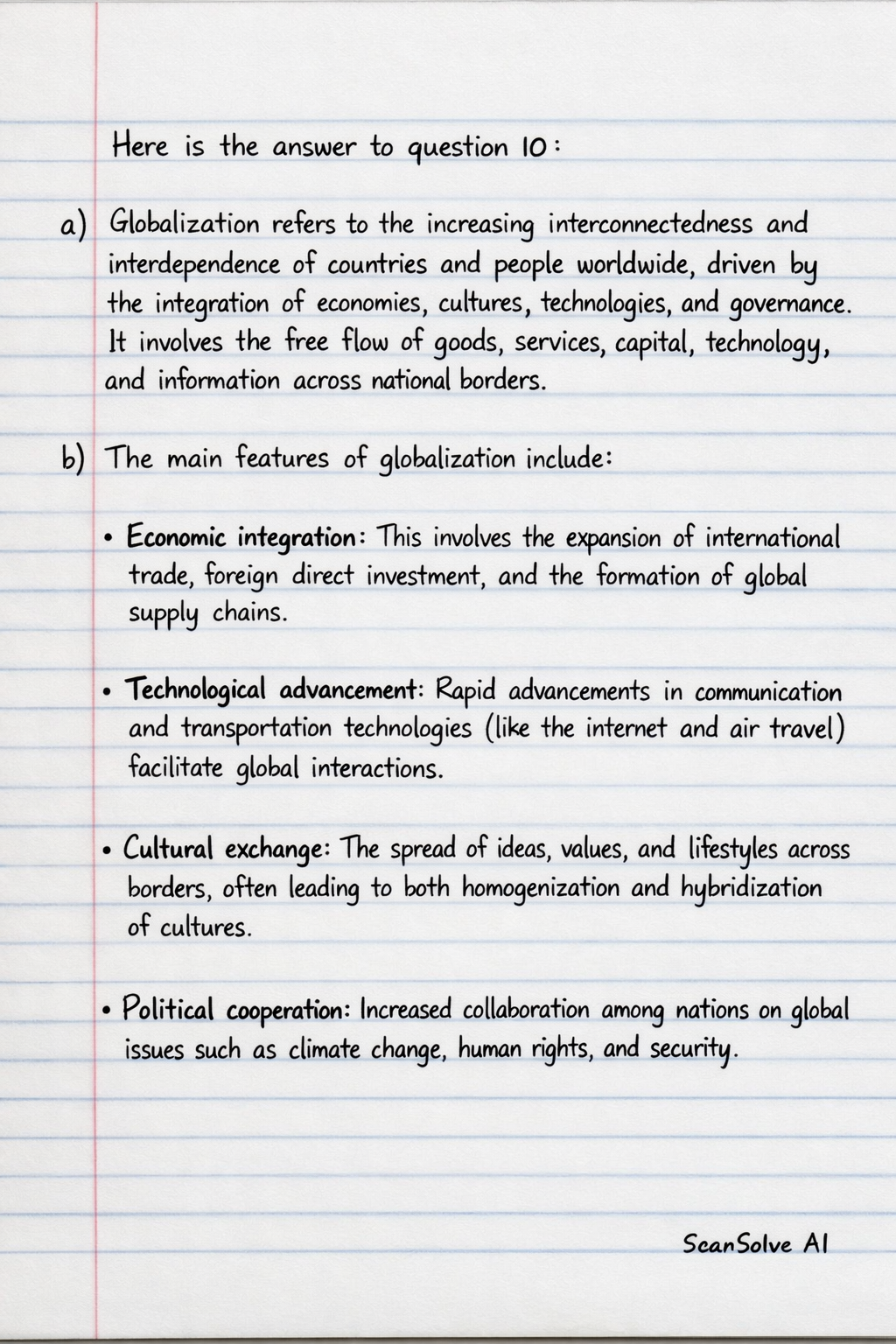
Here is the answer to question 10:
*a) Globalization refers to the increasing interconnectedness and interdependence of countries and people worldwide, driven by the integration of economies, cultures, technologies, and governance. It involves the free flow of goods, services, capital, technology, and information across national borders.
*b) The main features of globalization include:
- Economic integration: This involves the expansion of international trade, foreign direct investment, and the formation of global supply chains.
- Technological advancement: Rapid advancements in communication and transportation technologies (like the internet and air travel) facilitate global interactions.
- Cultural exchange: The spread of ideas, values, and lifestyles across borders, often leading to both homogenization and hybridization of cultures.
- Political cooperation: Increased collaboration among nations on global issues such as climate change, human rights, and security.
- Increased mobility: Greater movement of people (migration), capital, and information across national boundaries.
*c) Advantages of globalization:
- Economic growth: Can lead to increased trade, investment, and job creation, fostering economic development in participating countries.
- Technological diffusion: Facilitates the spread of new technologies and innovations, improving productivity and living standards.
- Cultural exchange and understanding: Promotes greater awareness and appreciation of diverse cultures, potentially reducing conflicts.
- Access to goods and services: Consumers gain access to a wider variety of products at potentially lower prices.
- Poverty reduction: Can lift people out of poverty through economic opportunities and integration into the global economy.
Disadvantages of globalization:
- Increased inequality: Can exacerbate income disparities between and within countries, benefiting some while marginalizing others.
- Job displacement: Industries in developed countries may face job losses due to outsourcing to lower-wage economies.
- Cultural homogenization: May lead to the erosion of local cultures and traditions as dominant global cultures spread.
- Environmental degradation: Increased industrial activity and transportation can contribute to pollution and resource depletion.
- Loss of national sovereignty: International agreements and institutions may limit the autonomy of national governments.
- Vulnerability to global crises: Economic downturns or health crises in one region can quickly spread globally.
Was this helpful?
Still stuck on this one?
Ask a follow-up, and the answer starts from this question.
Got a different question?Ask your own question
More Economics Questions
Handwritten Step-by-Step Solution
Get this as a handwritten image on WhatsApp — like a tutor wrote it for you.
Try on WhatsApp