
We read your photo as:
Explain the graphical representation and theory behind the cost curves.
Economics
ScanSolve AI Answer
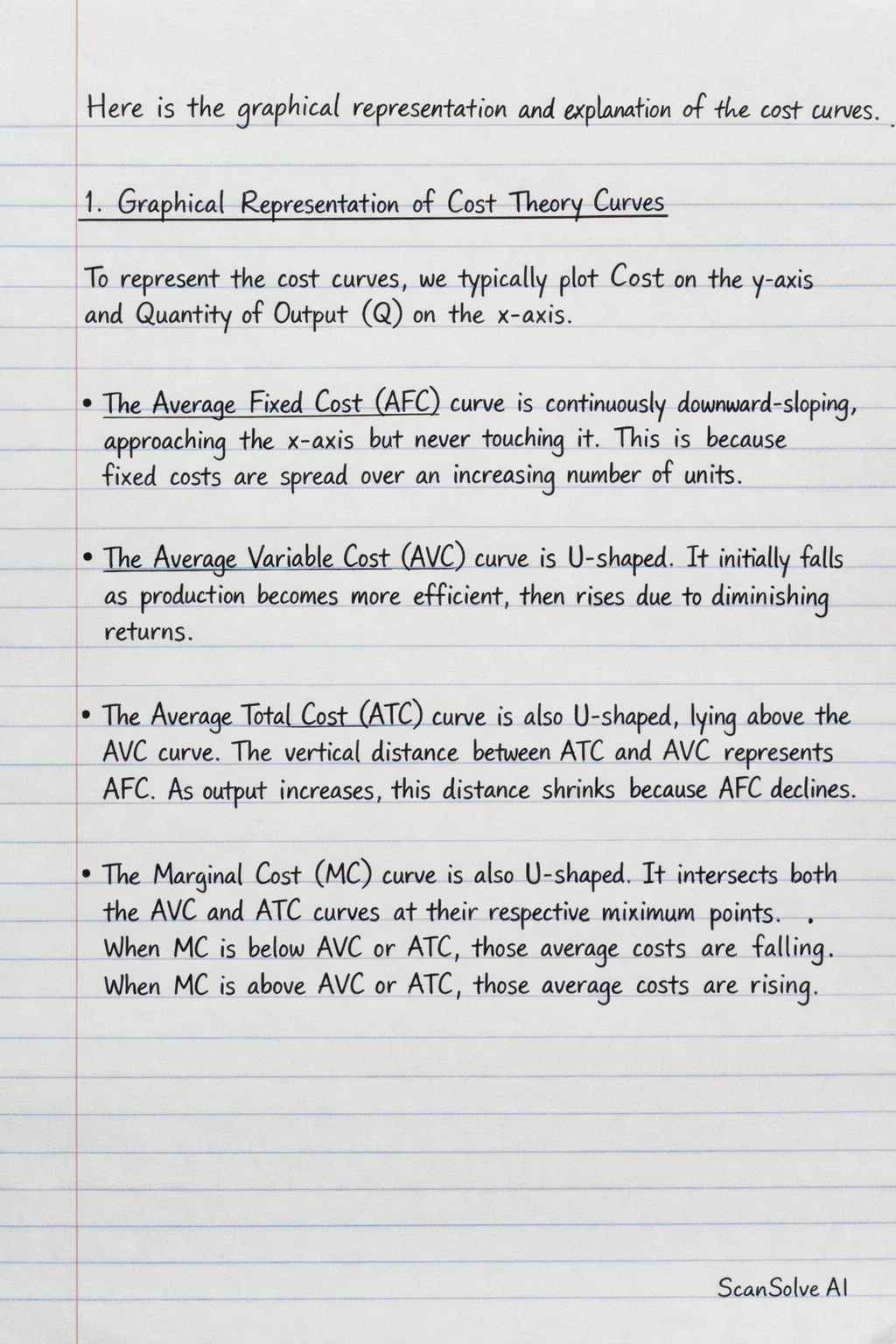
Here is the graphical representation and explanation of the cost curves.
1. Graphical Representation of Cost Theory Curves
To represent the cost curves, we typically plot Cost on the y-axis and Quantity of Output (Q) on the x-axis.
- The Average Fixed Cost (AFC) curve is continuously downward-sloping, approaching the x-axis but never touching it. This is because fixed costs are spread over an increasing number of units.
- The Average Variable Cost (AVC) curve is U-shaped. It initially falls as production becomes more efficient, then rises due to diminishing returns.
- The Average Total Cost (ATC) curve is also U-shaped, lying above the AVC curve. The vertical distance between ATC and AVC represents AFC. As output increases, this distance shrinks because AFC declines.
- The Marginal Cost (MC) curve is also U-shaped. It intersects both the AVC and ATC curves at their respective minimum points. When MC is below AVC or ATC, those average costs are falling. When MC is above AVC or ATC, those average costs are rising.
2. Explanation of Each Cost Curve
- a) Marginal Cost (MC) Curve: This curve represents the additional cost incurred by producing one more unit of output. It typically falls initially due to increasing returns to specialization, then rises sharply due to diminishing marginal returns to variable inputs.
- b) Average Cost (AC) Curve (Average Variable Cost - AVC): This curve shows the total variable cost per unit of output. It is calculated by dividing total variable cost (VC) by the quantity of output (Q). Like MC, it is typically U-shaped, reflecting initial efficiencies followed by diminishing returns.
- c) Average Total Cost (ATC) Curve: This curve represents the total cost per unit of output. It is calculated by dividing total cost (TC) by the quantity of output (Q), or by summing average fixed cost (AFC) and average variable cost (AVC). It is typically U-shaped, initially falling as fixed costs are spread over more units, then rising due to increasing variable costs per unit.
- d) Average Fixed Cost (AFC) Curve: This curve illustrates the total fixed cost per unit of output. It is calculated by dividing total fixed cost (FC) by the quantity of output (Q). As output increases, AFC continuously declines because the fixed costs are spread over a larger number of units.
Was this helpful?
Still stuck on this one?
Ask a follow-up, and the answer starts from this question.
Got a different question?Ask your own question
More Economics Questions
QExplain the cost theory curves, including their graphical representation, relationships, and…QExplain and illustrate the short-run cost curves: MC, ATC, AVC, and AFC.QIf a total cost curve is plotted, marginal cost can be illustrated by the A. slope of the tangent to…QExplain the concepts of supply, profit, marginal revenue, and shutdown point in the context of a…QIn economics, what curve illustrates the theoretical relationship between tax rates and the total…
Browse by topic:Microeconomics
Handwritten Step-by-Step Solution
Get this as a handwritten image on WhatsApp — like a tutor wrote it for you.
Try on WhatsApp