
We read your photo as:
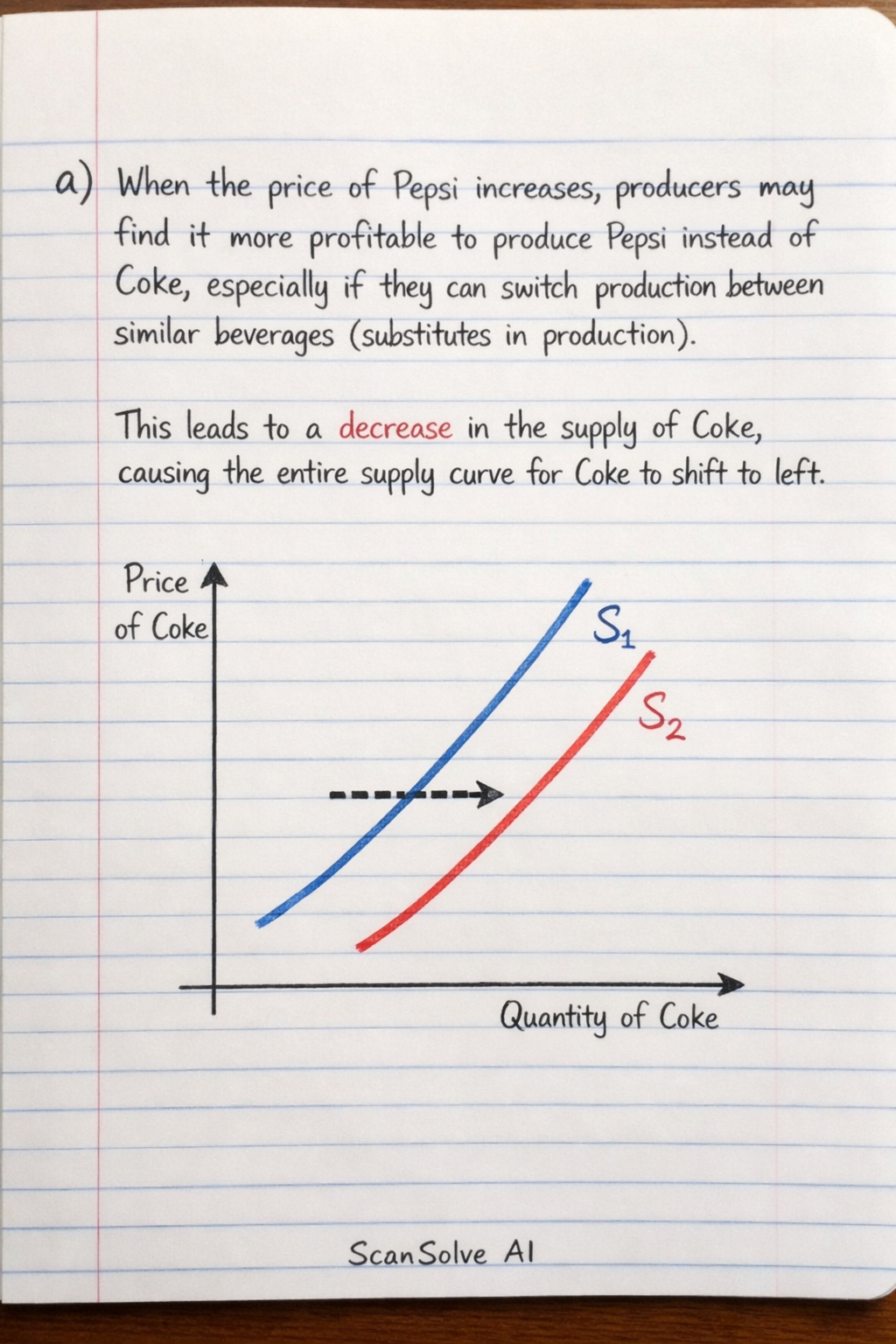
Illustrate on the graph below the effect on the supply of coke when the price of pepsi increases. Label your graph correctly.
ScanSolve AI Answer
a) When the price of Pepsi increases, producers may find it more profitable to produce Pepsi instead of Coke, especially if they can switch production between similar beverages (substitutes in production). This leads to a decrease in the supply of Coke, causing the entire supply curve for Coke to shift to the left.
\begin{tikzpicture}
    % Axes
    \draw[->] (0,0) -- (0,5) node[left] {Price of Coke};
    \draw[->] (0,0) -- (6,0) node[below] {Quantity of Coke};

    % Initial Supply Curve (S1)
    \draw[blue, thick] (1,1) node[below left] {$S_1$} -- (5,4);

    % New Supply Curve (S2)
    \draw[red, thick] (0.5,1) node[below right] {$S_2$} -- (4.5,4);

    % Arrow indicating shift
    \draw[->, dashed, thick] (3,2.5) -- (2,2.5);
\end{tikzpicture}
b) When the price of Pepsi increases, it becomes relatively more profitable for producers to manufacture Pepsi. As Coke and Pepsi are substitutes in production for many beverage companies, producers will reallocate resources from producing Coke to producing Pepsi. This results in a decrease in the overall supply of Coke.
Still stuck on this one?
Ask a follow-up, and the answer starts from this question.
More Economics Questions
Handwritten Step-by-Step Solution
Get this as a handwritten image on WhatsApp — like a tutor wrote it for you.
Try on WhatsApp