

This economics question tests your understanding of economic models and analysis. The step-by-step answer below applies the relevant framework and explains the reasoning.
ScanSolve AI Answer
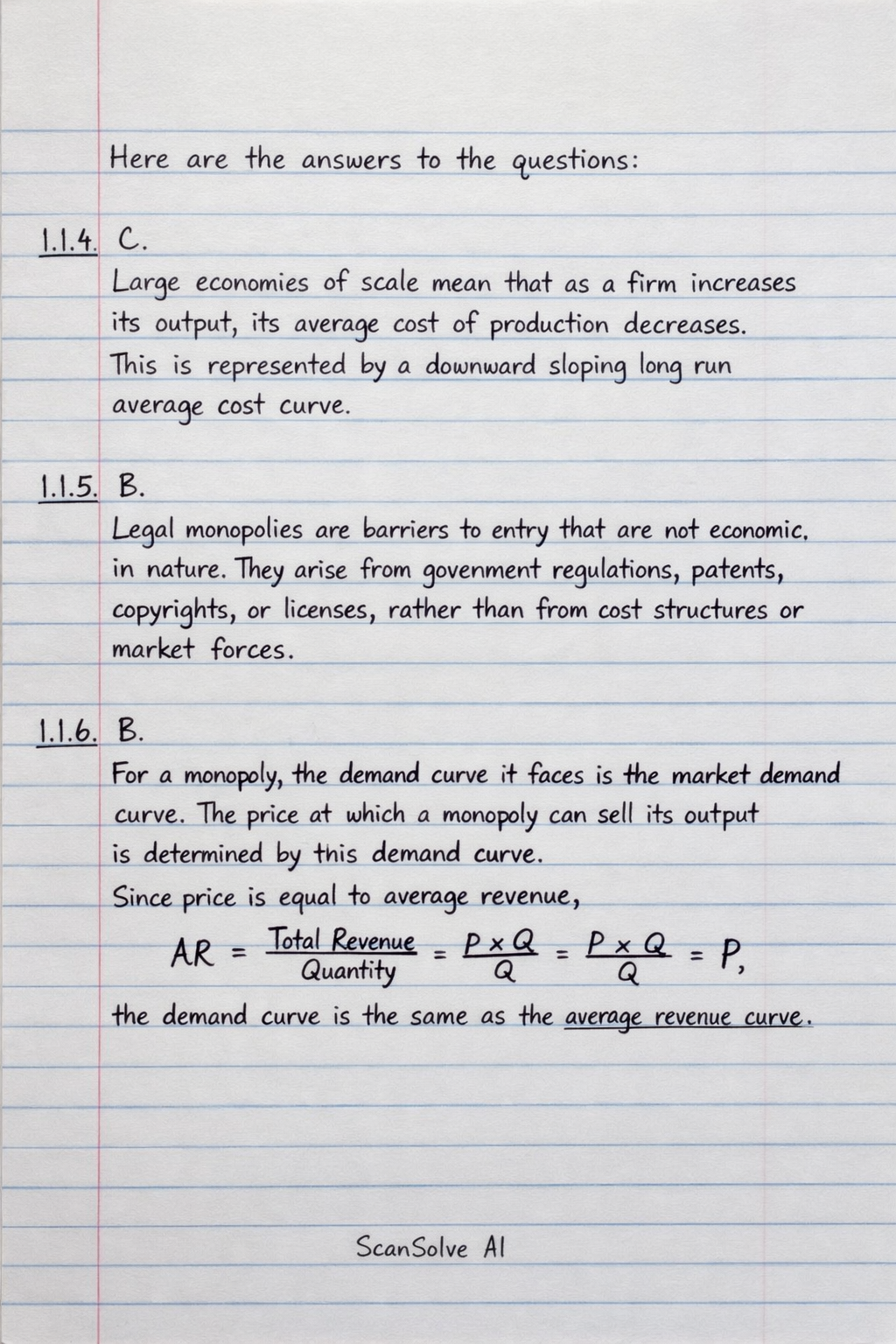
Here are the answers to the questions: 1.1.4. C. Large economies of scale mean that as a firm increases its output, its average cost of production decreases. This is represented by a downward sloping long run average cost curve. 1.1.5. B. Legal monopolies are barriers to entry that are not economic in nature. They arise from government regulations, patents, copyrights, or licenses, rather than from cost structures or market forces. 1.1.6. B. For a monopoly, the demand curve it faces is the market demand curve. The price at which a monopoly can sell its output is determined by this demand curve. Since price is equal to average revenue (AR = (Total Revenue)/(Quantity) = (P × Q)/(Q) = P), the demand curve is the same as the average revenue curve. 1.1.7. A. Allocative efficiency occurs when the price of a good equals its marginal cost (P = MC). A pure monopoly maximizes profit where marginal revenue equals marginal cost (MR = MC). However, because a monopoly faces a downward-sloping demand curve, its price (P) is always greater than its marginal revenue (MR). Therefore, at equilibrium, P > MR = MC, meaning price is not equal to marginal cost, leading to allocative inefficiency. 1.1.8. B. A monopoly is the sole producer in its market, so it faces the entire market demand curve. The market demand curve is typically downward sloping, indicating that as the price of the good increases, the quantity demanded decreases. That's 2 down. 3 left today — send the next one.