

This economics question tests your understanding of economic models and analysis. The step-by-step answer below applies the relevant framework and explains the reasoning.
ScanSolve AI Answer
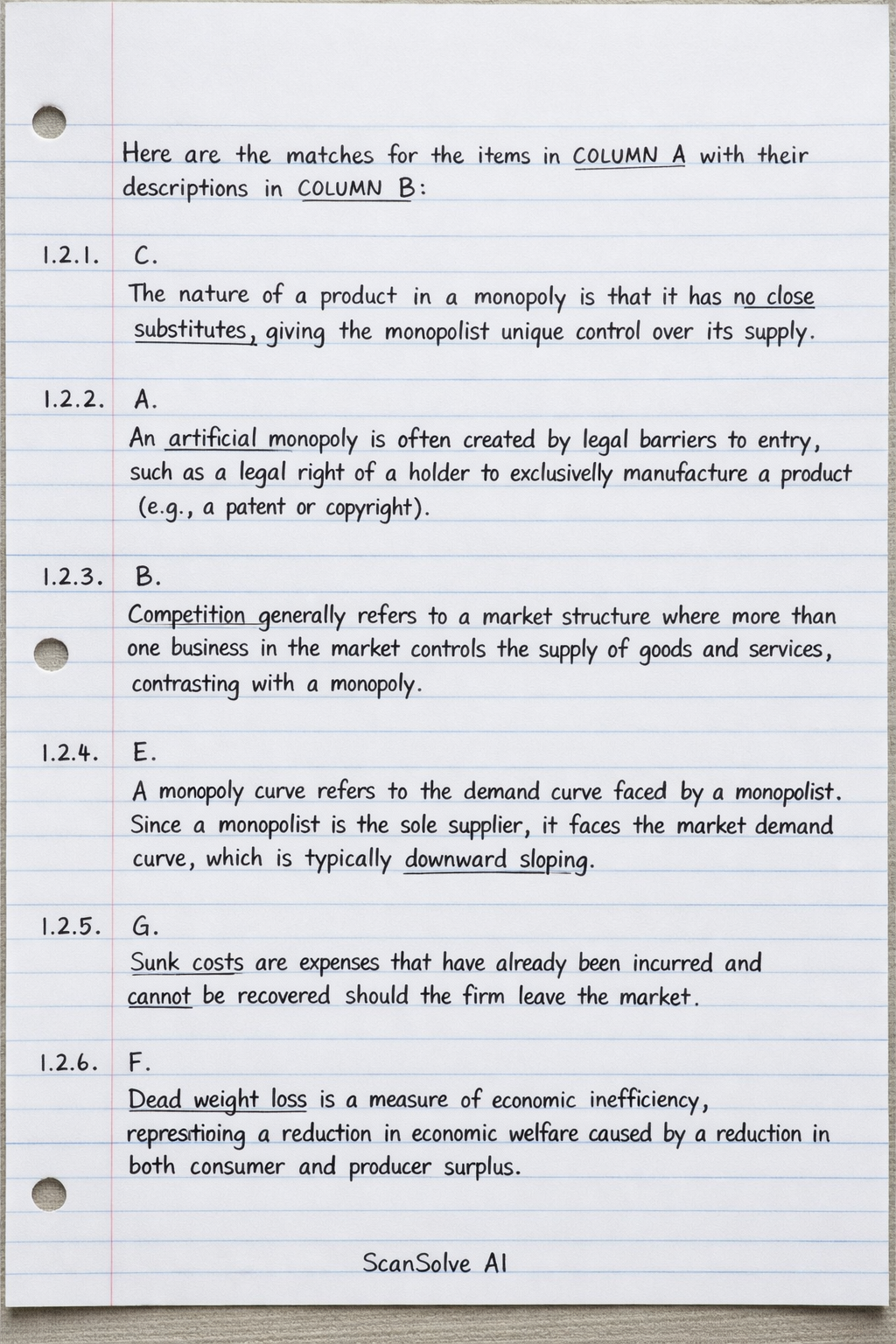
Here are the matches for the items in COLUMN A with their descriptions in COLUMN B: 1.2.1. C. The nature of a product in a monopoly is that it has no close substitutes, giving the monopolist unique control over its supply. 1.2.2. A. An artificial monopoly is often created by legal barriers to entry, such as a legal right of a holder to exclusively manufacture a product (e.g., a patent or copyright). 1.2.3. B. Competition generally refers to a market structure where more than one business in the market controls the supply of goods and services, contrasting with a monopoly. 1.2.4. E. A monopoly curve refers to the demand curve faced by a monopolist. Since a monopolist is the sole supplier, it faces the market demand curve, which is typically downward sloping. 1.2.5. G. Sunk costs are expenses that have already been incurred and cannot be recovered should the firm leave the market. 1.2.6. F. Dead weight loss is a measure of economic inefficiency, representing a reduction in economic welfare caused by a reduction in both consumer and producer surplus. 3 done, 2 left today. You're making progress.