
We read your photo as:
Explain the main objectives of monetary policy.
ScanSolve AI Answer
Step-by-step solution
7 stepsPart a· 2 steps
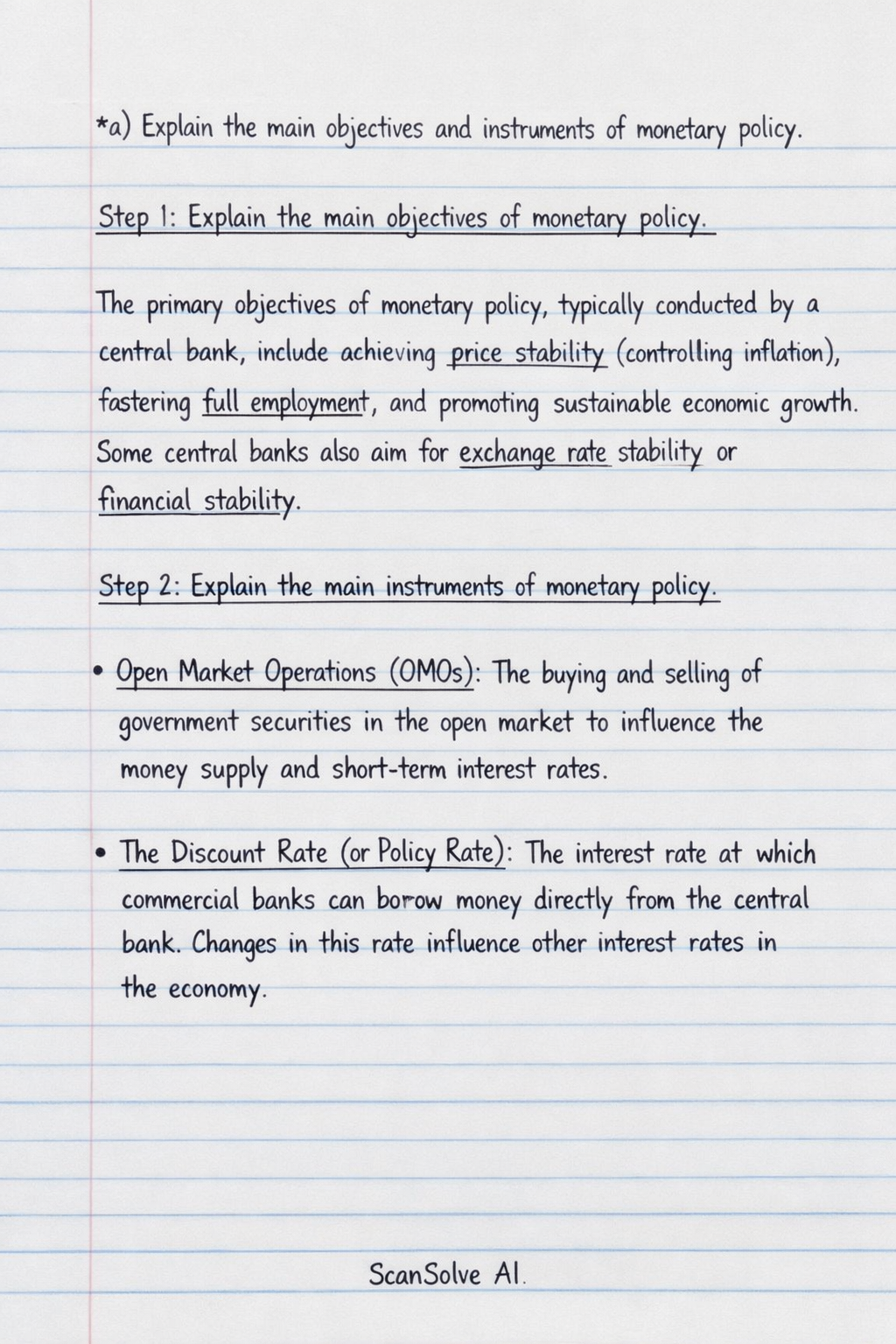
Explain the main objectives and instruments of monetary policy.
Explain the main objectives of monetary policy.
The primary objectives of monetary policy, typically conducted by a central bank, include achieving price stability (controlling inflation), fostering full employment, and promoting sustainable economic growth. Some central banks also aim for exchange rate stability or financial stability.
Explain the main instruments of monetary policy.
The main instruments of monetary policy are:
- Open Market Operations (OMOs): The buying and selling of government securities in the open market to influence the money supply and short-term interest rates.
- The Discount Rate (or Policy Rate): The interest rate at which commercial banks can borrow money directly from the central bank. Changes in this rate influence other interest rates in the economy.
- Reserve Requirements: The fraction of deposits that banks must hold in reserve, either in their vaults or at the central bank. Changing this ratio affects the amount of money banks have available to lend.
Part b· 5 steps
Explain the main objectives and instruments of fiscal policy.
Explain the main objectives of fiscal policy.
The main objectives of fiscal policy, conducted by the government, are to influence aggregate demand and achieve macroeconomic goals such as economic growth, full employment, price stability, and income redistribution. It also aims to manage the national debt and budget deficit.
Explain the main instruments of fiscal policy.
The main instruments of fiscal policy are:
- Government Spending (G): Direct expenditure by the government on goods and services (e.g., infrastructure, defense, education) and transfer payments (e.g., unemployment benefits, social security).
- Taxation (T): The levying of taxes on individuals and corporations. Changes in tax rates or the tax base affect disposable income and business investment.
c) Using an appropriate macroeconomic framework of IS-LM model, analyse how a combination of expansionary fiscal policy and contractionary monetary policy might be used in an economy experiencing high inflation and rising public debt.
Analyze the effects of expansionary fiscal policy in the IS-LM model.
An expansionary fiscal policy (e.g., increased government spending or tax cuts) shifts the IS curve to the right. This leads to an increase in aggregate demand, which, in the short run, tends to increase output () and the interest rate (). For an economy with high inflation, this policy would typically exacerbate the inflation problem by further increasing aggregate demand. It would also directly contribute to rising public debt by increasing the budget deficit.
Analyze the effects of contractionary monetary policy in the IS-LM model.
A contractionary monetary policy (e.g., the central bank selling government bonds, raising the policy rate, or increasing reserve requirements) reduces the money supply. This shifts the LM curve to the left. This leads to an increase in the interest rate () and a decrease in output (). For an economy with high inflation, this policy is appropriate as it reduces aggregate demand, thereby helping to curb inflation. However, the higher interest rates would increase the cost of servicing existing public debt, making the debt problem worse.
Analyze the combined effects of expansionary fiscal policy and contractionary monetary policy on an economy with high inflation and rising public debt.
When these two policies are combined:
- Interest Rates (r): Both policies push interest rates upwards. Expansionary fiscal policy increases demand for loanable funds, and contractionary monetary policy reduces the supply of money, leading to a significant increase in the equilibrium interest rate.
- Output (Y): The expansionary fiscal policy tends to increase output, while the contractionary monetary policy tends to decrease output. The net effect on equilibrium output is ambiguous and depends on the relative magnitudes of the shifts in the IS and LM curves.
- Inflation: The contractionary monetary policy aims to reduce inflation by dampening aggregate demand. However, the expansionary fiscal policy works in the opposite direction, stimulating demand and potentially offsetting some of the anti-inflationary effects of monetary policy. The overall impact on inflation is therefore uncertain and depends on which policy dominates.
- Public Debt: This policy mix is problematic for an economy with rising public debt. The expansionary fiscal policy directly increases the public debt by widening the budget deficit. Simultaneously, the significantly higher interest rates resulting from both policies will increase the cost of servicing that debt, making the overall public debt situation considerably worse.
In summary, while the contractionary monetary policy directly addresses high inflation, the expansionary fiscal policy counteracts this and significantly worsens the public debt problem. This specific combination is generally not well-suited for an economy facing both high inflation and rising public debt, as it creates conflicting pressures on inflation and exacerbates the debt burden.
Still stuck on this one?
Ask a follow-up, and the answer starts from this question.
More Economics Questions
Handwritten Step-by-Step Solution
Get this as a handwritten image on WhatsApp — like a tutor wrote it for you.
Try on WhatsApp