

This economics question tests your understanding of economic models and analysis. The step-by-step answer below applies the relevant framework and explains the reasoning.
ScanSolve AI Answer
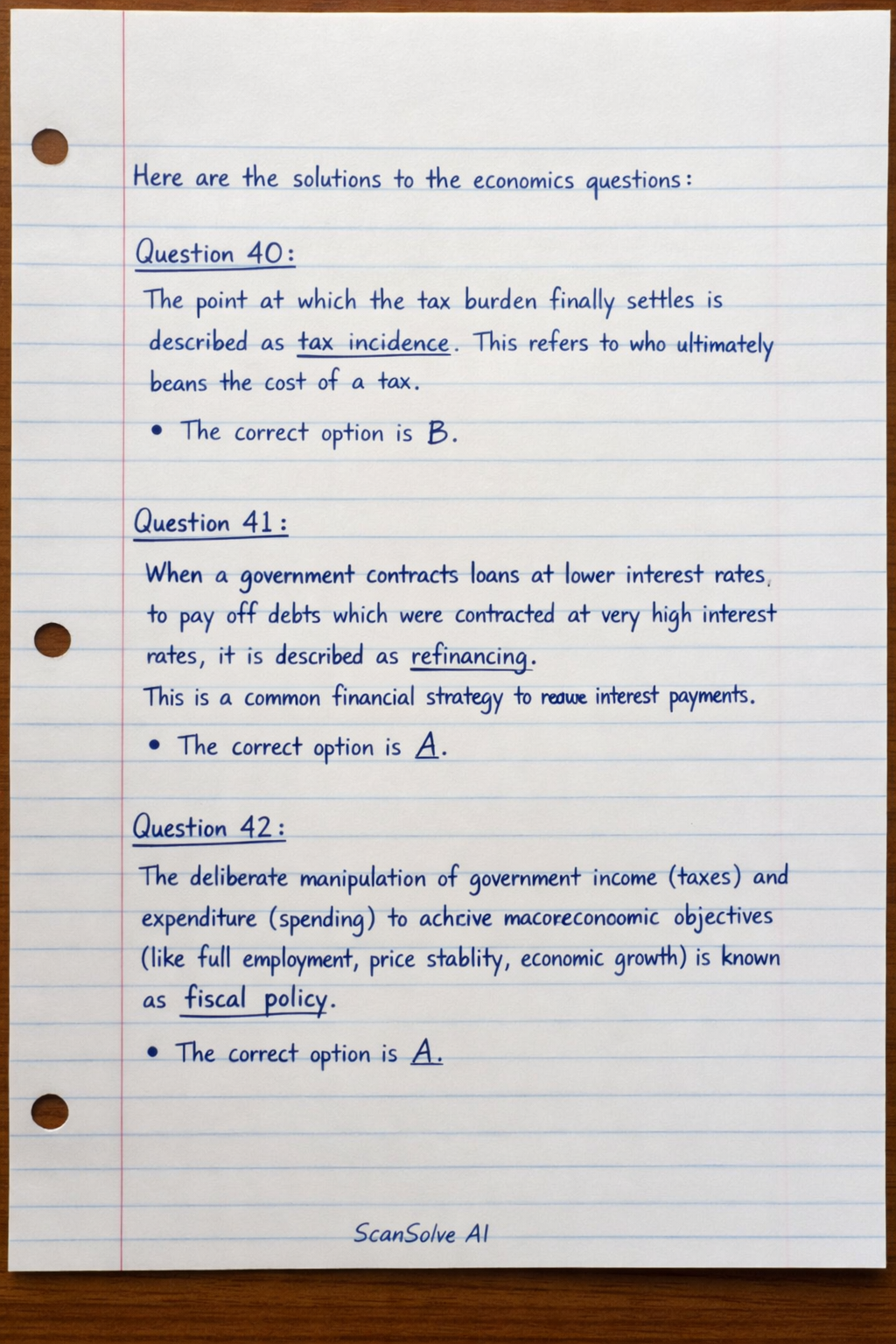
Here are the solutions to the economics questions: Question 40: The point at which the tax burden finally settles is described as tax incidence. This refers to who ultimately bears the cost of a tax. The correct option is B. Question 41: When a government contracts loans at lower interest rates to pay off debts which were contracted at very high interest rates, it is described as refinancing. This is a common financial strategy to reduce interest payments. The correct option is A. Question 42: The deliberate manipulation of government income (taxes) and expenditure (spending) to achieve macroeconomic objectives (like full employment, price stability, economic growth) is known as fiscal policy. The correct option is A. Question 43: To find the quantity of wheat imported before the tariff: 1. Locate the "World Price without tariff" line, which is at 100. 2. At this price, find the quantity demanded (D curve) and quantity supplied domestically (S curve). 3. Domestic demand at 100 is 400 tonnes. 4. Domestic supply at 100 is 100 tonnes. 5. Imports = Domestic Demand - Domestic Supply. Imports = 400 tonnes - 100 tonnes = 300 tonnes The correct option is B. Question 44: The main argument for protecting domestic industries is to shield them from foreign competition, thereby preventing a rapid increase in unemployment in those industries. The correct option is B. Question 45: Let's calculate the opportunity cost for each country: Country X: Opportunity cost of 1 computer = 1 million barrels of oil10 million computers = (1)/(10) barrel of oil. Opportunity cost of 1 barrel of oil = 10 million computers1 million barrels of oil = 10 computers. Country Y: Opportunity cost of 1 computer = 80 million barrels of oil100 million computers = (80)/(100) = (4)/(5) barrel of oil. Opportunity cost of 1 barrel of oil = 100 million computers80 million barrels of oil = (10)/(8) = (5)/(4) computers. Comparing the opportunity costs for computers: Country X's opportunity cost for 1 computer is (1)/(10) barrel of oil. Country Y's opportunity cost for 1 computer is (4)/(5) barrel of oil. Since (1)/(10) < (4)/(5), Country X has a lesser opportunity cost in the production of computers. The correct option is A. Question 46: A balance of payments deficit will reduce if a country's exports increase and/or its imports decrease. If its prices fall relative to foreign prices, its goods become cheaper for foreigners (increasing exports) and foreign goods become more expensive for domestic consumers (decreasing imports), thus reducing the deficit. The correct option is B. Question 47: A sustained increase in the real Gross Domestic Product (GDP) over time is the definition of economic growth. The correct option is C. Question 48: To promote economic growth, countries should promote investment. Investment in physical capital (factories, machinery) and human capital (education, training) increases productive capacity and is a key driver of growth. The correct option is C. Question 49: The Phillips curve illustrates an inverse relationship between the rate of unemployment and the rate of inflation. This suggests that governments face a trade-off between achieving (i) inflation and (ii) full employment. The correct option is A. Question 50: A more equitable distribution of income often means that lower-income households receive a larger share of income. These households tend to have a higher marginal propensity to consume. An increase in their income can lead to increased overall consumption and aggregate demand, which can stimulate production and reduce unemployment. The correct option is D. 3 done, 2 left today. You're making progress.