

This economics question tests your understanding of economic models and analysis. The step-by-step answer below applies the relevant framework and explains the reasoning.
ScanSolve AI Answer
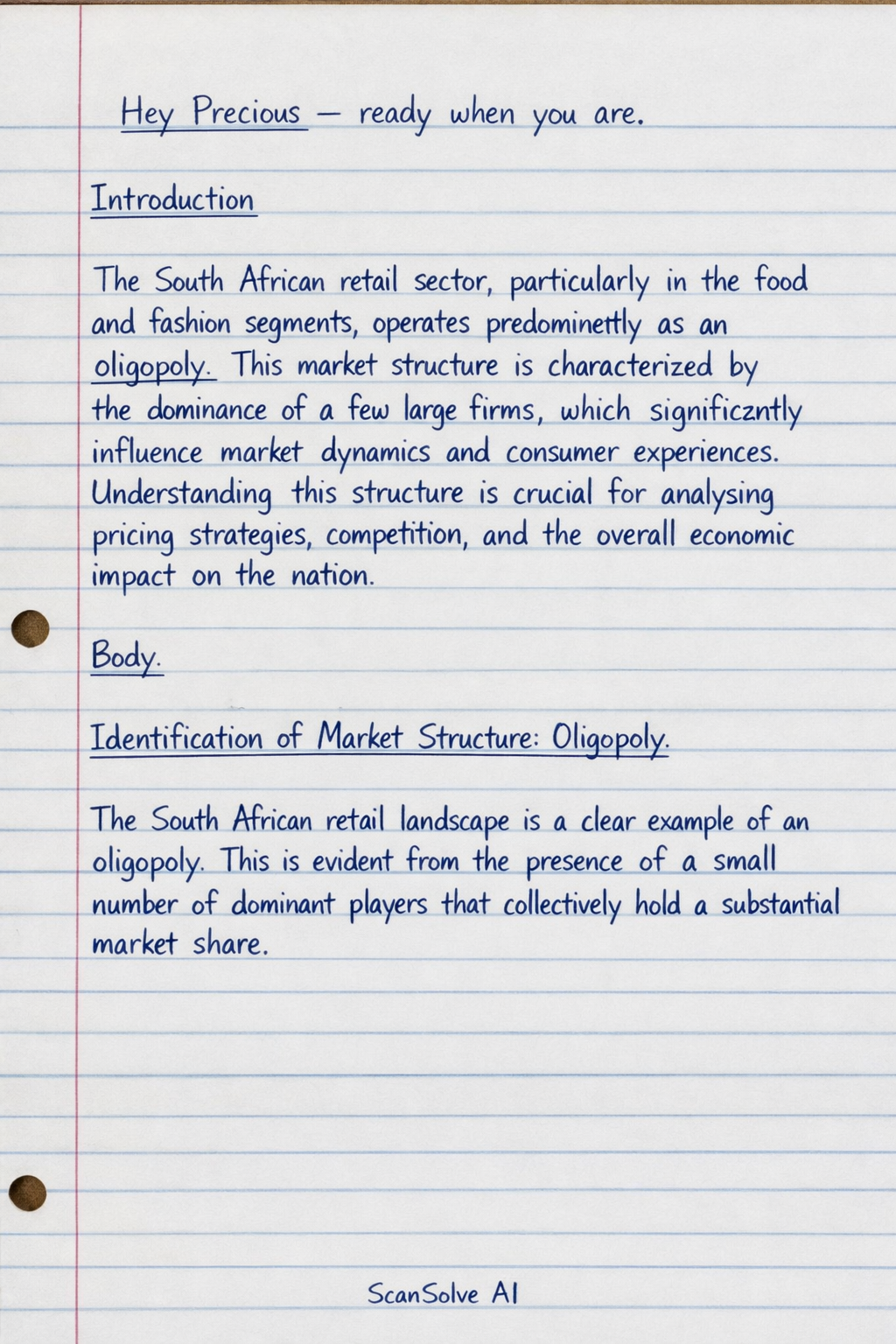
Hey Precious — ready when you are. Introduction The South African retail sector, particularly in the food and fashion segments, operates predominantly as an oligopoly. This market structure is characterized by the dominance of a few large firms, which significantly influence market dynamics and consumer experiences. Understanding this structure is crucial for analyzing pricing strategies, competition, and the overall economic impact on the nation. Body Identification of Market Structure: Oligopoly The South African retail landscape is a clear example of an oligopoly. This is evident from the presence of a small number of dominant players that collectively hold a substantial market share. Key Characteristics of an Oligopoly in SA Retail: Few Large Firms: The market is controlled by a handful of major retailers. High Barriers to Entry: Significant capital investment, established supply chains, and strong brand loyalty make it difficult for new firms to enter and compete effectively. Interdependence: Each firm's pricing and output decisions are heavily influenced by the actions and reactions of its rivals. This often leads to strategic interactions and careful consideration of competitive responses. Non-Price Competition: Firms frequently engage in extensive advertising, branding, loyalty programs, and product differentiation rather than solely competing on price. Major Retail Firms in South Africa (Food Sector): Prominent examples include Shoprite Holdings (encompassing Shoprite, Checkers, and Usave), Pick n Pay, Woolworths, and Spar Group. These entities collectively serve a vast consumer base across various income brackets. Control Over Prices: Firms in an oligopoly possess significant control over prices, acting as price makers. However, this control is not absolute. Their pricing power is constrained by the potential reactions of competitors. For instance, a price cut by one retailer might trigger a price war, while a price increase might lead to customers switching to rivals. This interdependence often results in price rigidity, where prices remain stable for extended periods. Strategies to Increase Market Share: Retail firms primarily increase market share through non-price competition. Key strategies include: Extensive Advertising and Branding: Building strong brand recognition and customer loyalty. Loyalty Programs: Rewarding repeat customers to encourage continued patronage. Product Differentiation: Offering unique private label brands, exclusive products, or specialized services (e.g., organic ranges at Woolworths). Customer Service Enhancement: Improving the shopping experience to attract and retain customers. Strategic Store Locations and Expansion: Opening new stores in underserved areas or expanding online retail platforms to reach a wider audience. Additional Part Threats to the Retail Sector and Impact on Consumers: The South African retail sector faces several significant threats: Economic Slowdowns and High Unemployment: Reduced consumer spending power directly impacts sales volumes. Rising Inflation: Increases operating costs for retailers and erodes consumer purchasing power. Load Shedding (Electricity Cuts): Disrupts operations, increases costs (e.g., for generators), and affects perishable goods. Supply Chain Disruptions: Global and local issues can lead to stock shortages and increased logistics costs. Increased Competition: From informal traders, smaller independent stores, and growing international e-commerce platforms. These threats can lead to higher operating costs for retailers, which are often passed on to consumers through increased prices. This can also result in reduced product variety, lower quality goods as firms cut costs, and potential job losses within the sector as businesses struggle to remain profitable. Conclusion The South African retail sector, characterized as an oligopoly, demonstrates how a few dominant firms shape market dynamics through strategic pricing and non-price competition. While these firms offer variety and convenience, they also face substantial economic and operational challenges. The interdependence inherent in an oligopoly means that the actions of one major retailer can have ripple effects across the entire market, ultimately influencing consumer choices, prices, and the overall health of the economy. Addressing the external threats, such as inflation and load shedding, is crucial for ensuring the stability and growth of this vital sector and mitigating adverse impacts on consumers. Rubric Considerations For a formal project, it is essential to ensure a clear and logical structure, as demonstrated above, to achieve high marks for "Structure/Presentation". Additionally, all information and data should be supported by a comprehensive "References/Bibliography" to validate the research and acknowledge sources, which would typically include academic journals, industry reports, and reputable news articles. What's next? Send 'em! 📸