

This economics question tests your understanding of economic models and analysis. The step-by-step answer below applies the relevant framework and explains the reasoning.
ScanSolve AI Answer
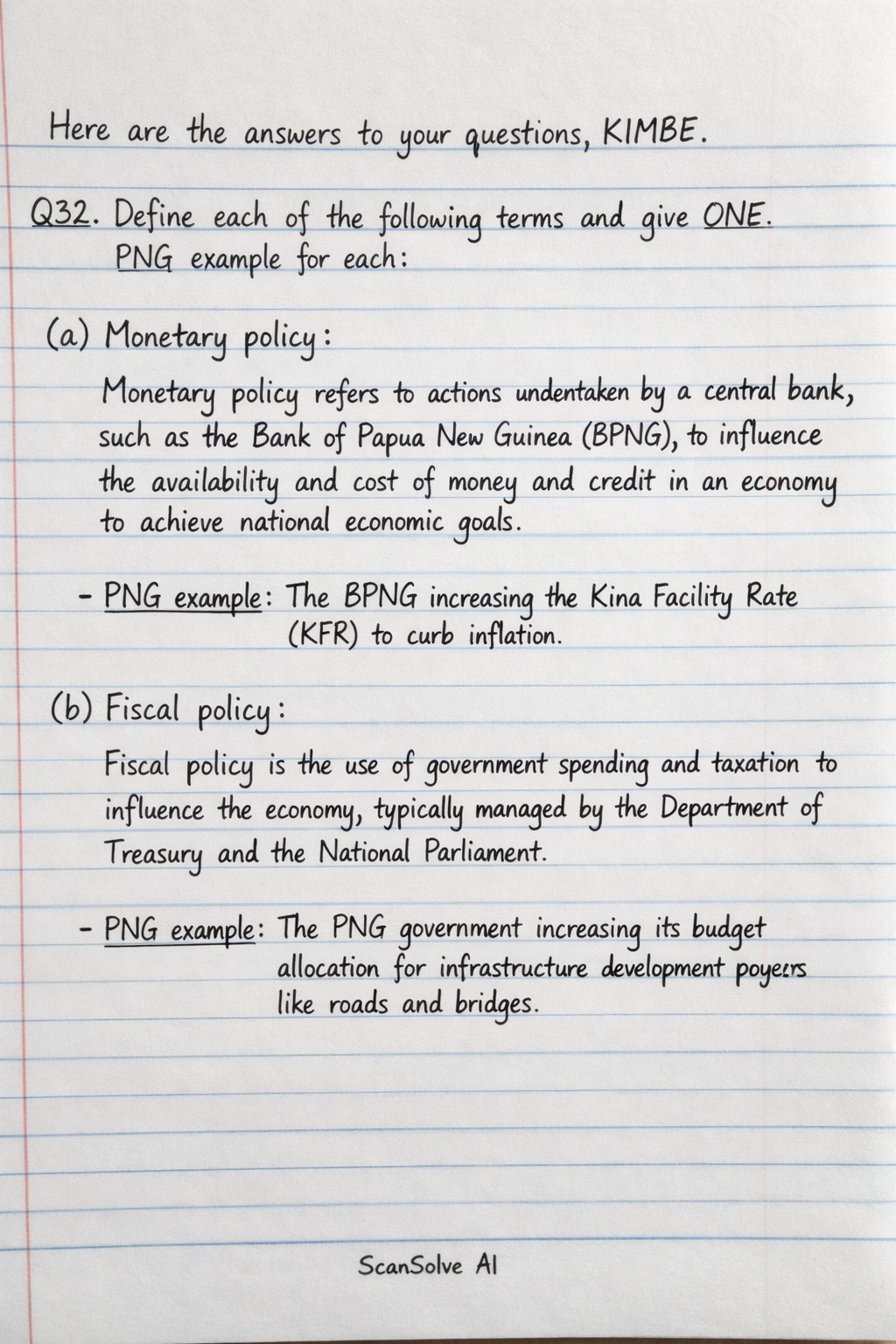
Here are the answers to your questions, KIMBE. Q32. Define each of the following terms and give ONE PNG example for each: (a) Monetary policy: Monetary policy refers to actions undertaken by a central bank, such as the Bank of Papua New Guinea (BPNG), to influence the availability and cost of money and credit in an economy to achieve national economic goals. PNG example: The BPNG increasing the Kina Facility Rate (KFR) to curb inflation. (b) Fiscal policy: Fiscal policy is the use of government spending and taxation to influence the economy, typically managed by the Department of Treasury and the National Parliament. PNG example: The PNG government increasing its budget allocation for infrastructure development projects like roads and bridges. (c) Inflation: Inflation is a general increase in the prices of goods and services in an economy over a period, leading to a fall in the purchasing power of money. PNG example: The rising cost of basic food items such as rice, tinned fish, and cooking oil in local markets across PNG. (d) Credit creation: Credit creation is the process by which commercial banks expand the money supply by making loans, which in turn generate new deposits within the banking system. PNG example: A commercial bank in PNG granting a K50,000 business loan to a small enterprise, which then deposits the funds into its account, increasing the money supply. Q33. List and briefly explain the SIX instruments (tools) of monetary policy used by the Bank of Papua New Guinea (BPNG). For each instrument, state whether increasing/imposing it will EXPAND or CONTRACT the economy. 1. Kina Facility Rate (KFR): This is the official interest rate set by BPNG for overnight borrowing and lending between commercial banks and the central bank. Increasing KFR* makes borrowing more expensive, which tends to CONTRACT the economy. 2. Open Market Operations (OMO): This involves the BPNG buying or selling government securities (like Treasury Bills and Inscribed Stock) in the financial markets. Selling securities* removes money from circulation, which tends to CONTRACT the economy. 3. Cash Reserve Requirement (CRR) / Liquid Assets Ratio (LGS Ratio): This is the percentage of deposits that commercial banks are legally required to hold as reserves with the BPNG or in liquid assets. Increasing the CRR/LGS ratio* reduces the funds available for lending, which tends to CONTRACT the economy. 4. Discount Rate / Lending Rate: This is the interest rate at which commercial banks can borrow funds directly from the BPNG. Increasing the discount rate* makes borrowing from BPNG more expensive, which tends to CONTRACT the economy. 5. Selective Credit Controls: These are direct directives or regulations issued by BPNG to commercial banks regarding the allocation or restriction of credit to specific sectors or for particular purposes. Imposing stricter controls* on certain types of loans (e.g., consumer loans) tends to CONTRACT lending in those areas. 6. Moral Suasion: This involves the BPNG using persuasion, advice, or informal requests to influence the lending and investment policies of commercial banks. Encouraging banks to reduce lending* would tend to CONTRACT the economy. Q34. Distinguish between RESTRICTIVE monetary policy and EXPANSIONARY monetary policy. For each type: (a) state its purpose, (b) identify when it would be used in PNG, and (c) give TWO specific policy actions. Restrictive (Tight) Monetary Policy: (a) Purpose: To decrease the money supply and credit availability in the economy. (b) When used in PNG: Typically used during periods of high inflation or when the economy is overheating (growing too rapidly). (c) Two specific policy actions: 1. Increasing the Kina Facility Rate (KFR). 2. Selling government securities in open market operations. Expansionary (Loose) Monetary Policy: (a) Purpose: To increase the money supply and credit availability in the economy. (b) When used in PNG: Typically used during periods of economic recession, slow growth, or high unemployment. (c) Two specific policy actions: 1. Decreasing the Kina Facility Rate (KFR). 2. Buying government securities in open market operations. Q35. Explain the FIVE types of unemployment. For each type, give a specific Papua New Guinea example. 1. Frictional Unemployment: Explanation:* This is short-term unemployment that occurs when individuals are voluntarily between jobs, searching for new employment, or entering the workforce for the first time. It is a natural part of a dynamic labor market. PNG Example:* A recent graduate from the University of Papua New Guinea actively searching for their first professional job in Port Moresby. 2. Structural Unemployment: Explanation:* This type of unemployment arises from a mismatch between the skills workers possess and the skills demanded by employers, or from long-term changes in the structure of the economy, such as technological advancements or the decline of specific industries. PNG Example:* Workers in a remote logging camp becoming unemployed because the timber resources have been depleted, and they lack the skills required for jobs in other growing sectors like services or technology. 3. Cyclical Unemployment: Explanation:* This unemployment is directly linked to the business cycle, increasing during economic recessions (when overall demand for goods and services falls) and decreasing during economic expansions. PNG Example:* Construction workers being laid off during an economic downturn when there is a significant reduction in new building projects and infrastructure development. 4. Seasonal Unemployment: Explanation:* This occurs due to regular, predictable fluctuations in demand for labor in certain industries that are tied to specific seasons of the year. PNG Example:* Workers employed in the coffee harvesting industry in the Highlands region experiencing unemployment during the non-harvesting months. 5. Disguised/Underemployment: Explanation:* This refers to a situation where individuals are employed but their labor is not fully utilized, or they are working in jobs below their skill level, or in roles where their marginal productivity is very low, meaning more people are working than are actually needed. PNG Example:* Several family members working on a small subsistence farm where the same output could be achieved with fewer workers, indicating that some labor is not contributing significantly to production. Last free one today — make it count tomorrow, or type /upgrade for unlimited.