
We read your photo as:
State and briefly explain any three (3) assumptions underlying the theory of consumer behaviour. Explain the concept of utility in relation to consumer behaviour with examples.
ScanSolve AI Answer
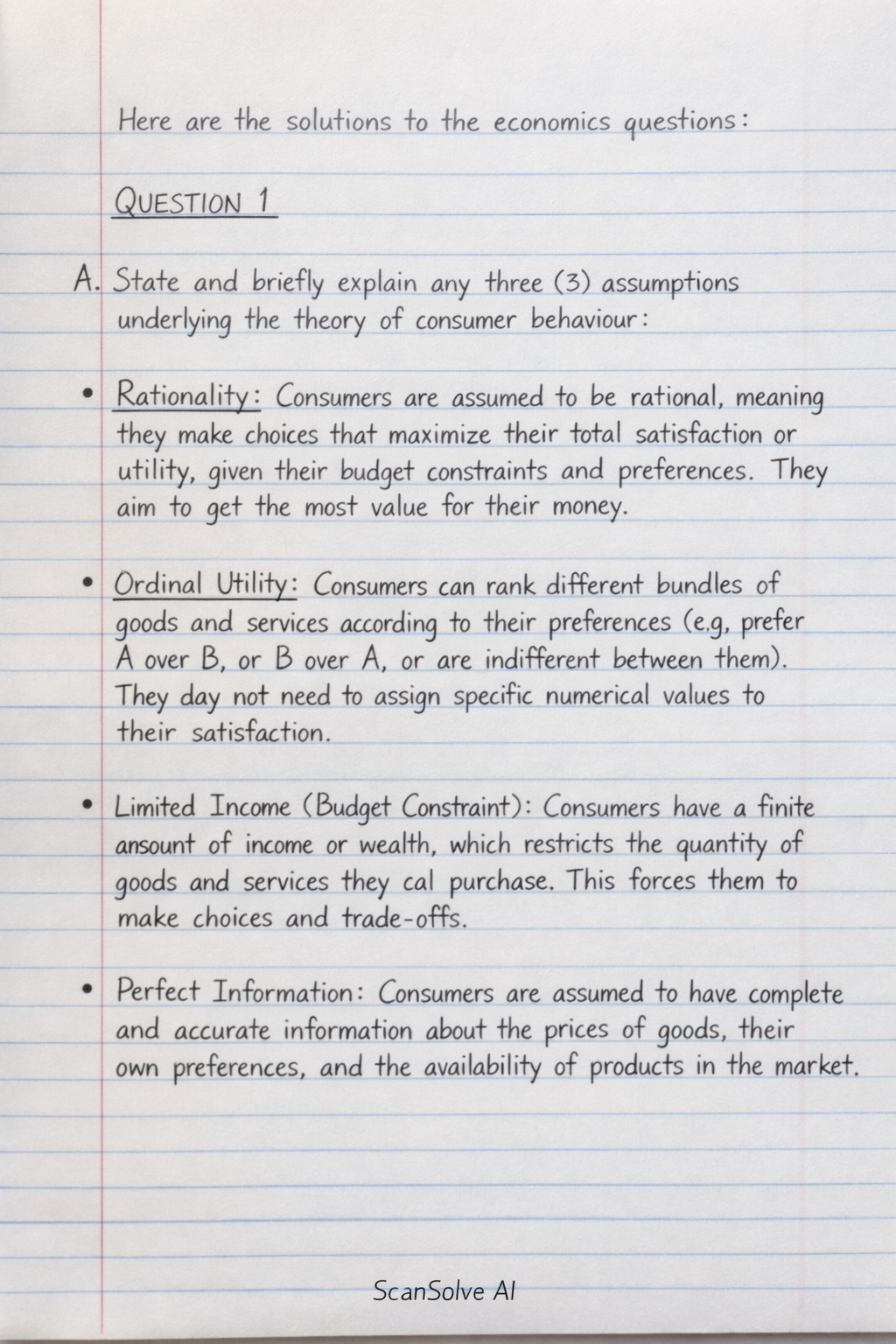
Here are the solutions to the economics questions:
QUESTION 1
A. State and briefly explain any three (3) assumptions underlying the theory of consumer behaviour.
- Rationality: Consumers are assumed to be rational, meaning they make choices that maximize their total satisfaction or utility, given their budget constraints and preferences. They aim to get the most value for their money.
- Ordinal Utility: Consumers can rank different bundles of goods and services according to their preferences (e.g., prefer A over B, or B over A, or are indifferent between them). They do not need to assign specific numerical values to their satisfaction.
- Limited Income (Budget Constraint): Consumers have a finite amount of income or wealth, which restricts the quantity of goods and services they can purchase. This forces them to make choices and trade-offs.
- Perfect Information: Consumers are assumed to have complete and accurate information about the prices of goods, their own preferences, and the availability of products in the market.
B. Explain the following concept in relations to consumer behaviour with examples:
-
i. Utility:
- Utility refers to the satisfaction, pleasure, or benefit that a consumer derives from consuming a good or service. It is a subjective measure of how much a consumer values something.
- Example: A person feels high utility from drinking a cold glass of water on a hot day.
-
ii. Total Utility (TU):
- Total utility is the overall or cumulative satisfaction obtained from consuming a specific quantity of a good or service. It is the sum of the utilities derived from each unit consumed.
- Example: If consuming one slice of pizza gives 10 units of utility and a second slice gives 8 units, the total utility from two slices is 18 units.
-
iii. Marginal Utility (MU):
- Marginal utility is the additional satisfaction or utility gained from consuming one more unit of a good or service. It measures the change in total utility resulting from a one-unit change in consumption.
- Example: If total utility from 2 slices of pizza is 18 units and from 3 slices is 24 units, the marginal utility of the third slice is units.
-
iv. Average Utility (AU):
- Average utility is the total utility divided by the total number of units of a good or service consumed. It represents the utility per unit of the good.
- Example: If total utility from 3 slices of pizza is 24 units, the average utility is units per slice.
QUESTION 2
A. Define the following:
-
i. Average variable cost (AVC):
- Average variable cost is the total variable cost of production divided by the total quantity of output produced. It represents the variable cost incurred per unit of output.
-
ii. Marginal cost schedule:
- A marginal cost schedule is a table or list that shows the additional cost incurred to produce one more unit of output at various levels of production. It illustrates how marginal cost changes as output increases.
B. CODEL Limited has the following cost structure:
i. Copy and complete the table above by calculating the values to fill the blank columns above.
First, identify the Total Fixed Cost (TFC). When Output (Q) is 0, Total Cost (TC) is GH¢800.00. Therefore, TFC = GH¢800.00.
Formulas used:
- (or since )
| Output (Q) | Total Cost (TC) in Cedis | Total Variable Cost (TVC) in Cedis | Average Variable Cost (AVC) in Cedis | Marginal Cost (MC) in Cedis |
|---|---|---|---|---|
| 0 | 800.00 | 0 | - | - |
| 1 | 1,000.00 | |||
| 2 | 1,400.00 | |||
| 3 | 2,100.00 | |||
| 4 | 2,800.00 | |||
| 5 | 4,000.00 | |||
| 6 | 6,000.00 |
ii. What market structure is CODEL operating in?
CODEL is operating in a perfectly competitive market. This is inferred from part C, where the industry price is given as fixed, implying that CODEL is a price taker and cannot influence the market price.
C. If the industry price is fixed at GH¢1,200
i. Determine the profit maximisation level of output. Explain your answer.
The profit maximization rule for any firm is to produce at the level of output where Marginal Revenue (MR) equals Marginal Cost (MC). In a perfectly competitive market, the firm is a price taker, so Price (P) = Marginal Revenue (MR).
Given: Industry Price (P) = GH¢1,200.
Therefore, Marginal Revenue (MR) = GH¢1,200.
We need to find the output level where MC is equal to or just below MR.
From the completed table:
- At Output = 1, MC = GH¢200
- At Output = 2, MC = GH¢400
- At Output = 3, MC = GH¢700
- At Output = 4, MC = GH¢700
- At Output = 5, MC = GH¢1,200
- At Output = 6, MC = GH¢2,000
Comparing MR (GH¢1,200) with MC:
- At Q=4, MC (GH¢700) < MR (GH¢1,200), so the firm should increase output.
- At Q=5, MC (GH¢1,200) = MR (GH¢1,200). This is the profit-maximizing point.
- At Q=6, MC (GH¢2,000) > MR (GH¢1,200), so producing this unit would reduce profit.
The profit maximization level of output is 5 units.
Explanation:
A firm maximizes profit by producing at the output level where its marginal revenue (MR) equals its marginal cost (MC).
Still stuck on this one?
Ask a follow-up, and the answer starts from this question.
More Economics Questions
Handwritten Step-by-Step Solution
Get this as a handwritten image on WhatsApp — like a tutor wrote it for you.
Try on WhatsApp