
We read your photo as:
Which of the following is the most appropriate personal opinion regarding the statement: "Even before COVID, one out of every five South Africans lived below the food poverty line"? e) I think that we
ScanSolve AI Answer
Answer
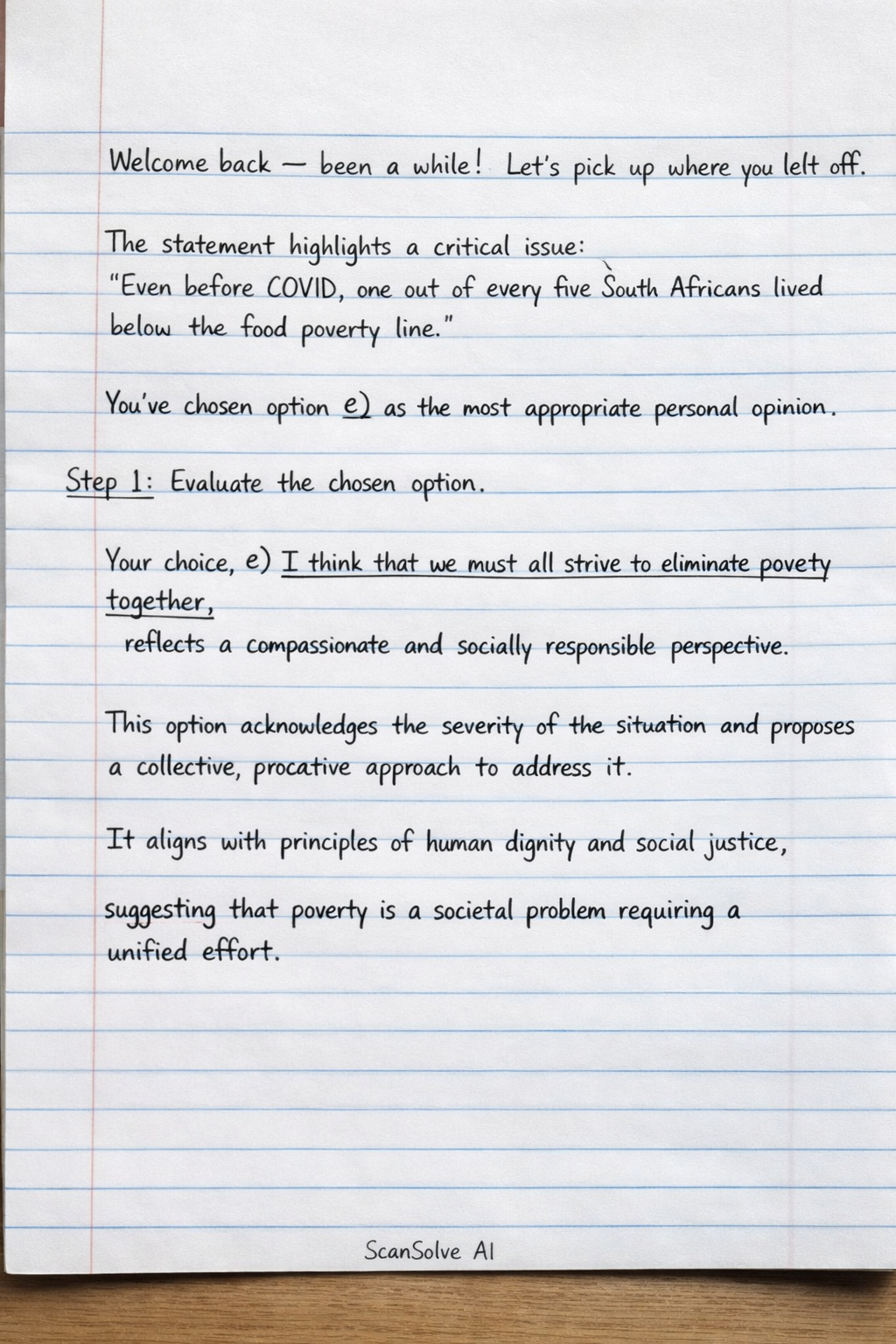
The statement highlights a critical issue: "Even before COVID, one out of every five South Africans lived below the food poverty line." You've chosen option e) as the most appropriate personal opinion.
Step-by-step solution
3 stepsEvaluate the chosen option.
Your choice, e) I think that we must all strive to eliminate poverty together, reflects a compassionate and socially responsible perspective. This option acknowledges the severity of the situation and proposes a collective, proactive approach to address it. It aligns with principles of human dignity and social justice, suggesting that poverty is a societal problem requiring a unified effort.
Explain why option e is the most suitable response.
The fact that one in five people live below the food poverty line is a profound indicator of systemic inequality and hardship. A truly ethical and empathetic response recognizes this as an unacceptable condition that demands action. Option e embodies the idea of collective responsibility, asserting that the well-being of all members of society is a shared concern. Poverty is not merely an individual failing but often a consequence of broader economic, social, and political structures. Therefore, its elimination requires collaborative efforts from governments, communities, organizations, and individuals working in solidarity. This approach fosters a more equitable and stable society for everyone.
Contrast with other options.
The other options present problematic viewpoints. Options a ("Who cares?") and d ("This is sad, but to be honest, it is not going to stop me from focusing on my own wellbeing first.") demonstrate a lack of empathy and social responsibility. Option c ("If they worked harder, they wouldn't be so poor.") is a simplistic and often inaccurate generalization that blames individuals for systemic issues. Most disturbingly, option b suggests that high mortality rates due to poverty are a "blessing in disguise," which is an inhumane and ethically reprehensible stance. Therefore, option e stands out as the only morally sound and constructive response to the challenge of widespread poverty.
The most appropriate personal opinion is e).
The statement that one out of every five South Africans lived below the food poverty line even before COVID-19 is deeply concerning and highlights a significant humanitarian crisis. My personal opinion on this matter is unequivocally aligned with option e): that we must all strive to eliminate poverty together. This perspective is rooted in the fundamental belief that every individual deserves access to basic necessities, including adequate food, and that widespread poverty is a collective failure, not an individual one.Poverty is a complex issue influenced by systemic factors such as economic inequality, lack of access to education and healthcare, and historical injustices. Blaming individuals for their circumstances, as suggested by some other options, ignores these broader societal structures. Instead, recognizing poverty as a shared challenge necessitates a collaborative response. Governments, non-governmental organizations, businesses, and individuals all have a role to play in creating sustainable solutions, whether through policy changes, economic development, educational initiatives, or direct aid.
Empathy and social responsibility dictate that we cannot simply ignore the suffering of others or view it as an inevitable outcome. A society's strength is often measured by how it treats its most vulnerable members. By working together, we can advocate for policies that promote equitable resource distribution, create opportunities for economic empowerment, and build resilient communities. This collective effort is not just about charity; it is about fostering a just and inclusive society where everyone has the chance to thrive. The elimination of poverty benefits not only those directly affected but also contributes to overall societal stability, health, and prosperity.
</Answer in here IN YOUR OWN WORDS>
Still stuck on this one?
Ask a follow-up, and the answer starts from this question.
More Economics Questions
Handwritten Step-by-Step Solution
Get this as a handwritten image on WhatsApp — like a tutor wrote it for you.
Try on WhatsApp