
We read your photo as:
Which of the following items should be included in national income accounting?
ScanSolve AI Answer
Answer
Step-by-step solution
3 stepsHere are the solutions to the questions:
Part 23· 3 steps
Calculate the initial total wage cost for 10 workers.
Calculate the new total wage cost for 11 workers.
Calculate the marginal cost of increasing the labor force from 10 to 11 persons.
Marginal cost is the change in total cost when one more unit (in this case, one more worker) is added.
The correct option is D.
The marginal cost is .
Part 24
When land has only one use, all of its income is economic rent because its opportunity cost in any alternative use is zero. Economic rent is the payment to a factor of production in excess of its opportunity cost. If there are no alternative uses, then the minimum payment required to keep it in its current use (transfer earnings) is effectively zero for other uses, making all income from its single use economic rent.
The correct option is B.
The reason is .
Part 25
Normal profit is the minimum level of profit needed for a company to remain competitive in the market. In economic terms, it occurs when a firm's total revenue (TR) equals its total economic cost (TC), which includes both explicit and implicit costs (including the opportunity cost of the entrepreneur's capital and time). When TR - TC equals zero, the firm is earning normal profit (zero economic profit).
The correct option is C.
Normal profit is .
Part 26
National income accounting measures the value of new goods and services produced in an economy.
- Sales of second-hand cars (A) are transactions of existing assets, not new production.
- Winnings from games of chance (B) are transfer payments or redistribution of wealth, not income from production.
- Unemployment benefits (D) are transfer payments from the government, not payment for current production.
- Commission earned from the sale of a house built 25 years ago (C) represents payment for a current service (the real estate agent's work), even though the house itself is an old asset. This service is new production. The correct option is C. The item that should be included in national income accounting is .
Part 27
Gross National Product (GNP) measures the total value of goods and services produced by a country's residents, regardless of location. Gross Domestic Product (GDP) measures the total value of goods and services produced within a country's borders, regardless of who owns the factors of production.
The relationship is:
Net Property Income from Abroad is the difference between property income received from abroad and property income paid abroad. Therefore, if GNP exceeds GDP, it is by the amount of net property income from abroad.
The correct option is D.
Gross national product exceeds gross domestic product by the amount of .
Part 28
A measure of national expenditure at market prices includes indirect taxes (like sales tax or VAT) and excludes subsidies. Factor costs, on the other hand, represent the actual cost of the factors of production (labor, capital, land, entrepreneurship) used to produce goods and services. To convert market prices to factor costs, indirect taxes are subtracted, and subsidies are added. Therefore, market prices do not reflect factor costs because they include indirect taxes and do not account for subsidies.
The correct option is D.
A measure of national expenditure at market prices does not reflect the true value of factor costs because it includes .
Part 34
The Accounting Rate of Return (ARR) method of investment appraisal calculates the average annual profit as a percentage of the initial or average investment. A significant disadvantage of the ARR method is that it ignores the time value of money, meaning it treats profits received in the future as having the same value as profits received today. Other methods like Net Present Value (NPV) and Internal Rate of Return (IRR) account for the time value of money by discounting future cash flows.
The correct option is D.
A disadvantage of the Accounting or Average Rate of Return (ARR) method of investment appraisal is that it .
Try one yourself
A new problem that tests the same skill.
Still stuck on this one?
Ask a follow-up, and the answer starts from this question.
More Economics Questions
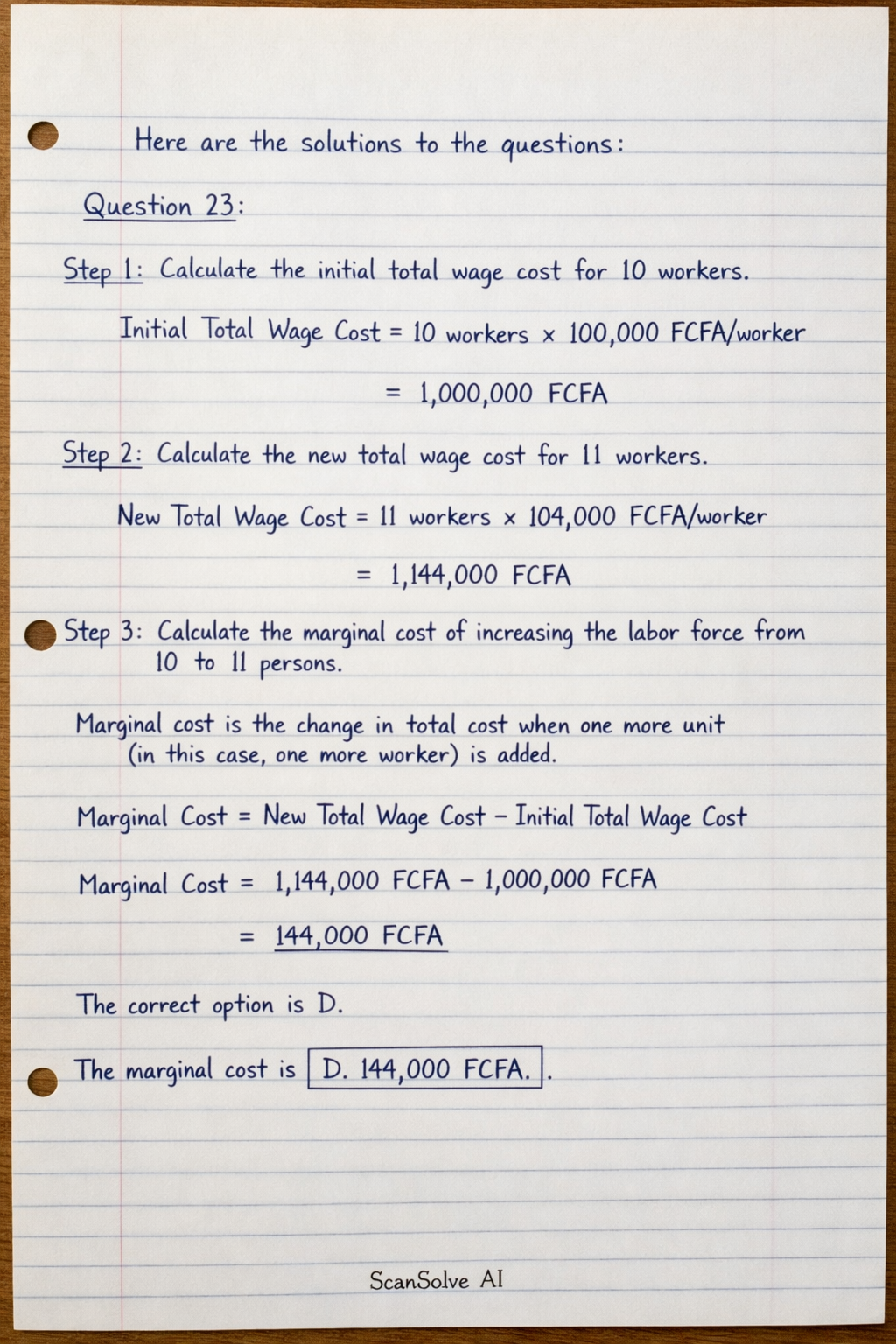
Handwritten Step-by-Step Solution
Get this as a handwritten image on WhatsApp — like a tutor wrote it for you.
Try on WhatsApp