
We read your photo as:
Outline a research methodology to investigate rural development, focusing on alternative energy and key economic factors. Include data presentation and analysis steps.
Economics
ScanSolve AI Answer
Step-by-step solution
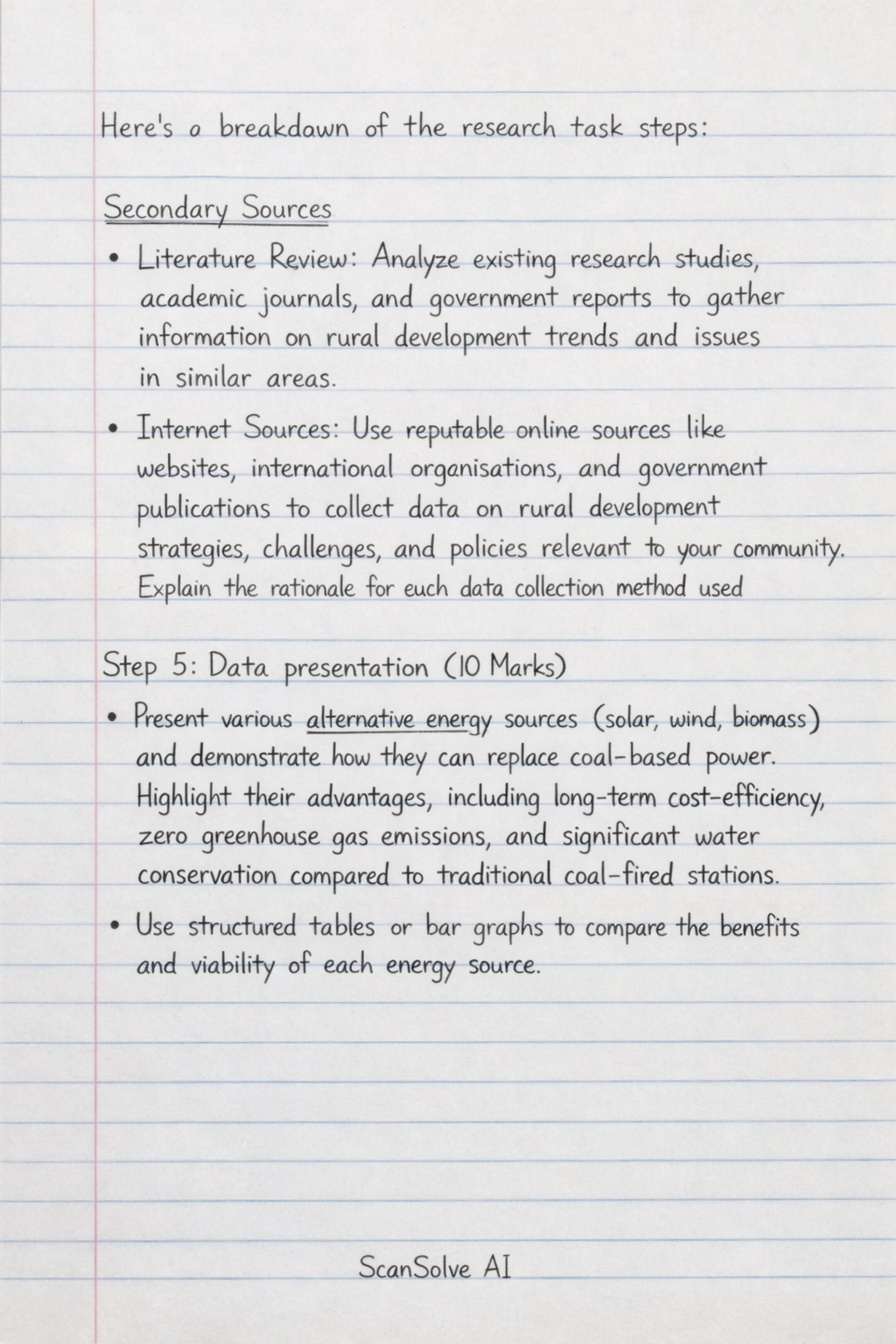
4 stepsHere's a breakdown of the research task steps:
Secondary Sources
- Literature Review: Analyze existing research studies, academic journals, and government reports to gather information on rural development trends and issues in similar areas.
- Internet Sources: Use reputable online sources like websites, international organizations, and government publications to collect data on rural development strategies, challenges, and policies relevant to your community. Explain the rationale for each data collection method used.
Data presentation (10 Marks)
- Present various alternative energy sources (solar, wind, biomass) and demonstrate how they can replace coal-based power. Highlight their advantages, including long-term cost-efficiency, zero greenhouse gas emissions, and significant water conservation compared to traditional coal-fired stations.
- Use structured tables or bar graphs to compare the benefits and viability of each energy source.
Data Analysis (20 Marks)
- Analyze the Collected Data: After gathering primary and secondary data (interviews, surveys, field observations, photographs, literature reviews), analyze it to identify key trends and patterns.
- Discuss Key Development Factors:
- Discuss how factors like farming practices, mining, and infrastructure influence rural development.
- Analyze how stable power would reduce the high cost of backup generators for local farming, mining, and small businesses.
- Discuss how reliable energy would improve healthcare and education (e.g., keeping lights on in schools, refrigerators running in clinics).
- Discuss how switching to solar or wind protects water resources, as these technologies use far less water than coal-fired power stations.
Recommendation, solutions and Conclusion (20 Marks)
- Provide clear, actionable solutions based on the research findings.
- Summarize the findings into a final statement.
- Conclude that South Africa's future power needs depend on moving from coal to renewable energy sources.
- State that utilizing natural resources will create a more stable, sustainable, and less polluting energy future for the country.
References and presentation (10 Marks)
- Reference at least 5 sources using the Harvard referencing style.
- Provide examples of Harvard referencing style for journals, books, and internet sources.
Was this helpful?
Still stuck on this one?
Ask a follow-up, and the answer starts from this question.
Got a different question?Ask your own question
More Economics Questions
QOutline a research plan for a study on rural development, focusing on alternative energy sources and…QCreate a research plan for a community economic development project, including identifying economic…QI need a msc research project topic on rural developmentQOutline Step 1 of your research task: defining the problem statement for a South African energy…QResearch task on sustainable alternative energy sources in South Africa for Grade 12, covering…
Handwritten Step-by-Step Solution
Get this as a handwritten image on WhatsApp — like a tutor wrote it for you.
Try on WhatsApp