

This economics question tests your understanding of economic models and analysis. The step-by-step answer below applies the relevant framework and explains the reasoning.
ScanSolve AI Answer
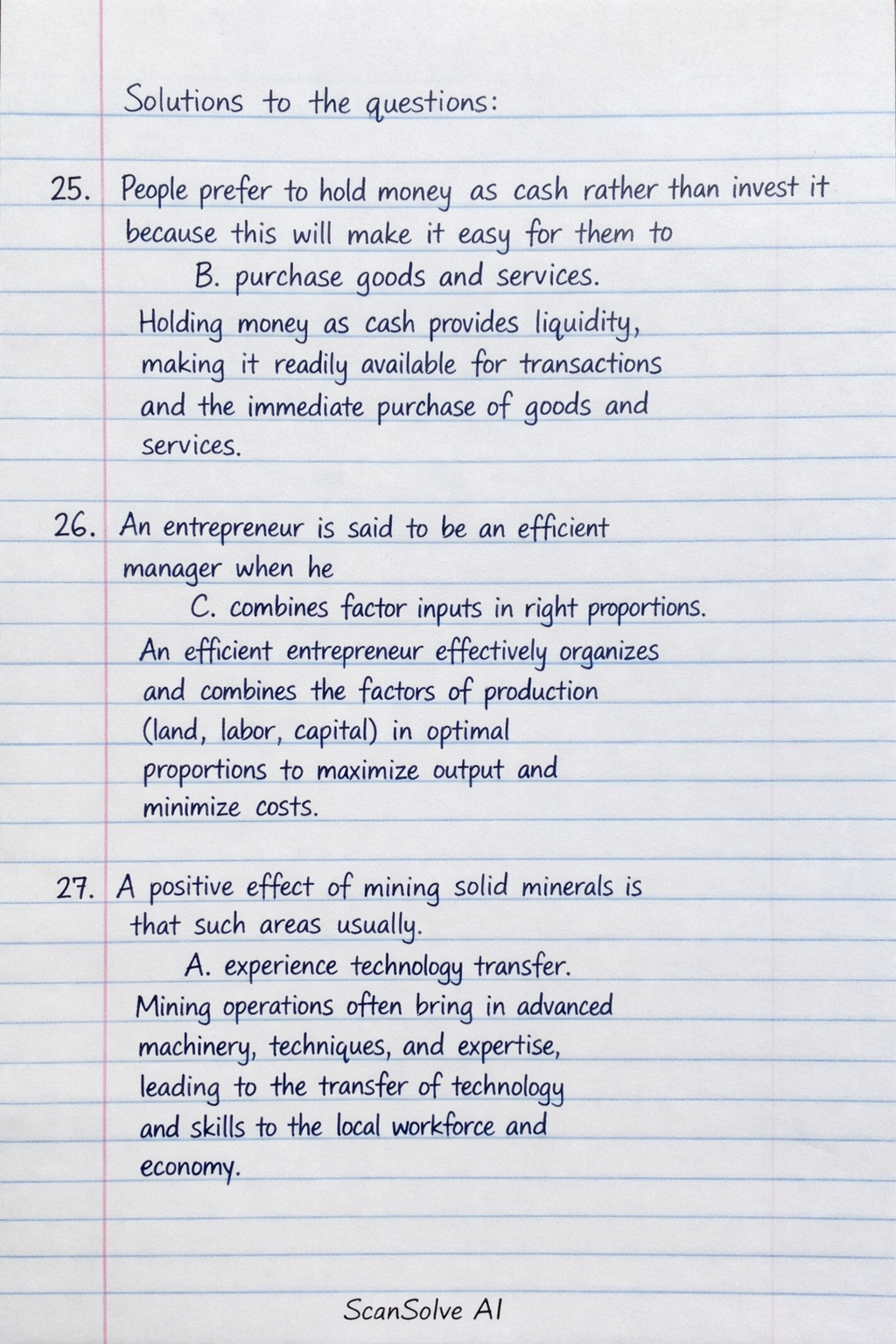
here are the solutions to the questions: 25. People prefer to hold money as cash rather than invest it because this will make it easy for them to B. purchase goods and services. Holding money as cash provides liquidity, making it readily available for transactions and the immediate purchase of goods and services. 26. An entrepreneur is said to be an efficient manager when he C. combines factor inputs in right proportions. An efficient entrepreneur effectively organizes and combines the factors of production (land, labor, capital) in optimal proportions to maximize output and minimize costs. 27. A positive effect of mining solid minerals is that such areas usually A. experience technology transfer. Mining operations often bring in advanced machinery, techniques, and expertise, leading to the transfer of technology and skills to the local workforce and economy. 28. The structural arrangement associated with resource allocation for solving the basic economic problems in every society is A. economic system. An economic system is the organized way a society allocates its scarce resources and distributes goods and services to its members, addressing the fundamental economic problems of what, how, and for whom to produce. 29. Voting in a co-operative society is C. on equal basis for members. Co-operative societies typically operate on the principle of "one member, one vote," regardless of the number of shares owned, ensuring democratic control. 30. To improve living standards in developing countries, policy makers should D. formulate plans designed to increase industrial productivity. Increasing industrial productivity leads to higher output, more jobs, increased income, and a greater availability of goods and services, all of which contribute to improved living standards. 31. The expenditure on inputs which changes as the output level changes in the short run is obtained from the formula A. Total Cost minus Total Variable Cost. This question seems to have a slight error in its options or phrasing. The expenditure on inputs that changes with output is Total Variable Cost. If the question is asking for Total Fixed Cost, then it would be Total Cost minus Total Variable Cost. Given the options, and assuming it's asking for the component that doesn't change with output (fixed cost), or perhaps a misphrasing for variable cost, let's re-evaluate. Total Cost (TC) = Total Fixed Cost (TFC) + Total Variable Cost (TVC). The expenditure on inputs which changes as the output level changes in the short run is the Total Variable Cost*. If the question is asking for the formula to find* Total Variable Cost, it would be: TVC = TC - TFC If the question is asking for the formula to find* Total Fixed Cost, it would be: TFC = TC - TVC Option A states "Total Cost minus Total Variable Cost", which equals Total Fixed Cost. Option B states "Total Cost minus Total Fixed Cost", which equals Total Variable Cost. The question asks for "The expenditure on inputs which changes as the output level changes in the short run". This is the definition of Total Variable Cost. Therefore, the formula to obtain it is Total Cost minus Total Fixed Cost. B. Total Cost minus Total Fixed Cost. 32. Devaluation of the currency of a country is mainly aimed at B. increasing the sale of local goods in foreign markets. Devaluation makes a country's exports cheaper for foreign buyers and imports more expensive for domestic consumers, thereby boosting exports and reducing imports, which helps improve the balance of trade. 33. Distribution of goods is enhanced by all of the following factors except D. existence of numerous middlemen. While middlemen play a role in distribution, an excessive or numerous amount of middlemen can sometimes complicate the supply chain, increase costs, and reduce efficiency, rather than enhancing distribution. The other options (access to credit, adequate storage, good communication) clearly enhance distribution. Got more? Send 'em!