

This economics question tests your understanding of economic models and analysis. The step-by-step answer below applies the relevant framework and explains the reasoning.
ScanSolve AI Answer
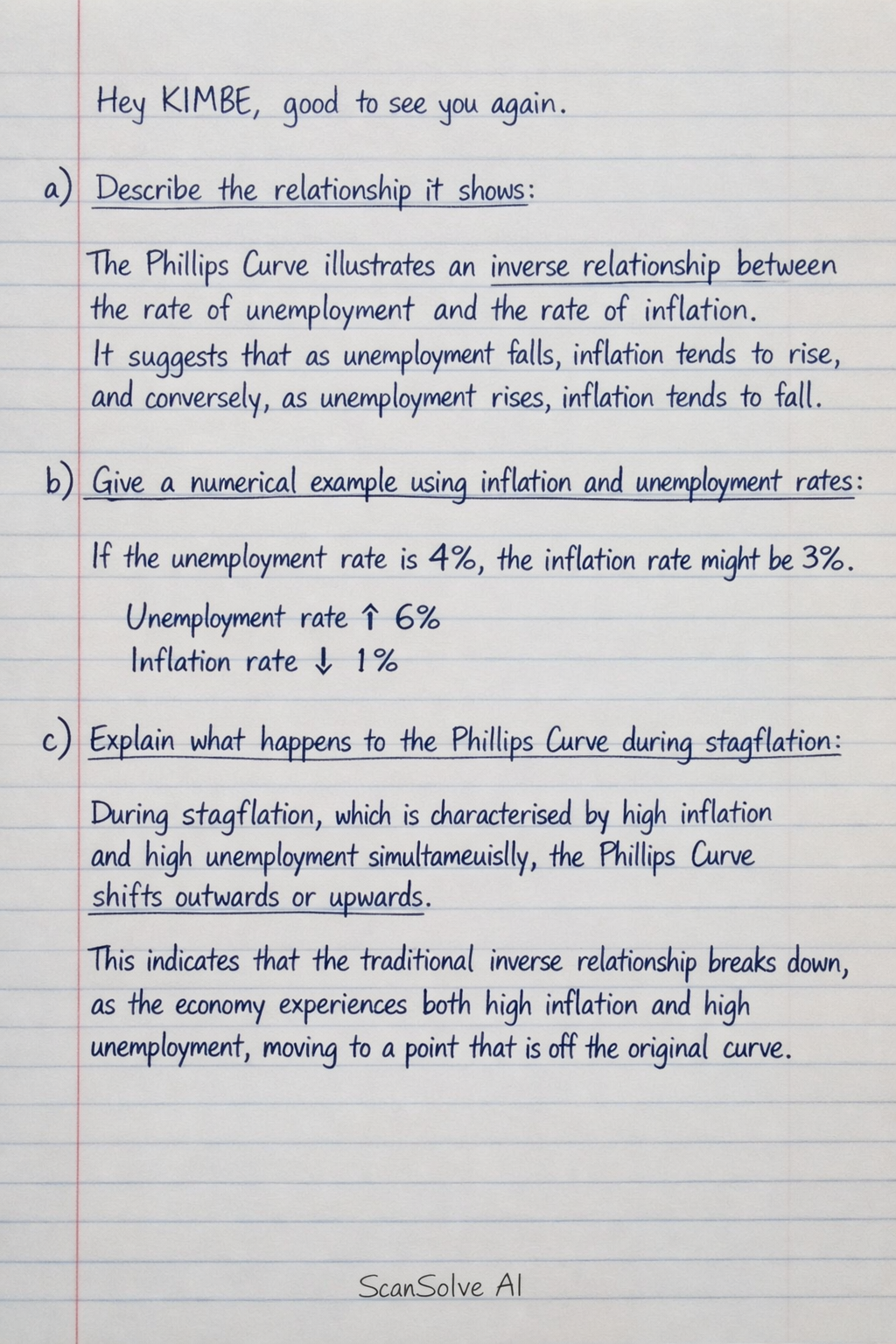
Hey KIMBE, good to see you again. a) Describe the relationship it shows: The Phillips Curve illustrates an inverse relationship between the rate of unemployment and the rate of inflation. It suggests that as unemployment falls, inflation tends to rise, and conversely, as unemployment rises, inflation tends to fall. b) Give a numerical example using inflation and unemployment rates: If the unemployment rate is 4%, the inflation rate might be 3%. If the unemployment rate increases to 6%, the inflation rate might decrease to 1%. c) Explain what happens to the Phillips Curve during stagflation: During stagflation, which is characterized by high inflation and high unemployment simultaneously, the Phillips Curve shifts outwards or upwards. This indicates that the traditional inverse relationship breaks down, as the economy experiences both high inflation and high unemployment, moving to a point that is off the original curve. Send me the next one 📸