
Price of elasticity of demand :0.5 Income elasticity of demand :0.2 Cross -price elasticity of demand : -0.3
ScanSolve AI Answer
Step-by-step solution
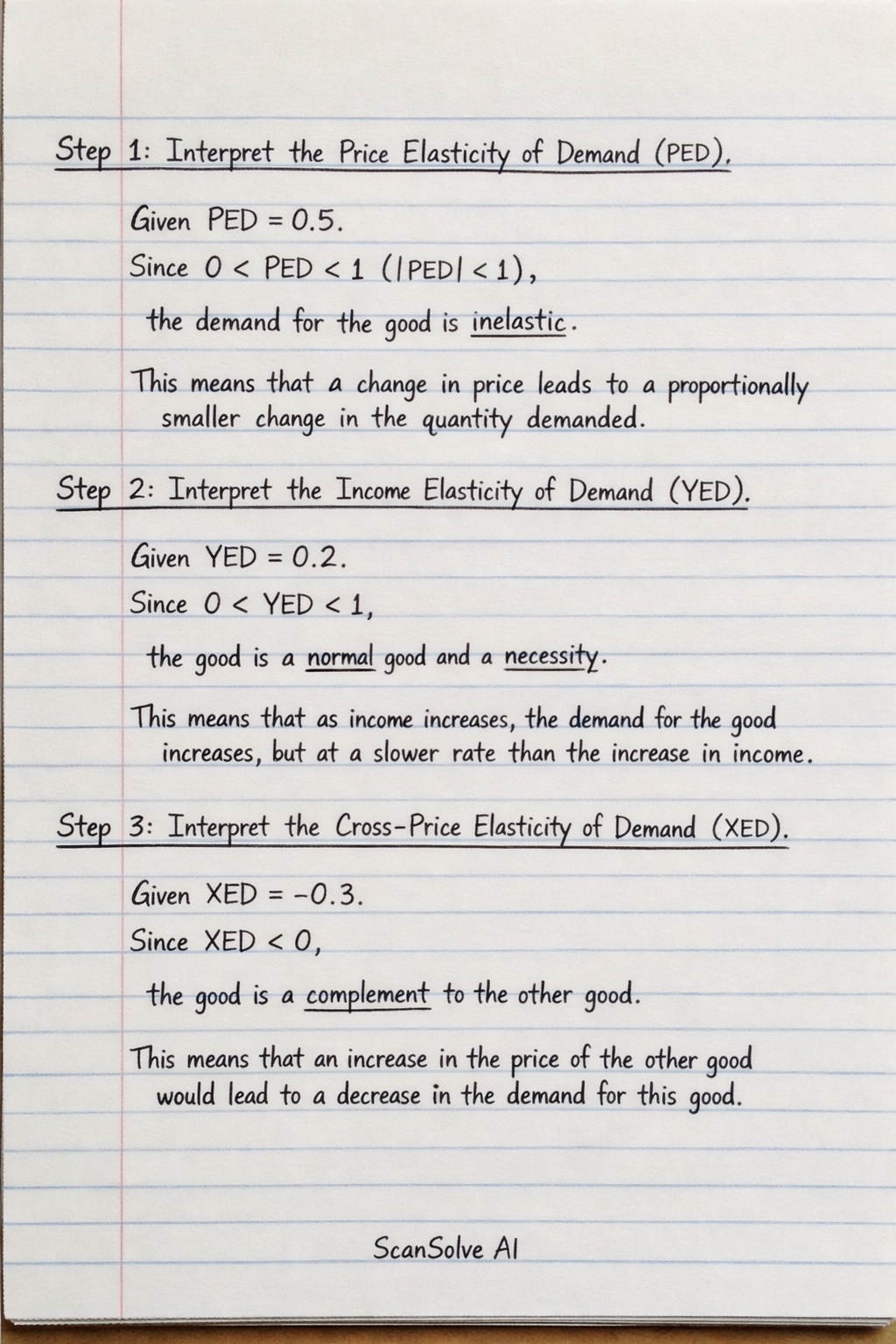
3 stepsInterpret the Price Elasticity of Demand (PED).
Given PED = 0.5. Since (or ), the demand for the good is inelastic. This means that a change in price leads to a proportionally smaller change in the quantity demanded.
Interpret the Income Elasticity of Demand (YED).
Given YED = 0.2. Since , the good is a normal good and specifically a necessity. This means that as income increases, the demand for the good increases, but at a slower rate than the increase in income.
Interpret the Cross-Price Elasticity of Demand (XED).
Given XED = . Since , the good is a complement to the other good. This means that an increase in the price of the other good would lead to a decrease in the demand for this good.
Based on the given elasticities:
- Price Elasticity of Demand (0.5): The good has inelastic demand.
- Income Elasticity of Demand (0.2): The good is a normal good and a necessity.
- Cross-Price Elasticity of Demand (): The good is a complement to the other good.
Still stuck on this one?
Ask a follow-up, and the answer starts from this question.
More Economics Questions
Handwritten Step-by-Step Solution
Get this as a handwritten image on WhatsApp — like a tutor wrote it for you.
Try on WhatsApp