
We read your photo as:
Refer to the table on the income Elasticity of Demand for Jasmine rice and Bestla Tin fish. Calculate the income elasticity of demand for Bests tin fish and state the type of elasticity.
Economics
ScanSolve AI Answer
Step-by-step solution
8 stepsPart a· 4 steps
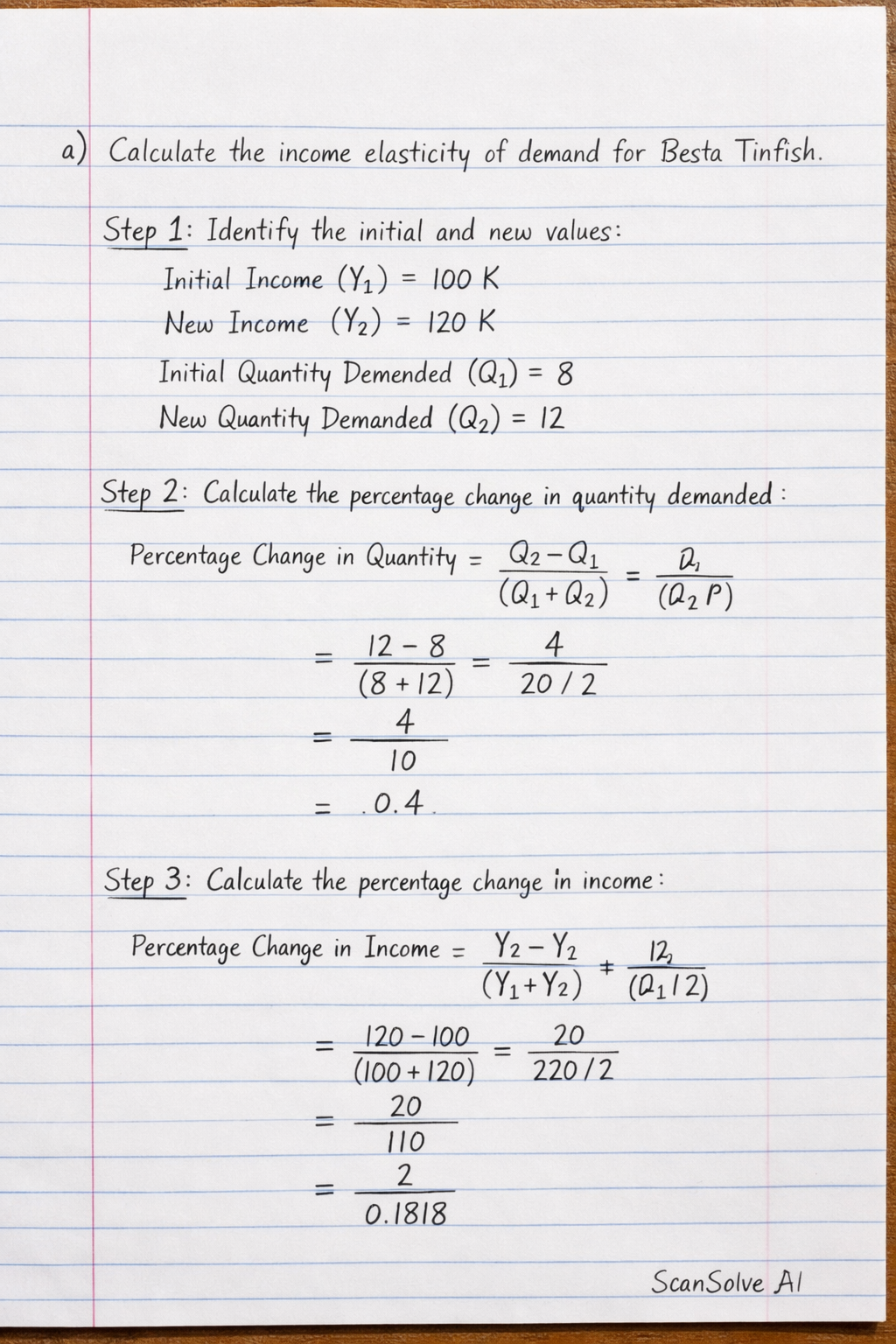
Calculate the income elasticity of demand for Besta Tinfish.
Identify the initial and new values for income and quantity demanded for Besta Tinfish.
Initial Income () = 100 K
New Income () = 120 K
Initial Quantity Demanded () = 8
New Quantity Demanded () = 12Calculate the percentage change in quantity demanded using the midpoint formula.
Calculate the percentage change in income using the midpoint formula.
Calculate the Income Elasticity of Demand (YED) for Besta Tinfish.
Since the YED is positive and greater than 1 (), Besta Tinfish is a luxury good (income elastic).
Part b· 4 steps
Calculate the income elasticity of demand for Jasmine rice.
Identify the initial and new values for income and quantity demanded for Jasmine rice.
Initial Income () = 100 K
New Income () = 120 K
Initial Quantity Demanded () = 10
New Quantity Demanded () = 11Calculate the percentage change in quantity demanded using the midpoint formula.
Calculate the percentage change in income using the midpoint formula.
Calculate the Income Elasticity of Demand (YED) for Jasmine rice.
Since the YED is positive and between 0 and 1 (), Jasmine rice is a necessity good (income inelastic).
Was this helpful?
Still stuck on this one?
Ask a follow-up, and the answer starts from this question.
Got a different question?Ask your own question
More Economics Questions
QFrom Table 2.1, Calculate: i. co-efficient of income. ii. what type of goods is garri to Mr…QIncome(Rs.) 200. 240. 280. 320 Quantity. 50. 80. 100. 110 Calculate the income elasticity of…QFrom Table 2.1, calculate the elasticity of supply between these points A and B, and D and E. State…QDifferentiate between 'cross elasticity of demand' and 'income elasticity of demand'.QExplain income elasticity of demand and cross elasticity of demand.
Browse by topic:Microeconomics
Handwritten Step-by-Step Solution
Get this as a handwritten image on WhatsApp — like a tutor wrote it for you.
Try on WhatsApp