
We read your photo as:
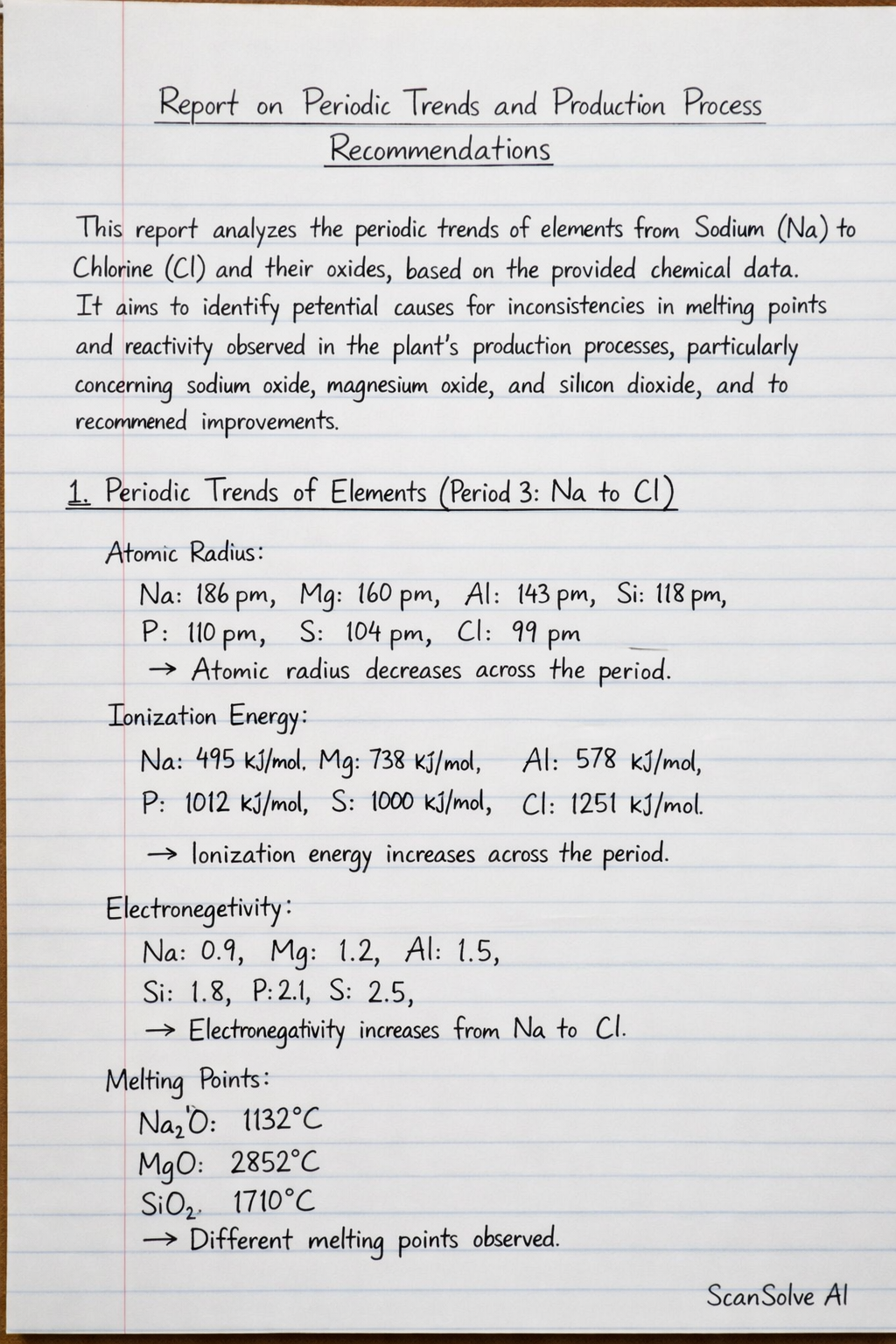
Report on Periodic Trends and Production Process Recommendations
ScanSolve AI Answer
Report on Periodic Trends and Production Process Recommendations
This report analyzes the periodic trends of elements from Sodium (Na) to Chlorine (Cl) and their oxides, based on the provided chemical data. It aims to identify potential causes for inconsistencies in melting points and reactivity observed in the plant's production processes, particularly concerning sodium oxide, magnesium oxide, and silicon dioxide, and to recommend improvements.
1. Periodic Trends of Elements (Period 3: Na to Cl)
- Atomic Radius: The atomic radius decreases across Period 3 from Na to Cl. This is due to an increasing nuclear charge (more protons) pulling the valence electrons closer to the nucleus, while the number of electron shells remains constant.
- Ionisation Energy: The first ionisation energy generally increases across Period 3. This trend is attributed to the increasing nuclear charge and decreasing atomic radius, which make it harder to remove an electron from the valence shell. Minor deviations occur, such as Aluminium having a lower ionisation energy than Magnesium, and Sulphur having a lower ionisation energy than Phosphorus, due to electron shielding and orbital stability effects.
- Melting Point of Elements:
- From Na to Al, melting points increase (Na: , Mg: , Al: ). These are metals with increasing strength of metallic bonding due to more delocalized electrons and smaller atomic size.
- Silicon (Si: ) has the highest melting point due to its giant covalent structure, requiring significant energy to break strong covalent bonds.
- From Phosphorus (P: ) to Chlorine (Cl: ), melting points decrease. These are non-metals with simple molecular structures (P, S, Cl). Their melting points depend on the weak intermolecular forces (van der Waals forces), which are much easier to overcome than metallic or covalent bonds.
2. Periodic Trends of Oxides (NaO to ClO)
- Melting Point and Structure of Oxides:
- Sodium oxide (NaO: ), Magnesium oxide (MgO: ), Aluminium oxide (AlO: ): These are ionic compounds with giant ionic lattice structures. They have very high melting points due to strong electrostatic forces between oppositely charged ions. MgO has a significantly higher melting point than NaO due to the higher charge density of Mg and O ions, leading to stronger ionic bonds.
- Silicon dioxide (SiO: ): This is a giant covalent structure, similar to silicon itself. It has a very high melting point because a large amount of energy is required to break the strong covalent bonds throughout the network.
- Phosphorus oxide (PO: ), Sulphur oxides (SO: Gas/Sublimes), Chlorine oxides (ClO: Gas/Gas): These are covalent molecular compounds with simple molecular structures. They have low melting points (or sublime/are gases at room temperature) because only weak intermolecular forces need to be overcome, not strong covalent bonds.
3. Implications for Plant Production
The plant uses sodium oxide, magnesium oxide, and silicon dioxide.
- Sodium oxide (NaO) and Magnesium oxide (MgO) are basic ionic oxides. MgO has a much higher melting point and is less reactive with water than NaO due to stronger ionic bonding.
- Silicon dioxide (SiO) is an acidic giant covalent oxide with a very high melting point and is largely unreactive with water.
Inconsistencies in melting points and reactivity could arise from:
- Impurities: Presence of other elements or compounds can disrupt crystal lattices or alter intermolecular forces, leading to varied melting points.
- Variations in Synthesis: Inconsistent reaction conditions (temperature, pressure, stoichiometry) can lead to products with different purities, crystal structures, or particle sizes, affecting their properties.
- Degradation/Reaction: Exposure to moisture or carbon dioxide during storage or processing can lead to the formation of hydroxides or carbonates, which have different melting points and reactivities than the pure oxides.
4. Recommendations for Production Processes
- Ensure Raw Material Purity: Implement strict quality control for raw materials (Na, Mg, Si) to minimize impurities that can affect the final oxide properties.
- Optimize Synthesis Conditions: Standardize and tightly control the synthesis parameters (temperature, pressure, atmosphere) for each oxide to ensure consistent purity, crystal structure, and desired physical properties.
- Controlled Storage and Handling: Store oxides in dry, inert atmospheres to prevent reaction with moisture or carbon dioxide, which can lead to degradation and altered properties.
- Implement Robust Quality Assurance: Regularly test the melting points, purity, and reactivity of the produced oxides using analytical techniques (e.g., X-ray diffraction, differential scanning calorimetry,
Still stuck on this one?
Ask a follow-up, and the answer starts from this question.
More Economics Questions
Handwritten Step-by-Step Solution
Get this as a handwritten image on WhatsApp — like a tutor wrote it for you.
Try on WhatsApp