

This economics question tests your understanding of economic models and analysis. The step-by-step answer below applies the relevant framework and explains the reasoning.
ScanSolve AI Answer
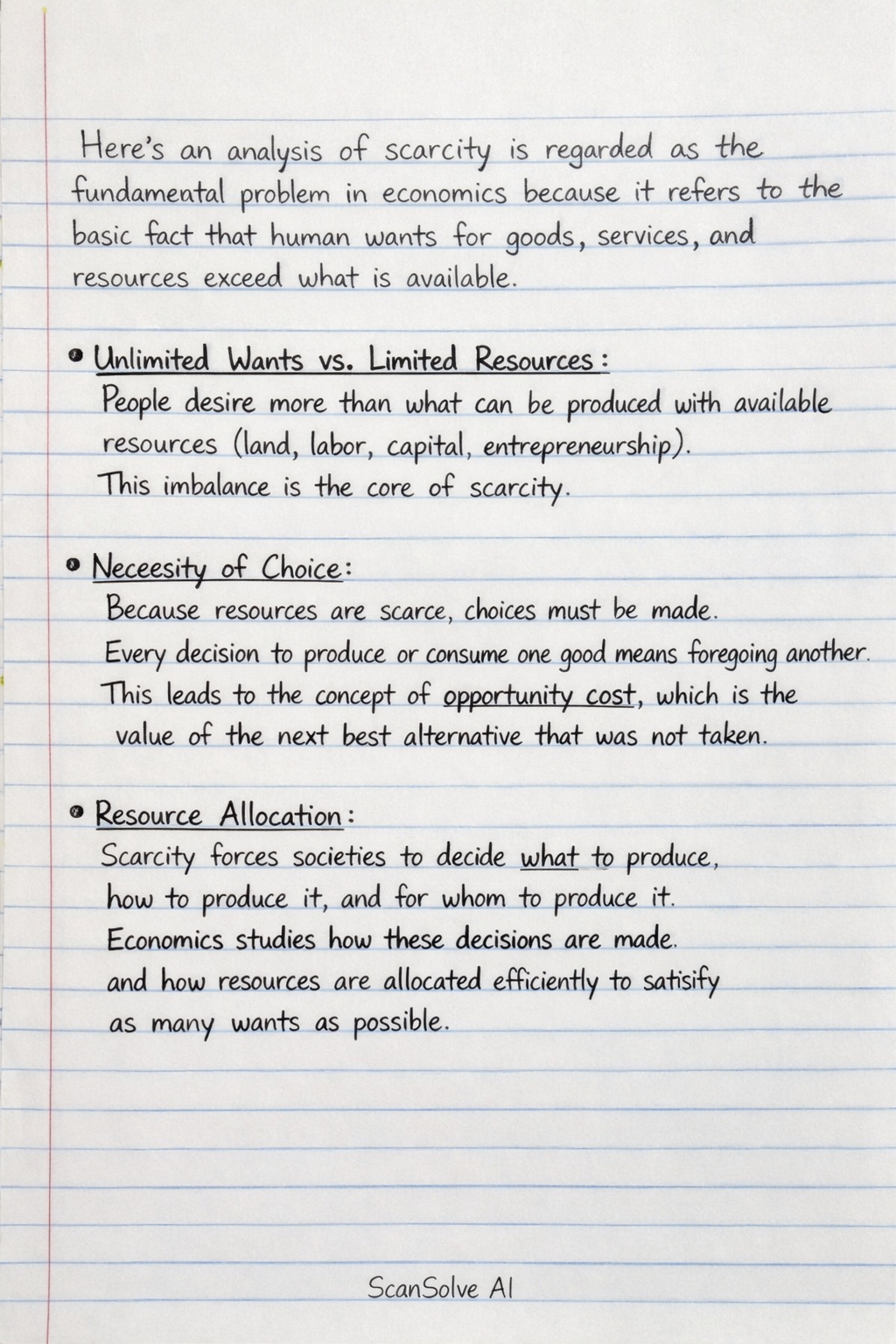
Scarcity is regarded as the fundamental problem in economics because it refers to the basic fact that human wants for goods, services, and resources exceed what is available. Unlimited Wants vs. Limited Resources: People desire more than what can be produced with the available resources (land, labor, capital, entrepreneurship). This imbalance is the core of scarcity. Necessity of Choice: Because resources are scarce, choices must be made. Every decision to produce or consume one good means foregoing another. This leads to the concept of opportunity cost*, which is the value of the next best alternative that was not taken. Resource Allocation: Scarcity forces societies to decide what to produce, how to produce it, and for whom* to produce it. Economics studies how these decisions are made and how resources are allocated efficiently to satisfy as many wants as possible. Foundation of Economic Study: Without scarcity, there would be no need for economics. If all resources were abundant and free, there would be no need to study how to manage them or make choices. Therefore, scarcity is the driving force behind all economic activity and analysis.