
We read your photo as:
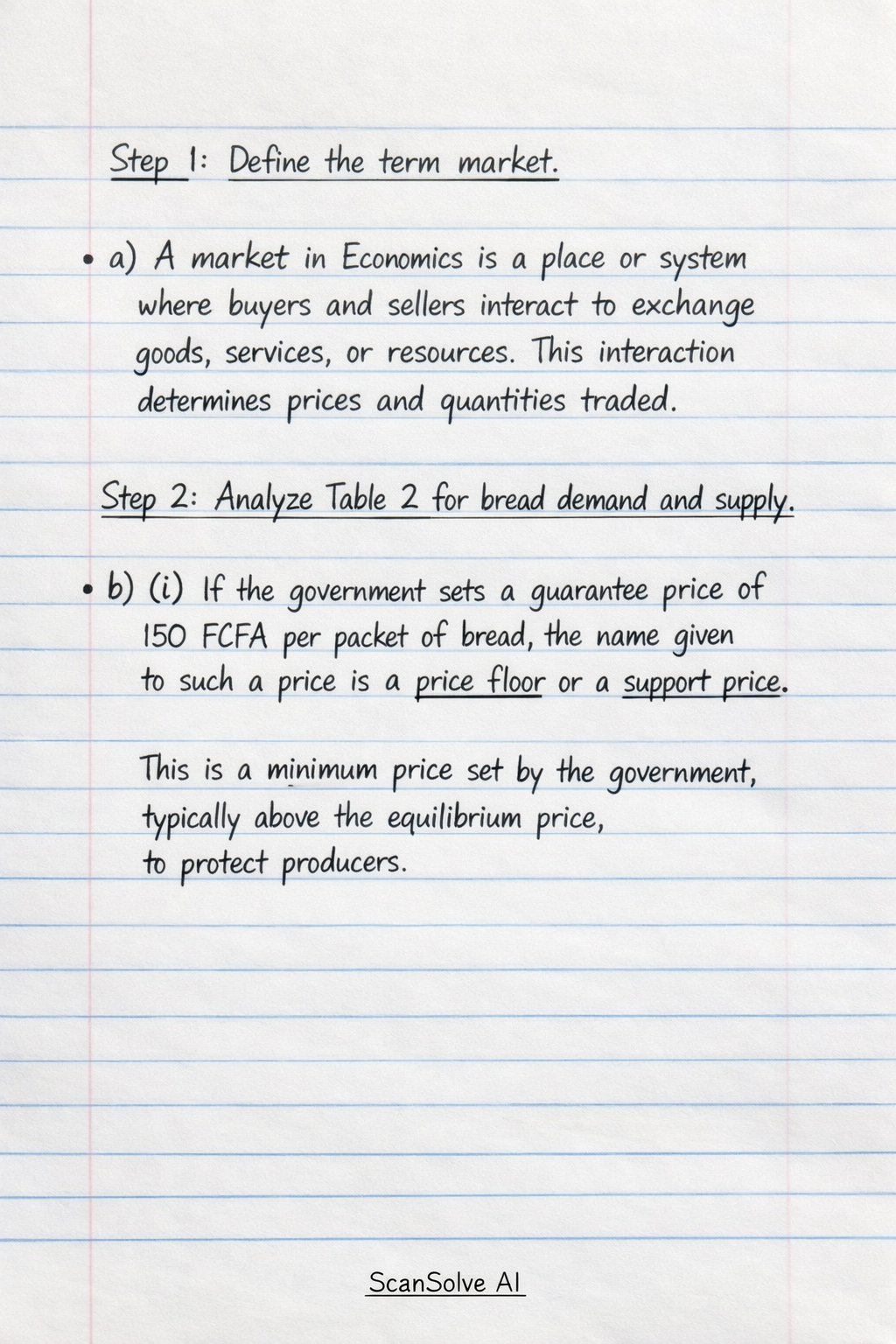
Define the term market.
ScanSolve AI Answer
Step-by-step solution
4 stepsDefine the term market.
- a) A market in Economics is a place or system where buyers and sellers interact to exchange goods, services, or resources. This interaction determines prices and quantities traded.
Analyze Table 2 for bread demand and supply.
-
b) (i) If the government sets a guarantee price of 150 FCFA per packet of bread, the name given to such a price is a price floor or a support price*. This is a minimum price set by the government, typically above the equilibrium price, to protect producers.
-
b) (ii) Calculate the costs to the government if it imposes a price of 300 FCFA per packet of bread and decides to buy the excess in the market. From Table 2, at a price of 300 FCFA: Quantity supplied = 400 packets Quantity demanded = 150 packets Excess supply = Quantity supplied - Quantity demanded
Cost to the government = Excess supply Price
-
b) (iii) Calculate the price elasticity of demand if the price of bread falls from 250 FCFA to 200 FCFA per packet and identify whether it is elastic or inelastic. Using the midpoint formula for Price Elasticity of Demand (PED):
From Table 2: At FCFA, packets. At FCFA, packets.
Change in Quantity () =
Change in Price () =
Average Quantity =
Average Price =The absolute value of PED is .
Since , the demand is elastic.
The final answer is
-
State and explain three factors which affect elasticity of supply.
- c) (i) Time Period: In the short run, supply tends to be inelastic because firms have limited ability to change their production capacity. In the long run, firms can adjust all factors of production, making supply more elastic.
- c) (ii) Availability of Inputs: If the raw materials and other factors of production required to produce a good are readily available and easily acquired, supply will be more elastic. If inputs are scarce or specialized, supply will be inelastic.
- c) (iii) Production Capacity/Spare Capacity: If a firm has significant spare capacity, it can easily increase output in response to a price rise, making supply more elastic. If it is operating at full capacity, supply will be inelastic.
Outline three functions of the retailer in the channel of distribution.
- d) (i) Breaking Bulk: Retailers purchase goods in large quantities from wholesalers or manufacturers and then sell them in smaller, more convenient units to individual consumers.
- d) (ii) Providing Variety: Retail
Still stuck on this one?
Ask a follow-up, and the answer starts from this question.
More Economics Questions
Handwritten Step-by-Step Solution
Get this as a handwritten image on WhatsApp — like a tutor wrote it for you.
Try on WhatsApp