
We read your photo as:
What are the answers to the following questions regarding Indian Planning Commission, monopoly, income distribution, zero-base budgeting, and a crop?
ScanSolve AI Answer
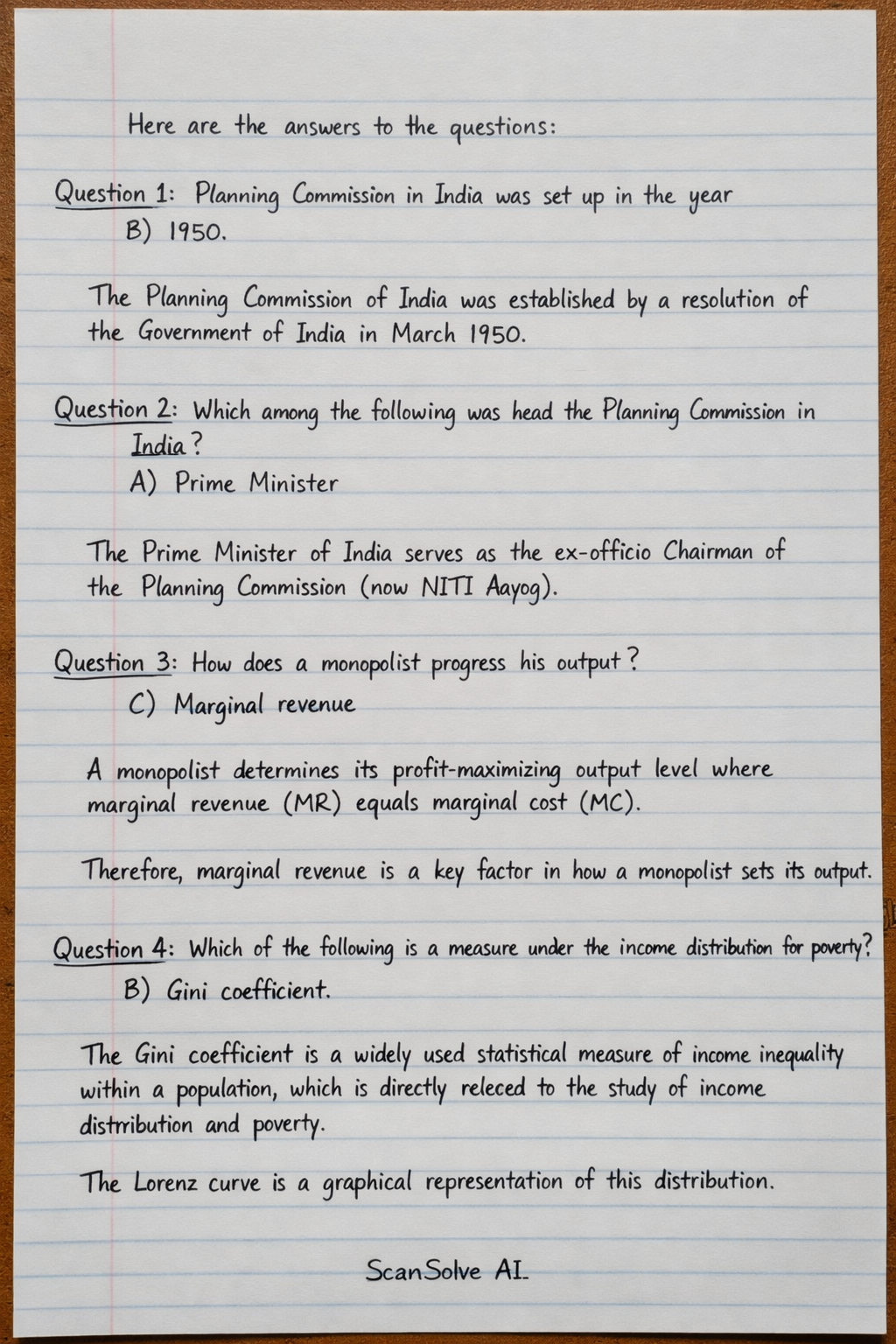
Here are the answers to the questions:
Question 1: Planning Commission in India was set up in the year
B) 1950
The Planning Commission of India was established by a resolution of the Government of India in March 1950.
Question 2: Which among the following was head the Planning Commission in India?
A) Prime Minister
The Prime Minister of India serves as the ex-officio Chairman of the Planning Commission (now NITI Aayog).
Question 3: How does a monopolist progress his output?
C) Marginal revenue
A monopolist determines its profit-maximizing output level where marginal revenue (MR) equals marginal cost (MC). Therefore, marginal revenue is a key factor in how a monopolist sets its output.
Question 4: Which of the following is a measure under the income distribution for poverty?
B) Gini coefficient
The Gini coefficient is a widely used statistical measure of income inequality within a population, which is directly related to the study of income distribution and poverty. The Lorenz curve is a graphical representation of this distribution.
Question 5: The concept of 'zero-base budgeting' was first introduced in
A) USA
Zero-base budgeting (ZBB) was developed in the United States by Peter Pyhrr at Texas Instruments in the late 1960s and later adopted by President Jimmy Carter for the federal budget.
Question 6: For which of the following crops does India have the largest cultivated area in the world?
D) Pulses
India holds the distinction of having the largest cultivated area for pulses globally, in addition to being the largest producer and consumer.
Question 7: One of the most fundamental strategies of economic growth is simply to increase the proportion of national income saved. This view is upheld in which of the following models?
A) Harrod-Domar Model
The Harrod-Domar model emphasizes that economic growth is directly dependent on the rate of saving and investment in an economy.
Question 8: Y = X^a K^b L^c. Which of the following economist used this equation in his growth model?
C) R. M. Solow
Robert Solow's neoclassical growth model (Solow-Swan model) extensively uses a production function, often a Cobb-Douglas type (similar to the one shown, though the 'X' variable is unusual), to explain how capital, labor, and technology contribute to economic growth.
Question 9: Econometric models by definition are
C) Stochastic
Econometric models are inherently stochastic because they include a random error term to account for unobserved factors, measurement errors, and the inherent unpredictability in economic relationships.
Still stuck on this one?
Ask a follow-up, and the answer starts from this question.
More Economics Questions
Handwritten Step-by-Step Solution
Get this as a handwritten image on WhatsApp — like a tutor wrote it for you.
Try on WhatsApp