
We read your photo as:
What is the difference between TU and MU? Determine the consumers equilibrium position.
ScanSolve AI Answer
This answer stops before the end.
It was cut off when it was first written. Ask ScanSolve this question again for the full working.
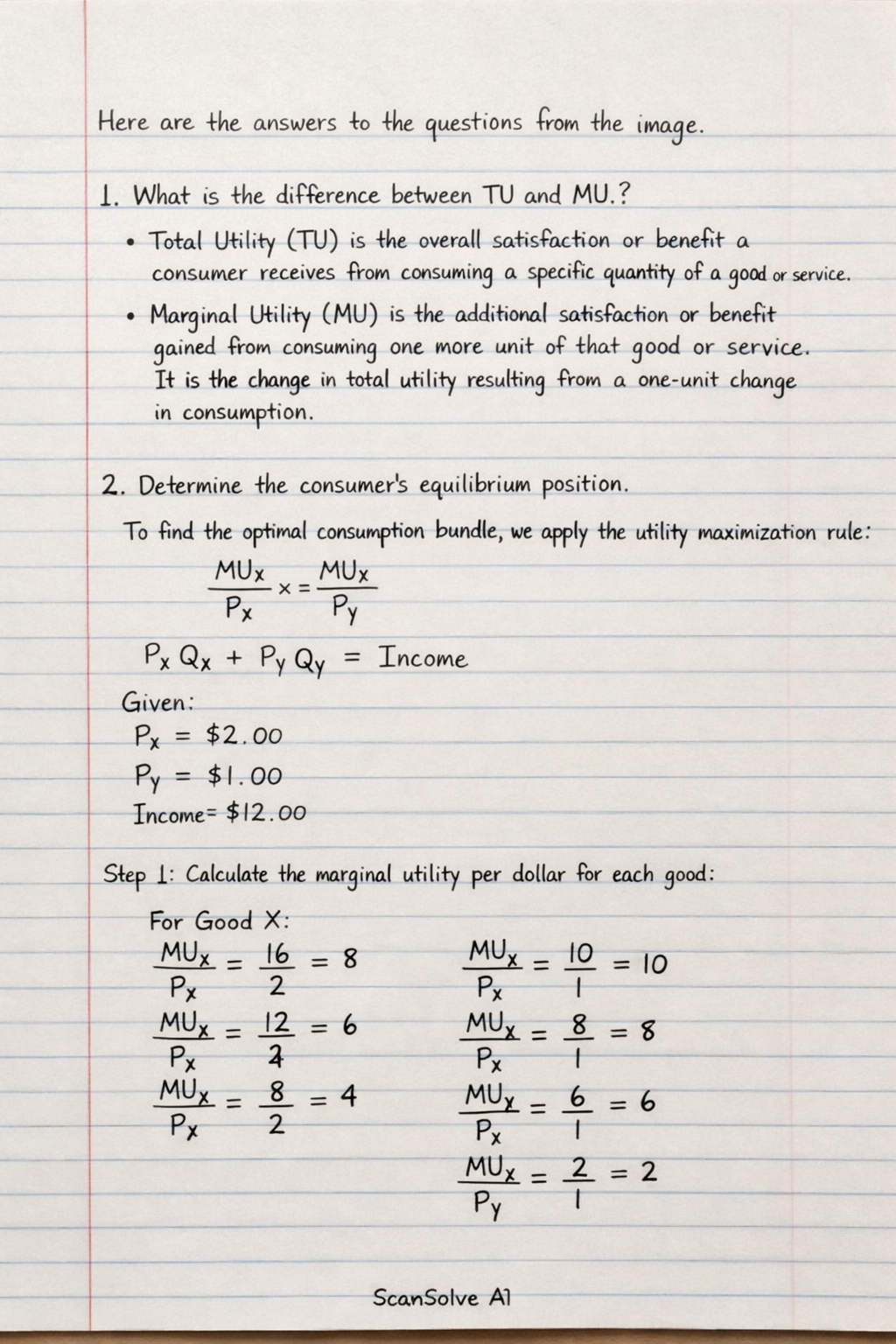
Here are the answers to the questions from the image.
1. What is the difference between TU and MU?
- Total Utility (TU) is the overall satisfaction or benefit a consumer receives from consuming a specific quantity of a good or service.
- Marginal Utility (MU) is the additional satisfaction or benefit gained from consuming one more unit of that good or service. It is the change in total utility resulting from a one-unit change in consumption.
2. Determine the consumer's equilibrium position.
To find the optimal consumption bundle, we apply the utility maximization rule: and .
Given:
P_x = \2.00P_y = $1.00= $12.00$
Step 1: Calculate the marginal utility per dollar for each good.
| Q | \frac{MU_x}{P_x} = \frac{MU_x}{\2}$ | \frac{MU_y}{P_y} = \frac{MU_y}{\1}$ | ||
|---|---|---|---|---|
| 1 | 16 | 11 | ||
| 2 | 14 | 10 | ||
| 3 | 12 | 9 | ||
| 4 | 10 | 8 | ||
| 5 | 8 | 7 | ||
| 6 | 6 | 6 | ||
| 7 | 4 | 5 | ||
| 8 | 2 | 4 |
Step 2: Allocate income to maximize utility. We purchase units that give the highest $MU/$$.
- Buy 1 Y (). Cost:
1 \times \1 = $1$11Q_x=0, Q_y=1$) - Buy 1 Y (). Cost:
1 \times \1 = $1$10Q_x=0, Q_y=2$) - Buy 1 Y (). Cost:
1 \times \1 = $1$9Q_x=0, Q_y=3$) - Now, for is 8, and for is 8. We can buy one of each.
- Buy 1 X (). Cost:
1 \times \2 = $2$7Q_x=1, Q_y=3$) - Buy 1 Y (). Cost:
1 \times \1 = $1$6Q_x=1, Q_y=4$)
- Buy 1 X (). Cost:
- Next, for is 7, and for is 7.
- Buy 1 X (). Cost:
1 \times \2 = $2$4Q_x=2, Q_y=4$) - Buy 1 Y (). Cost:
1 \times \1 = $1$3Q_x=2, Q_y=5$)
- Buy 1 X (). Cost:
- Finally, for is 6, and for is 6.
- Buy 1 X (). Cost:
1 \times \2 = $2$1Q_x=3, Q_y=5$) - Buy 1 Y (). Cost:
1 \times \1 = $1$0Q_x=3, Q_y=6$)
- Buy 1 X (). Cost:
Step 3: Verify the conditions for the optimal bundle ().
- Budget Constraint: The total expenditure matches the income.
- Equimarginal Principle: For , . For , . The principle is satisfied.
The optimal consumption bundle is:
Still stuck on this one?
Ask a follow-up, and the answer starts from this question.
More Economics Questions
Handwritten Step-by-Step Solution
Get this as a handwritten image on WhatsApp — like a tutor wrote it for you.
Try on WhatsApp