

This economics question tests your understanding of economic models and analysis. The step-by-step answer below applies the relevant framework and explains the reasoning.
ScanSolve AI Answer
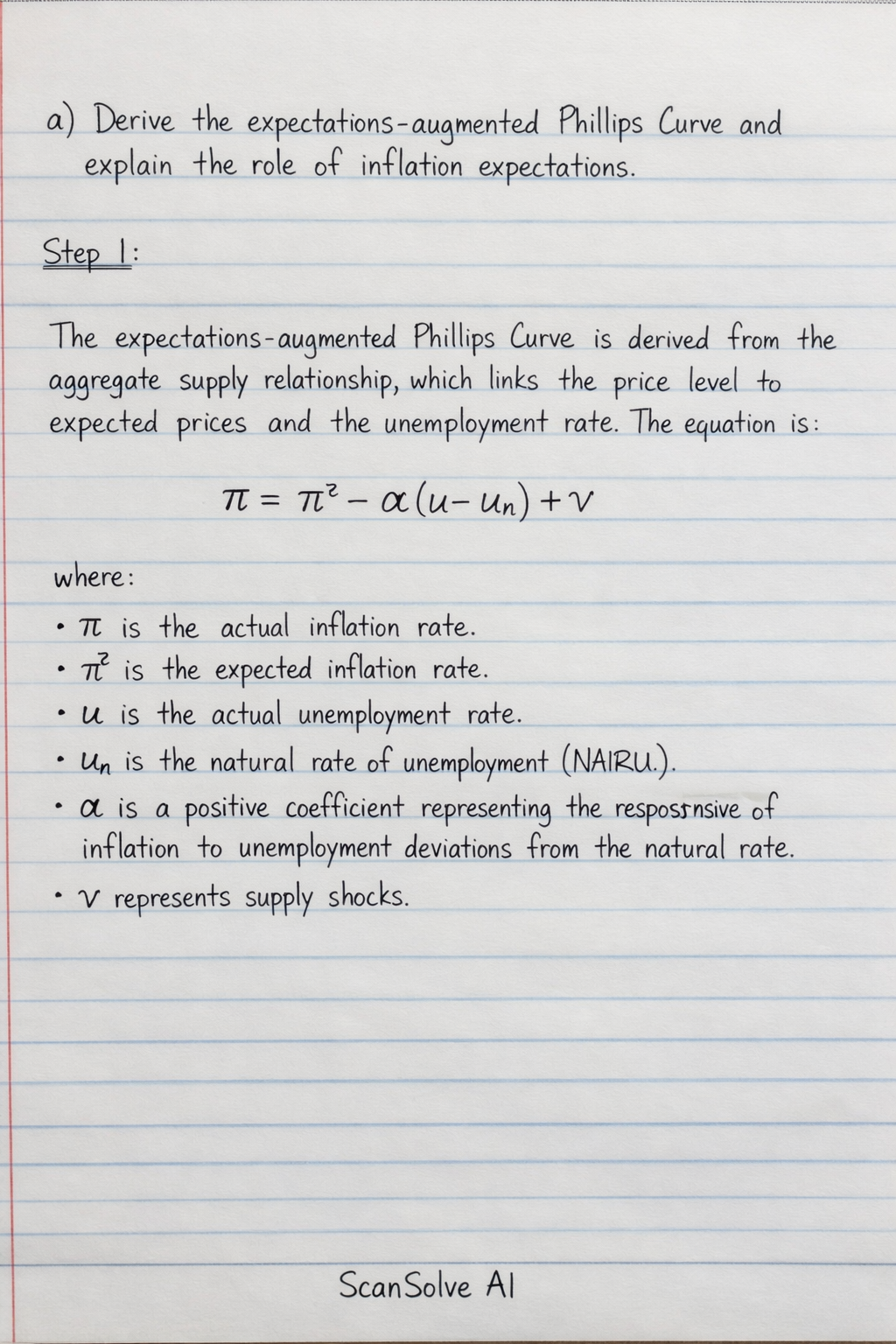
a) Derive the expectations-augmented Phillips Curve and explain the role of inflation expectations. Step 1: The expectations-augmented Phillips Curve is derived from the aggregate supply relationship, which links the price level to expected prices and the unemployment rate. The equation is: = ^e - (u - u_n) + where: • is the actual inflation rate. • ^e is the expected inflation rate. • u is the actual unemployment rate. • u_n is the natural rate of unemployment (NAIRU). • is a positive coefficient representing the responsiveness of inflation to unemployment deviations from the natural rate. • represents supply shocks. Step 2: Explain the role of inflation expectations in the short-run trade-off. In the short run, inflation expectations (^e) are often fixed or adjust slowly. If policymakers try to reduce unemployment below u_n through expansionary policies, actual inflation () will rise. As long as ^e remains constant, there is a downward-sloping short-run Phillips Curve, indicating a trade-off: lower unemployment comes at the cost of higher inflation. Step 3: Explain the role of inflation expectations in the long-run trade-off. In the long run, people's inflation expectations fully adjust to actual inflation, meaning = ^e. When this occurs, the expectations-augmented Phillips Curve equation simplifies to: 0 = -(u - u_n) This implies that u = u_n. Therefore, in the long run, there is no trade-off between inflation and unemployment. The long-run Phillips Curve is vertical at the natural rate of unemployment (NAIRU). Any attempt to permanently keep unemployment below NAIRU by increasing inflation will only lead to accelerating inflation as expectations continuously adjust upwards. b) Analyse the effects of an unanticipated expansionary monetary policy using NAIRU and adaptive/rational expectations. Step 1: Define NAIRU. The NAIRU (Non-Accelerating Inflation Rate of Unemployment) is the unemployment rate at which inflation remains stable, neither accelerating nor decelerating. It represents the economy's natural rate of unemployment, determined by structural factors in the labor market. Step 2: Analyse effects under adaptive expectations. • Short Run: With adaptive expectations, people form their inflation expectations based on past inflation. An unanticipated expansionary monetary policy increases aggregate demand, leading to higher output and lower unemployment (below NAIRU). This also causes actual inflation to rise. Since the policy was unanticipated, expected inflation does not immediately adjust, so > ^e. This creates a temporary short-run trade-off, moving the economy along the existing short-run Phillips Curve. • Long Run: As actual inflation persists, people's adaptive expectations gradually adjust upwards. This causes the short-run Phillips Curve to shift upwards. To maintain the lower unemployment rate, even higher inflation would be required. Eventually, expectations catch up to actual inflation ( = ^e), and unemployment returns to the NAIRU, but at a permanently higher inflation rate. Step 3: Analyse effects under rational expectations. • Short Run: With rational expectations, people use all available information to form their expectations. If an expansionary monetary policy is truly unanticipated, agents are initially surprised. The increase in aggregate demand leads to a temporary rise in output and a fall in unemployment (below NAIRU), accompanied by higher actual inflation. This short-run effect is brief because agents quickly update their expectations. • Long Run: Under rational expectations, agents quickly learn and incorporate the new policy into their expectations. If the policy is sustained, they will anticipate future inflation. As soon as they anticipate higher inflation, their expectations adjust immediately and fully. This causes the short-run Phillips Curve to shift upwards very rapidly. Consequently, the unemployment rate quickly returns to the NAIRU, but at a higher inflation rate. The period of unemployment being below NAIRU is very brief, or even negligible, as expectations adjust almost instantly.