
This economics question tests your understanding of economic models and analysis. The step-by-step answer below applies the relevant framework and explains the reasoning.
ScanSolve AI Answer
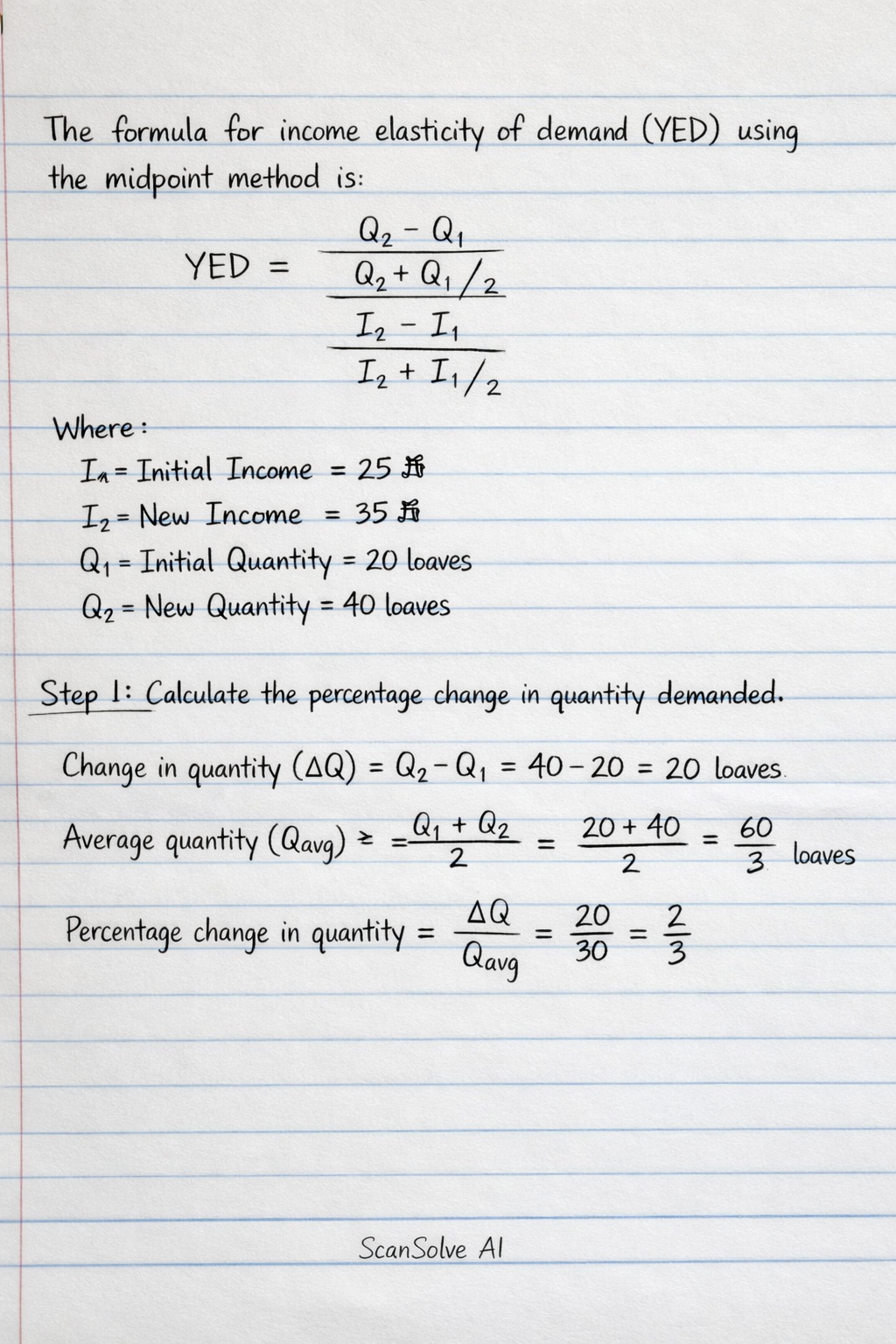
This question involves calculating the elasticity of demand based on changes in income and quantity. We will assume that "price increase to 35" refers to the policeman's salary (income) increasing from 25 ♌ to 35 ♌, as the initial 25 ♌ is stated as "monthly salary". Therefore, we are calculating the income elasticity of demand. The formula for income elasticity of demand (YED) using the midpoint method is: YED = (Q_2 - Q_1)/((Q_2 + Q_1)/2)(I_2 - I_1)/((I_2 + I_1)/2) Where: I_1 = Initial Income = 25 ♌ I_2 = New Income = 35 ♌ Q_1 = Initial Quantity = 20 loaves Q_2 = New Quantity = 40 loaves Step 1: Calculate the percentage change in quantity demanded. Change in quantity ( Q) = Q_2 - Q_1 = 40 - 20 = 20 loaves Average quantity (Q_avg) = (Q_1 + Q_2)/(2) = (20 + 40)/(2) = (60)/(2) = 30 loaves Percentage change in quantity = ( Q)/(Q_avg) = (20)/(30) = (2)/(3) Step 2: Calculate the percentage change in income. Change in income ( I) = I_2 - I_1 = 35 - 25 = 10 ♌ Average income (I_avg) = (I_1 + I_2)/(2) = (25 + 35)/(2) = (60)/(2) = 30 ♌ Percentage change in income = ( I)/(I_avg) = (10)/(30) = (1)/(3) Step 3: Calculate the Income Elasticity of Demand. YED = Percentage change in quantityPercentage change in income YED = (2)/(3)(1)/(3) YED = (2)/(3) × (3)/(1) YED = 2 The value of the income elasticity of demand is 2. 2 Last free one today — make it count tomorrow, or type /upgrade for unlimited.