
We read your photo as:
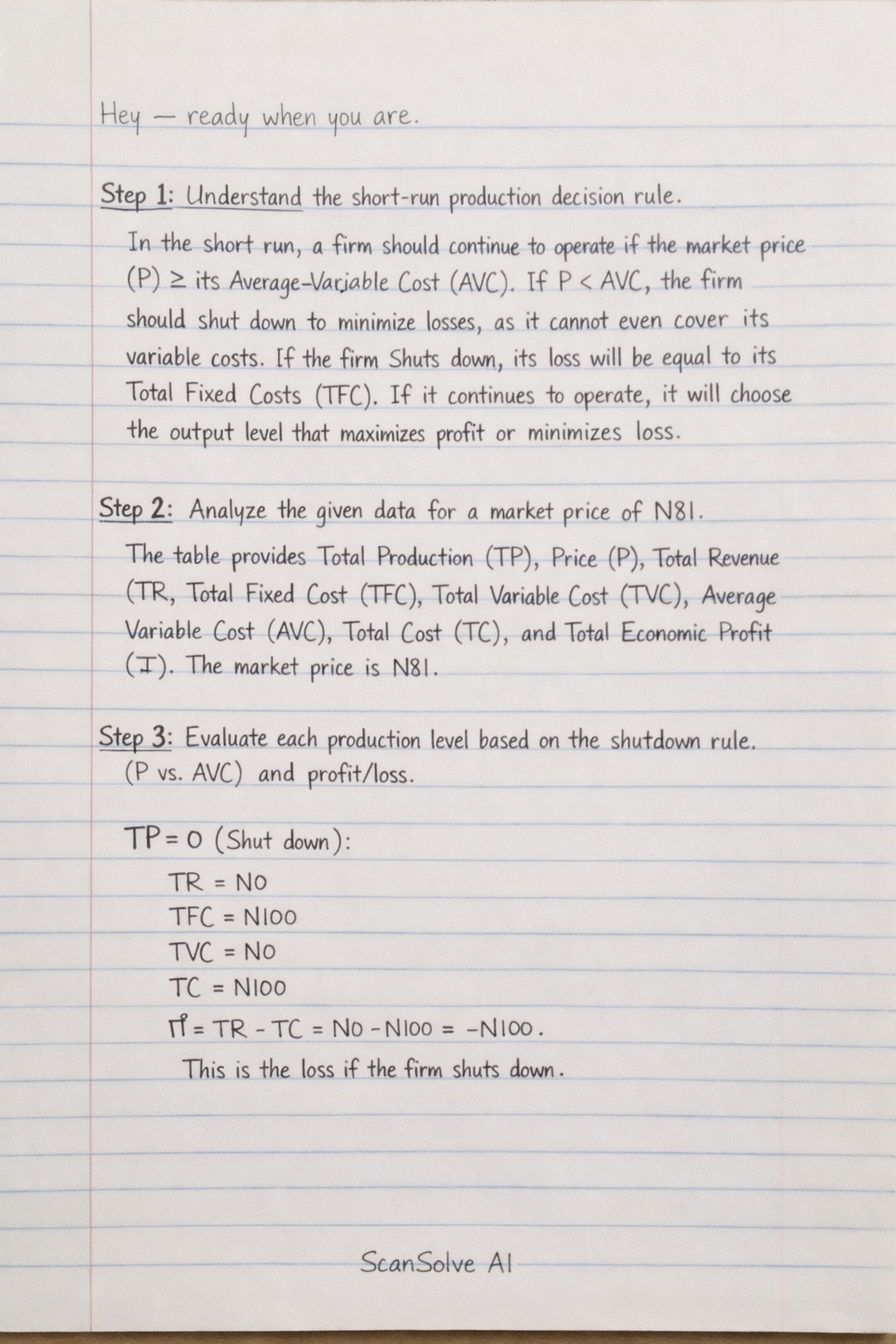
Understand the short-run production decision rule.
ScanSolve AI Answer
Answer
Step-by-step solution
4 stepsUnderstand the short-run production decision rule.
In the short run, a firm should continue to operate if the market price (P) is greater than or equal to its average variable cost (AVC). If P is less than AVC, the firm should shut down to minimize losses, as it cannot even cover its variable costs. If the firm shuts down, its loss will be equal to its total fixed costs (TFC). If it continues to operate, it will choose the output level that maximizes profit or minimizes loss.
Analyze the given data for a market price of N81.
The table provides Total Production (TP), Price (P), Total Revenue (TR), Total Fixed Cost (TFC), Total Variable Cost (TVC), Average Variable Cost (AVC), Total Cost (TC), and Total Economic Profit (). The market price is N81.
Evaluate each production level based on the shutdown rule (P vs. AVC) and profit/loss.
-
TP = 0 (Shut down):
- TR = N0
- TFC = N100
- TVC = N0
- TC = N100
- = TR - TC = N0 - N100 = -N100. This is the loss if the firm shuts down.
-
TP = 1: P = N81, AVC = N90. Since P < AVC (N81 < N90), the firm should not produce at this level. = -N109.
-
TP = 2: P = N81, AVC = N85. Since P < AVC (N81 < N85), the firm should not produce at this level. = -N108.
-
TP = 3: P = N81, AVC = N80. Since P > AVC (N81 > N80), the firm can produce. = -N97.
-
TP = 4: P = N81, AVC = N75. Since P > AVC (N81 > N75), the firm can produce. = -N76.
-
TP = 5: P = N81, AVC = N74. Since P > AVC (N81 > N74), the firm can produce. = -N65.
-
TP = 6: P = N81, AVC = N75. Since P > AVC (N81 > N75), the firm can produce. = -N64.
-
TP = 7: P = N81, AVC = N77. Since P > AVC (N81 > N77), the firm can produce. = -N73.
-
TP = 8: P = N81, AVC = N81.25. Since P < AVC (N81 < N81.25), the firm should not produce at this level. = -N102.
-
TP = 9: P = N81, AVC = N87. Since P < AVC (N81 < N87), the firm should not produce at this level. = -N151.
-
TP = 10: P = N81, AVC = N93. Since P < AVC (N81 < N93), the firm should not produce at this level. = -N220.
-
Determine the optimal production decision.
The firm aims to minimize its losses. We compare the losses from all viable production levels (where P AVC) and the loss from shutting down (TP=0).
- Loss if shut down (TP=0): -N100
- Loss at TP=3: -N97
- Loss at TP=4: -N76
- Loss at TP=5: -N65
- Loss at TP=6: -N64
- Loss at TP=7: -N73
The smallest loss (or highest profit, in this case, the least negative value) is -N64, which occurs at a production level of 6 units. At this output, P (N81) is greater than AVC (N75), so continuing production is the correct decision.
The firm should continue operating because at the optimal output level (6 units), the price (N81) is greater than the average variable cost (N75). The condition for continuing operation is P AVC. The condition for shutting down is P < AVC.
The production decision for Ebuka's Cement when the market price falls to N81 is to produce 6 units.
The final answer is .
Try one yourself
A new problem that tests the same skill.
Still stuck on this one?
Ask a follow-up, and the answer starts from this question.
More Economics Questions
Handwritten Step-by-Step Solution
Get this as a handwritten image on WhatsApp — like a tutor wrote it for you.
Try on WhatsApp