

This mathematics problem involves applying core mathematical principles and formulas. Below you will find a complete step-by-step solution with detailed explanations for each step, helping you understand not just the answer but the method behind it.
ScanSolve AI Answer
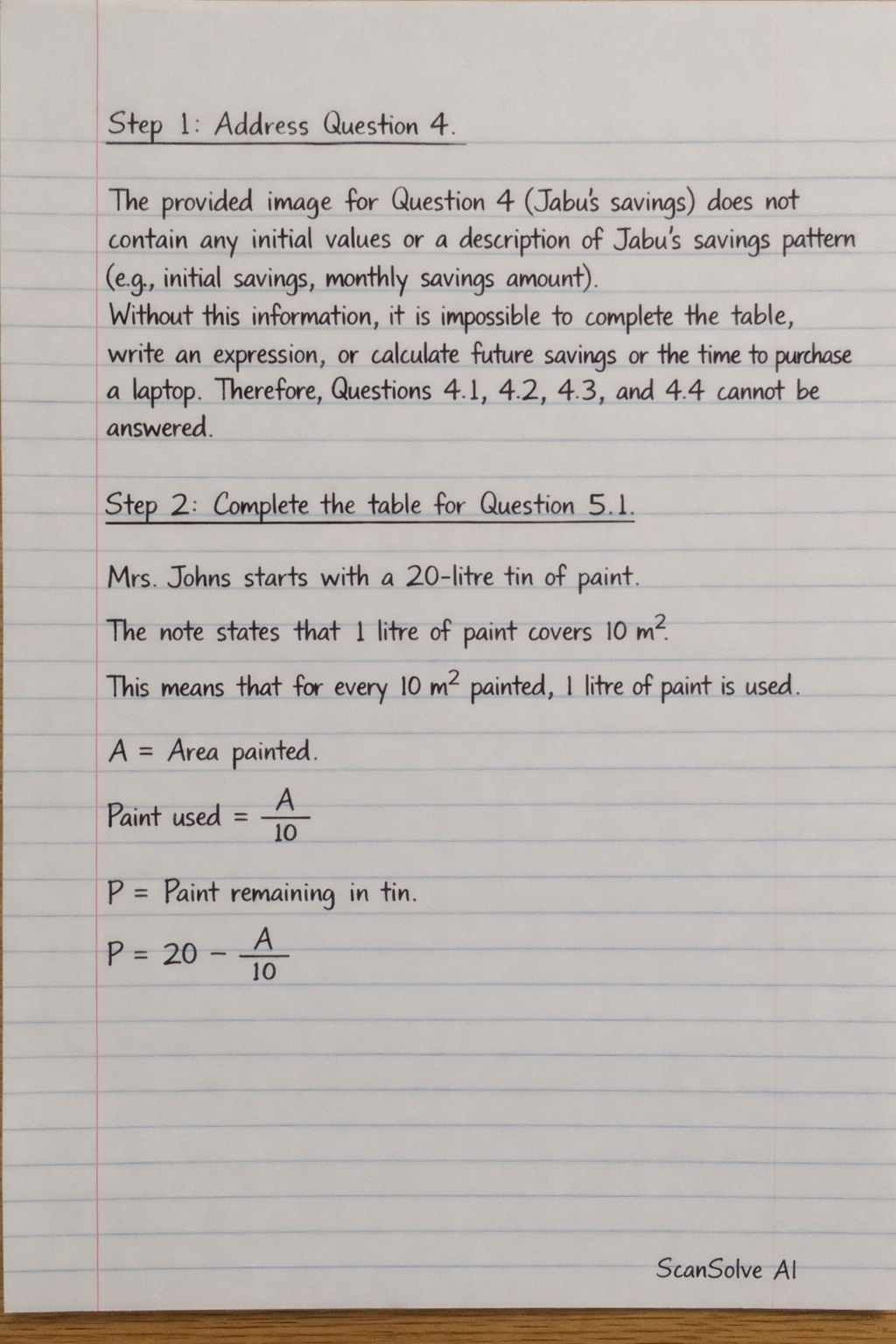
Step 1: Address Question 4. The provided image for Question 4 (Jabu's savings) does not contain any initial values or a description of Jabu's savings pattern (e.g., initial savings, monthly savings amount). Without this information, it is impossible to complete the table, write an expression, or calculate future savings or the time to purchase a laptop. Therefore, Questions 4.1, 4.2, 4.3, and 4.4 cannot be answered. Step 2: Complete the table for Question 5.1. Mrs. Johns starts with a 20-litre tin of paint. The note states that 1 litre of paint covers 10 m^2. This means that for every 10 m^2 painted, 1 litre of paint is used. The amount of paint used for an area A is (A)/(10) litres. The paint remaining in the tin (P) is 20 - (A)/(10). Let's calculate the paint remaining for each given area: • Area painted = 0 m^2: P = 20 - (0)/(10) = 20 - 0 = 20 litres. (Given) • Area painted = 20 m^2: P = 20 - (20)/(10) = 20 - 2 = 18 litres. • Area painted = 35 m^2: P = 20 - (35)/(10) = 20 - 3.5 = 16.5 litres. • Area painted = 50 m^2: P = 20 - (50)/(10) = 20 - 5 = 15 litres. • Area painted = 75 m^2: P = 20 - (75)/(10) = 20 - 7.5 = 12.5 litres. The completed table is: | Area painted (m^2) | 0 | 20 | 35 | 50 | 75 | | :-------------------- | :-: | :-: | :--: | :-: | :--: | | Paint remaining in the tin (litres) | 20 | 18 | 16.5 | 15 | 12.5 | Step 3: Answer Question 5.2. The relationship between the area painted and the amount of paint remaining in the tin is linear and inversely proportional. As the area painted increases, the amount of paint remaining in the tin decreases at a constant rate. Specifically, for every 10 m^2 painted, 1 litre of paint is used, causing the remaining paint to decrease by 1 litre. Step 4: Answer Question 5.3. To draw a graph of area painted against the amount of paint remaining, you would plot the following points: • (0, 20) • (20, 18) • (35, 16.5) • (50, 15) • (75, 12.5) The x-axis would represent "Area painted (m^2)" and the y-axis would represent "Paint remaining in the tin (litres)". The graph would be a straight line sloping downwards from (0, 20) to (200, 0), where 200 m^2 is the total area that can be painted with 20 litres of paint. Step 5: Answer Question 5.4. One reason why walls need to be painted is for aesthetic improvement, to enhance the appearance of a room or building, change its color, or refresh its look. Another reason is for protection, to shield the wall surface from wear and tear, moisture, dirt, and minor damage.