
We read your photo as:
Hey scan help me with answers to this qestion but put the answers in english
ScanSolve AI Answer
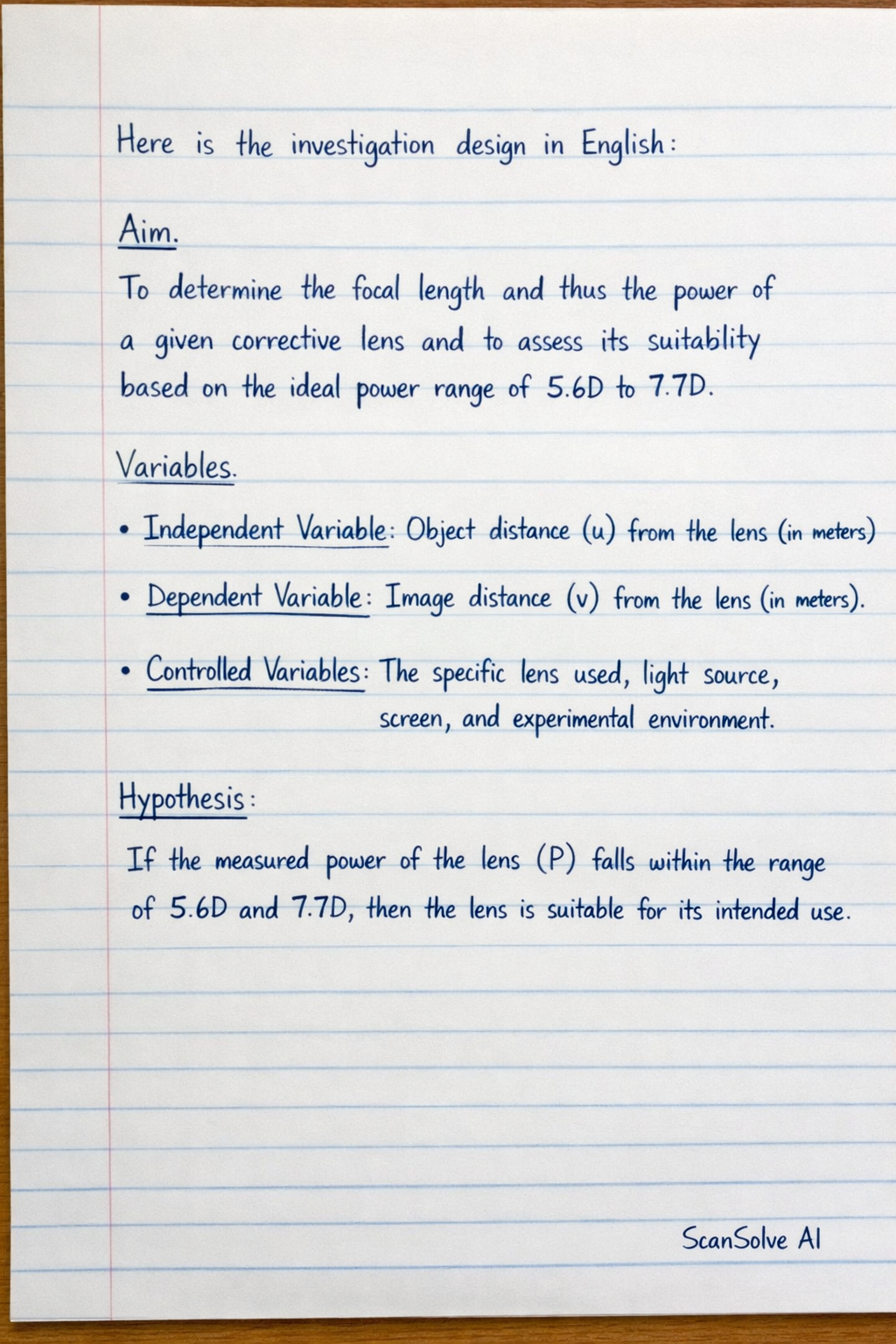
Here is the investigation design in English:
Aim
To determine the focal length and thus the power of a given corrective lens and to assess its suitability based on the ideal power range of 5.6D to 7.7D.
Variables
- Independent Variable: Object distance () from the lens (in meters).
- Dependent Variable: Image distance () from the lens (in meters).
- Controlled Variables: The specific lens used, light source, screen, and experimental environment.
Hypothesis
If the measured power of the lens () falls within the range of 5.6D and 7.7D, then the lens is suitable for its intended use.
Procedure
- Set up an optical bench on a flat table.
- Place a light source (such as a candle or a lamp with a cross-wire) at one end of the bench.
- Position the corrective lens in the middle of the bench.
- Place a screen on the other side of the lens.
- Adjust the object distance () by moving the light source.
- Move the screen until a sharp and clear image is formed. Measure the image distance ().
- Repeat steps 5 and 6 for at least 5 different sets of data, varying the object distance ().
- Record all data in a table.
Possible Sources of Error
- Parallax errors when reading distance measurements.
- Uncertainty in determining the sharpest image.
- The lens might not be perfectly perpendicular to the optical bench.
Precautions
- Ensure the lens is mounted vertically and centrally on the optical bench.
- Take distance measurements from the optical center of the lens.
- Use a bright light source with a distinct cross-wire to obtain a clear image.
- Avoid parallax errors by reading measurements with the eye level with the mark.
Data Presentation
The data will be presented in the following table:
| Experiment | (m) | (m) | (m) | (m) |
|---|---|---|---|---|
| 1 | ||||
| 2 | ||||
| 3 | ||||
| 4 | ||||
| 5 |
Data Analysis
- Plot a graph of against .
- From the lens formula, , we can rearrange it as .
- The graph will be a straight line. Determine the y-intercept or x-intercept. The value of the intercept will give .
- From the value of , calculate the focal length () and then the power of the lens () using the formula: Where is in meters and is in diopters (D).
Advice/Recommendation
Compare the calculated power of the lens () with the given ideal range (5.6D to 7.7D).
- If , then the lens is suitable for its intended use.
- If or , then the lens is not suitable for its intended use.
- Provide advice to the learners based on these findings.
Still stuck on this one?
Ask a follow-up, and the answer starts from this question.
More English Questions
Handwritten Step-by-Step Solution
Get this as a handwritten image on WhatsApp — like a tutor wrote it for you.
Try on WhatsApp