
I want the explanation in English
ScanSolve AI Answer
Step-by-step solution
3 stepsHere's how the trigonometric values for , , and are derived using special right-angled triangles.
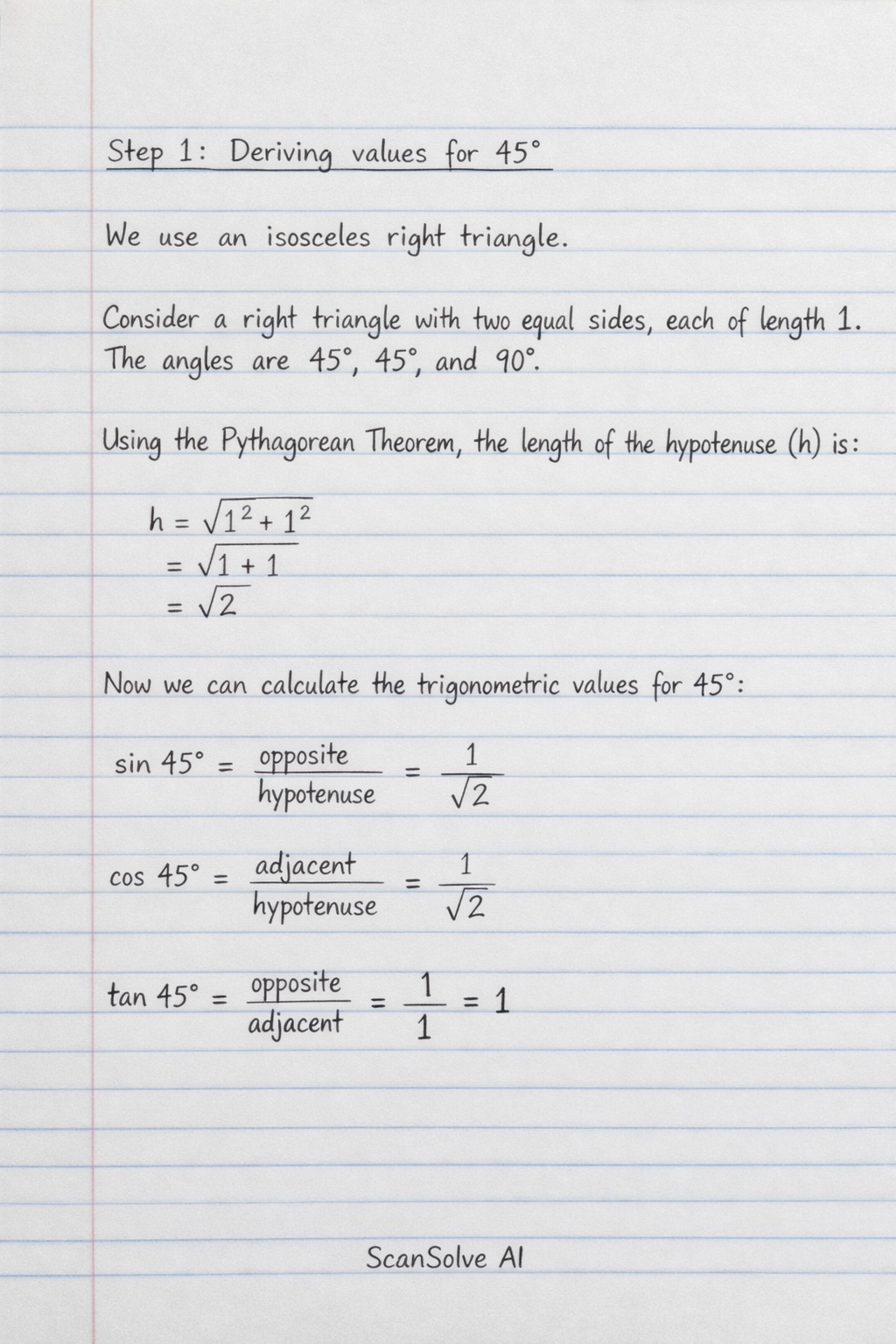
Deriving values for
We use an isosceles right-angled triangle.
Consider a right-angled triangle with two equal sides, each of length 1. The angles will be , , and .
Using the Pythagorean Theorem, the length of the hypotenuse () is:Now we can calculate the trigonometric values for :
Deriving values for and
We use an equilateral triangle with side lengths of 2. All angles are .
Draw an altitude from one vertex to the midpoint of the opposite side. This altitude bisects the top angle and the base, creating two right-angled triangles.
In each right-angled triangle:- The hypotenuse is 2.
- The side opposite the angle (or adjacent to the angle) is 1 (half of the equilateral triangle's side).
- Using the Pythagorean Theorem, the length of the side opposite the angle (or adjacent to the angle) is :
Calculating values for and
For the angle:
- Opposite side is 1.
- Adjacent side is .
- Hypotenuse is 2.
For the angle:
- Opposite side is .
- Adjacent side is 1.
- Hypotenuse is 2.
These derivations show how the standard trigonometric values for these special angles are obtained using basic geometry and the Pythagorean Theorem.
Still stuck on this one?
Ask a follow-up, and the answer starts from this question.
More English Questions
Handwritten Step-by-Step Solution
Get this as a handwritten image on WhatsApp — like a tutor wrote it for you.
Try on WhatsApp