

This chemistry question involves key chemical concepts and calculations. The detailed solution below walks through each step, from identifying the reaction type to computing the final answer.
ScanSolve AI Answer
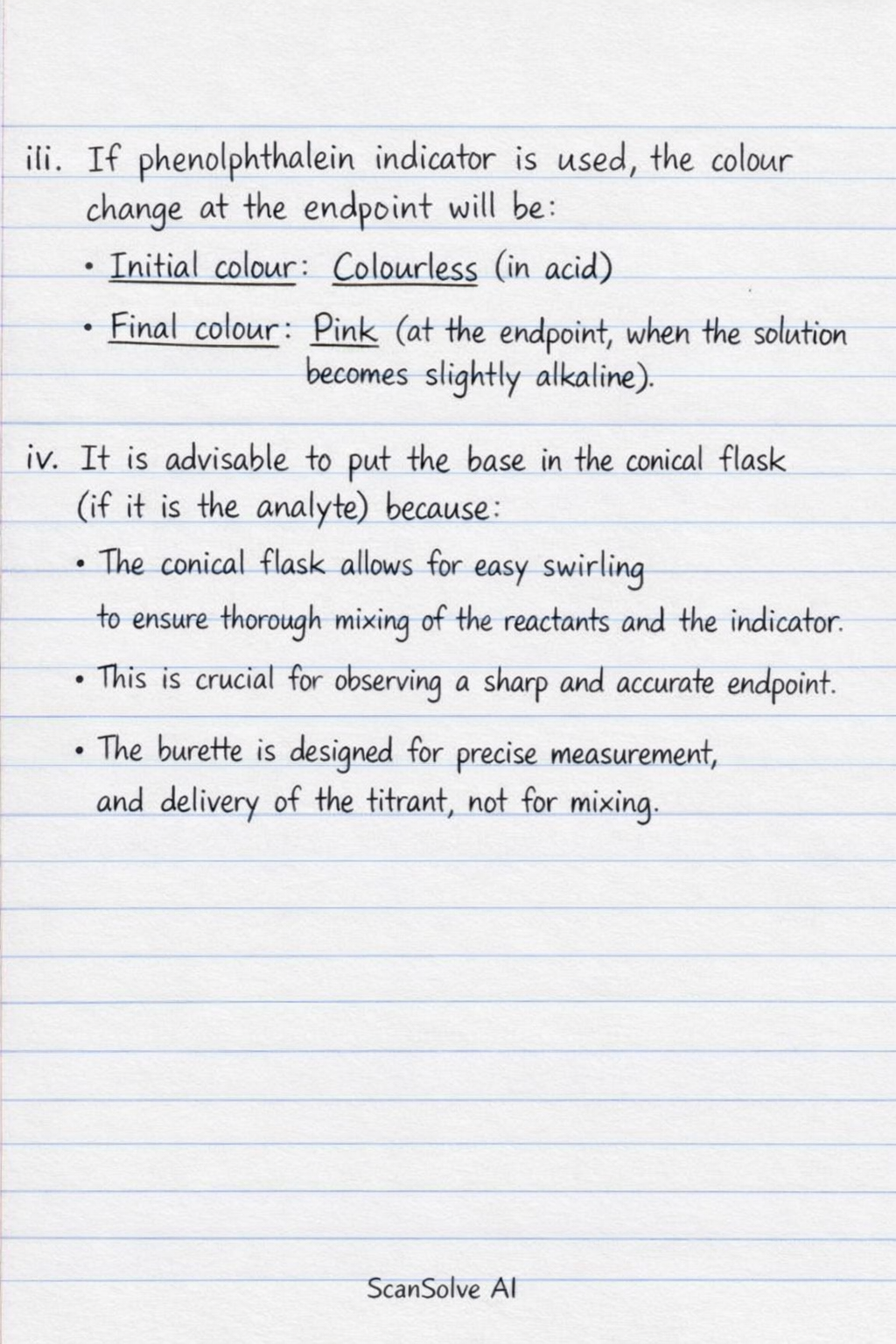
iii. If phenolphthalein indicator is used, the colour change at the endpoint of the reaction will be: Initial colour: Colourless* (in acid) Final colour: Pink* (at the endpoint, when the solution becomes slightly alkaline) iv. It is advisable to put the base in the conical flask (if it is the analyte) because the conical flask allows for easy swirling to ensure thorough mixing of the reactants and the indicator. This is crucial for observing a sharp and accurate endpoint. The burette is designed for precise measurement and delivery of the titrant, not for mixing. v. Two precautions the student must follow to ensure accurate determination of the concentration of the acid are: 1. Rinse the burette with the titrant (base) and the pipette with the analyte (acid) before use to prevent dilution or contamination. 2. Ensure there are no air bubbles in the burette tip before starting the titration, as these can lead to inaccurate volume readings. 3. Read the burette at eye level to avoid parallax error when determining the volume of titrant used. 4. Add the titrant dropwise near the endpoint while continuously swirling the conical flask to ensure thorough mixing and to observe the exact point of colour change. 5. Repeat the titration until concordant results (volumes within ± 0.1 mL or ± 0.2 mL) are obtained. vi. Calculate the concentration of the HCl used. Given the reaction: HCl_(aq) + NaOH_(aq) NaCl_(aq) + H_2O_(l) Step 1: Identify the mole ratio from the balanced equation. From the equation, 1 mole of HCl reacts with 1 mole of NaOH. So, the mole ratio n_HCl : n_NaOH = 1:1. Step 2: Extract data from the student's readings and make necessary assumptions. The handwritten numbers appear to be titration volumes. Assuming the concordant values are for the volume of NaOH used: Average volume of NaOH used, V_NaOH = 2.4 mL. We need the concentration of NaOH and the volume of HCl used. These are not provided in the question. Let's assume standard values for a typical titration: Concentration of NaOH, C_NaOH = 0.100 mol/dm^3 (or 0.100 M) Volume of HCl pipetted, V_HCl = 25.00 mL (or 0.02500 dm^3) Step 3: Apply the titration formula. For a 1:1 mole ratio reaction: C_HCl V_HCl = C_NaOH V_NaOH Where: C_HCl = Concentration of HCl (unknown) V_HCl = Volume of HCl = 25.00 mL C_NaOH =