We read your photo as:

Please answer the question . The answers should be in English please

English

ScanSolve AI Answer

Answers

2 parts
a

18 N\text{18 N}

b

6.9×10⁴ s6.9 \times 10^4 \text{ s}

Step-by-step solution

5 steps

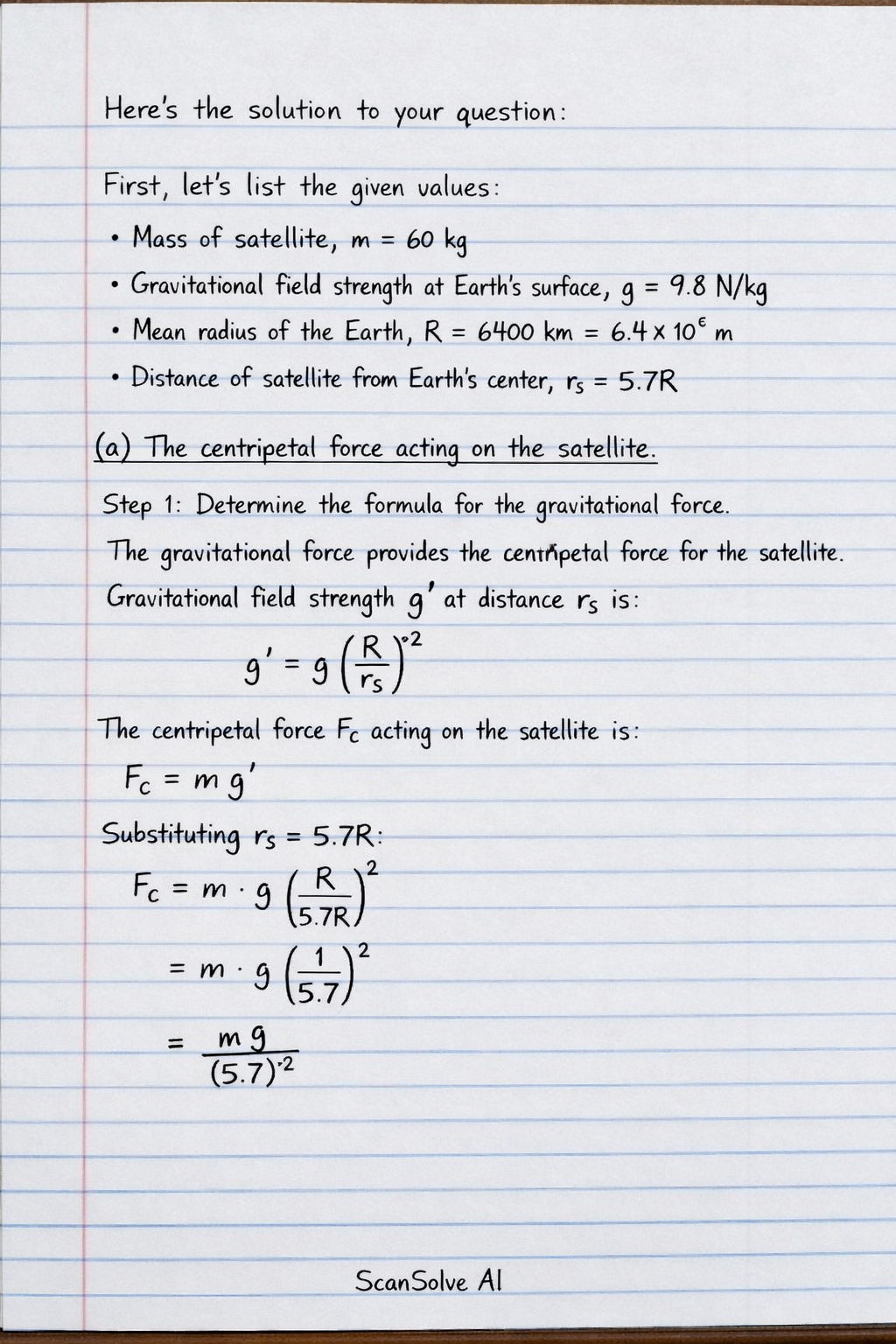
Here's the solution to your question:

First, let's list the given values:

  • Mass of satellite, m=60 kgm = 60 \text{ kg}
  • Gravitational field strength at Earth's surface, g=9.8 N/kgg = 9.8 \text{ N/kg}
  • Mean radius of the Earth, R=6400 km=6.4×10⁶ mR = 6400 \text{ km} = 6.4 \times 10^6 \text{ m}
  • Distance of satellite from Earth's center, rs=5.7Rr_s = 5.7R

Part a· 2 steps

The centripetal force acting on the satellite

  1. Determine the formula for the gravitational force.

    The gravitational force provides the centripetal force for the satellite. The gravitational field strength g′g' at a distance rsr_s from the center of the Earth is related to the surface gravitational field strength gg by the formula:

    g′=g(Rrs)2g' = g \left(\frac{R}{r_s}\right)^2

    The centripetal force FcF_c acting on the satellite is then Fc=mg′F_c = m g'.
    Substituting rs=5.7Rr_s = 5.7R:

    Fc=m⋅g(R5.7R)2=m⋅g(15.7)2=mg(5.7)2F_c = m \cdot g \left(\frac{R}{5.7R}\right)^2 = m \cdot g \left(\frac{1}{5.7}\right)^2 = \frac{m g}{(5.7)^2}
  2. Substitute the given values and calculate the centripetal force.

    Fc=60 kg×9.8 N/kg(5.7)2F_c = \frac{60 \text{ kg} \times 9.8 \text{ N/kg}}{(5.7)^2} Fc=58832.49F_c = \frac{588}{32.49} Fc≈18.09786 NF_c \approx 18.09786 \text{ N}

    Rounding to two significant figures:

    Fc≈18 NF_c \approx \boxed{\text{18 N}}

Part b

6.9×10⁴ s6.9 \times 10^4 \text{ s}

The period of the satellite in orbit

  1. Calculate the orbital radius of the satellite.

    rs=5.7R=5.7×(6.4×106 m)r_s = 5.7R = 5.7 \times (6.4 \times 10^6 \text{ m}) rs=3.648×10⁷ mr_s = 3.648 \times 10^7 \text{ m}
  2. Calculate the orbital velocity of the satellite.

    The centripetal force is also given by Fc=mv2rsF_c = \frac{m v^2}{r_s}. Equating this to the gravitational force mg′m g':

    mv2rs=mg′\frac{m v^2}{r_s} = m g' v2=g′rsv^2 = g' r_s

    Substitute g′=g(Rrs)2g' = g \left(\frac{R}{r_s}\right)^2:

    v2=g(Rrs)2rs=gR2rsv^2 = g \left(\frac{R}{r_s}\right)^2 r_s = \frac{g R^2}{r_s} v=gR2rsv = \sqrt{\frac{g R^2}{r_s}}

    Substitute the values:

    v=9.8 m/s2×(6.4×106 m)23.648×10⁷ mv = \sqrt{\frac{9.8 \text{ m/s}^2 \times (6.4 \times 10^6 \text{ m})^2}{3.648 \times 10^7 \text{ m}}} v=9.8×40.96×10123.648×107v = \sqrt{\frac{9.8 \times 40.96 \times 10^{12}}{3.648 \times 10^7}} v=1.09999×10⁷ m2/s2v = \sqrt{1.09999 \times 10^7 \text{ m}^2/\text{s}^2} v≈3316.6 m/sv \approx 3316.6 \text{ m/s}
  3. Calculate the period of the satellite.

    The period TT is the time taken for one complete orbit, given by T=2πrsvT = \frac{2 \pi r_s}{v}.

    T=2π×(3.648×107 m)3316.6 m/sT = \frac{2 \pi \times (3.648 \times 10^7 \text{ m})}{3316.6 \text{ m/s}} T≈2292194403316.6T \approx \frac{229219440}{3316.6} T≈69110.8 sT \approx 69110.8 \text{ s}

    Rounding to two significant figures:

    T≈6.9×10⁴ sT \approx \boxed{6.9 \times 10^4 \text{ s}}
Was this helpful?

Try one yourself

A new problem that tests the same skill.

Still stuck on this one?

Ask a follow-up, and the answer starts from this question.

Got a different question?Ask your own question
Handwritten step-by-step solution preview

Handwritten Step-by-Step Solution

Get this as a handwritten image on WhatsApp — like a tutor wrote it for you.

Try on WhatsApp