
We read your photo as:
Please answer the questions and send the anwers in English
ScanSolve AI Answer
Answer
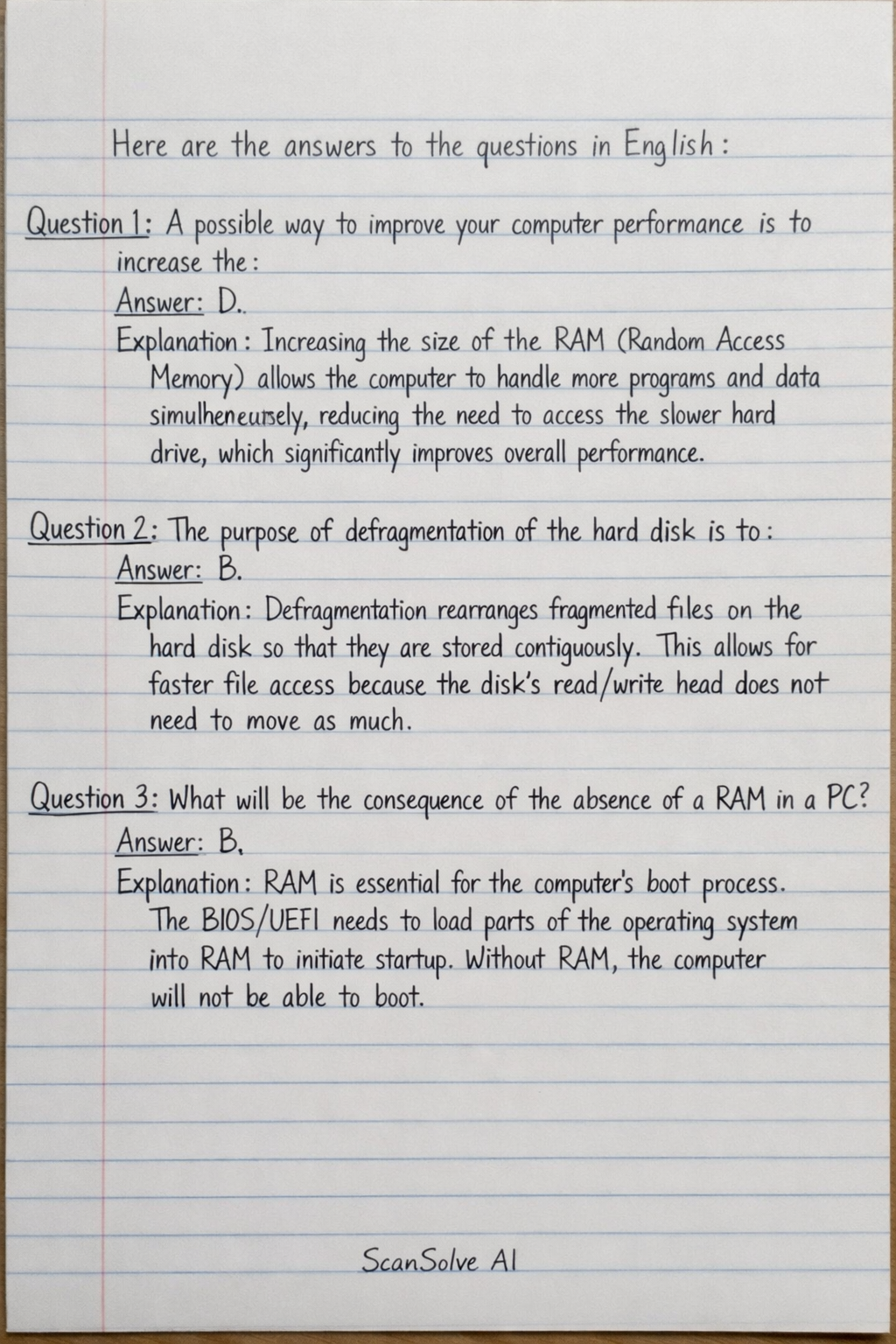
Here are the answers to the questions in English:
Question 1: A possible way to improve your computer performance is to increase the:
- Answer: D
- Explanation: Increasing the size of the RAM (Random Access Memory) allows the computer to handle more programs and data simultaneously, reducing the need to access the slower hard drive, which significantly improves overall performance.
Question 2: The purpose of defragmentation of the hard disk is to:
- Answer: B
- Explanation: Defragmentation rearranges fragmented files on the hard disk so that they are stored contiguously. This allows for faster file access because the disk's read/write head does not need to move as much.
Question 3: What will be the consequence of the absence of a RAM in a PC?
- Answer: B
- Explanation: RAM is essential for the computer's boot process. The BIOS/UEFI needs to load parts of the operating system into RAM to initiate startup. Without RAM, the computer will not be able to boot.
Question 4: The program structure that allows a set of instructions to be done repeatedly is called a (n):
- Answer: C
- Explanation: Iteration (or a loop) is a fundamental control structure in programming that allows a block of code to be executed multiple times, either while a condition is met or for a defined number of times.
Question 5: A memory type found in the CPU is the:
- Answer: A
- Explanation: Registers are small, very fast storage locations situated directly inside the CPU, used to hold data and instructions currently being processed.
Question 6: An example of Object-oriented programming language is:
- Answer: A
- Explanation: C++ is a widely recognized programming language that supports the Object-Oriented Programming (OOP) paradigm, including concepts like classes, objects, inheritance, and polymorphism.
Question 7: Which technique is preferable for transferring a large amount of data to and from a memory in a short time?
- Answer: A
- Explanation: Direct Memory Access (DMA) allows peripheral devices to transfer data directly to and from main memory without involving the CPU, which is highly efficient for large data transfers.
Question 8: One way to prevent RSI (Repetitive Strain Injury) by secretaries is to:
- Answer: B
- Explanation: Using wrist pads can help maintain a neutral wrist position during typing, reducing strain and the risk of developing RSIs related to repetitive movements.
Question 9: Which of the following is the fastest guided transmission medium?
- Answer: D
- Explanation: Optical fiber uses light to transmit data, which allows it to achieve significantly higher transmission speeds and over longer distances compared to copper cables (twisted pair, coaxial, telephone).
Question 10: can be written in hexadecimal as:
- Answer: D
- Explanation: To convert the binary number to hexadecimal, we group the bits in fours from the right, padding with leading zeros if necessary: Now, convert each group of four bits to its hexadecimal equivalent: Thus, . This result is not among the given options. However, it is common for such questions to contain a slight typo. If the binary number was intended to be (12 bits), then: This would result in , which is option D. Given the multiple-choice format, option D is the most likely intended answer, assuming a typo in the question.
Question 11: The device that directs network signals to take specific pathways in a WAN is called a:
- Answer: A
- Explanation: A gateway is a device that connects networks using different protocols and can route traffic between them, which is essential for directing signals in a Wide Area Network (WAN). A router is a type of gateway.
Question 12: The content in the web pages stored in a school intranet can be viewed by use of:
- Answer: C
- Explanation: Web browsers (such as Chrome, Firefox, Edge) are software applications specifically designed to display and interact with web pages.
Question 13: A software that converts codes from assembly language to object code is known as a/an:
- Answer: C
- Explanation: An assembler is a program that translates assembly language (a low-level programming language) into machine code (object code) that the computer can execute directly.
Question 14: A programmer can effectively manipulate the items in an array data structure through the use of a(n):
- Answer: A
- Explanation: Array elements are accessed and manipulated using their index, which is an integer representing their position within the array.
Question 15: A communication status which tolerate two way communication simultaneously is called:
- Answer: C
- Explanation: Full-duplex communication allows both parties to transmit and receive data simultaneously, unlike half-duplex where communication is bidirectional but not simultaneous.
Question 16: Two network segments with different protocols can communicate with the help of a:
- Answer: B
- Explanation: A gateway is a device that enables networks using different protocols to communicate by performing protocol translation.
Question 17: An employee can operate from home using the organization's network. This is called:
- Answer: C
- Explanation: Teleworking (or remote work) is the practice of working from a location away from the main office, often at home, using communication technologies to connect to the company's network.
Question 18: The maximum number of characters that can be represented by a computer using 8 bits system is:
- Answer: D
- Explanation: With 8 bits, each bit can have two states (0 or 1). The total number of unique combinations possible is . Therefore, 256 different characters can be represented.
Try one yourself
A new problem that tests the same skill.
Still stuck on this one?
Ask a follow-up, and the answer starts from this question.
More English Questions
Handwritten Step-by-Step Solution
Get this as a handwritten image on WhatsApp — like a tutor wrote it for you.
Try on WhatsApp