We read your photo as:

Plot the vertices of triangle PQR.

English

ScanSolve AI Answer

Answers

3 parts
b
(1,2)

90∘ counter-clockwise90^\circ \text{ counter-clockwise}

c

P2(9,6),Q2(−3,3),R2(−9,−3)P^2(9,6), Q^2(-3,3), R^2(-9,-3)

d

P3(−4,−1),Q3(0,−2),R3(1,−4)P^3(-4,-1), Q^3(0,-2), R^3(1,-4)

Step-by-step solution

10 steps

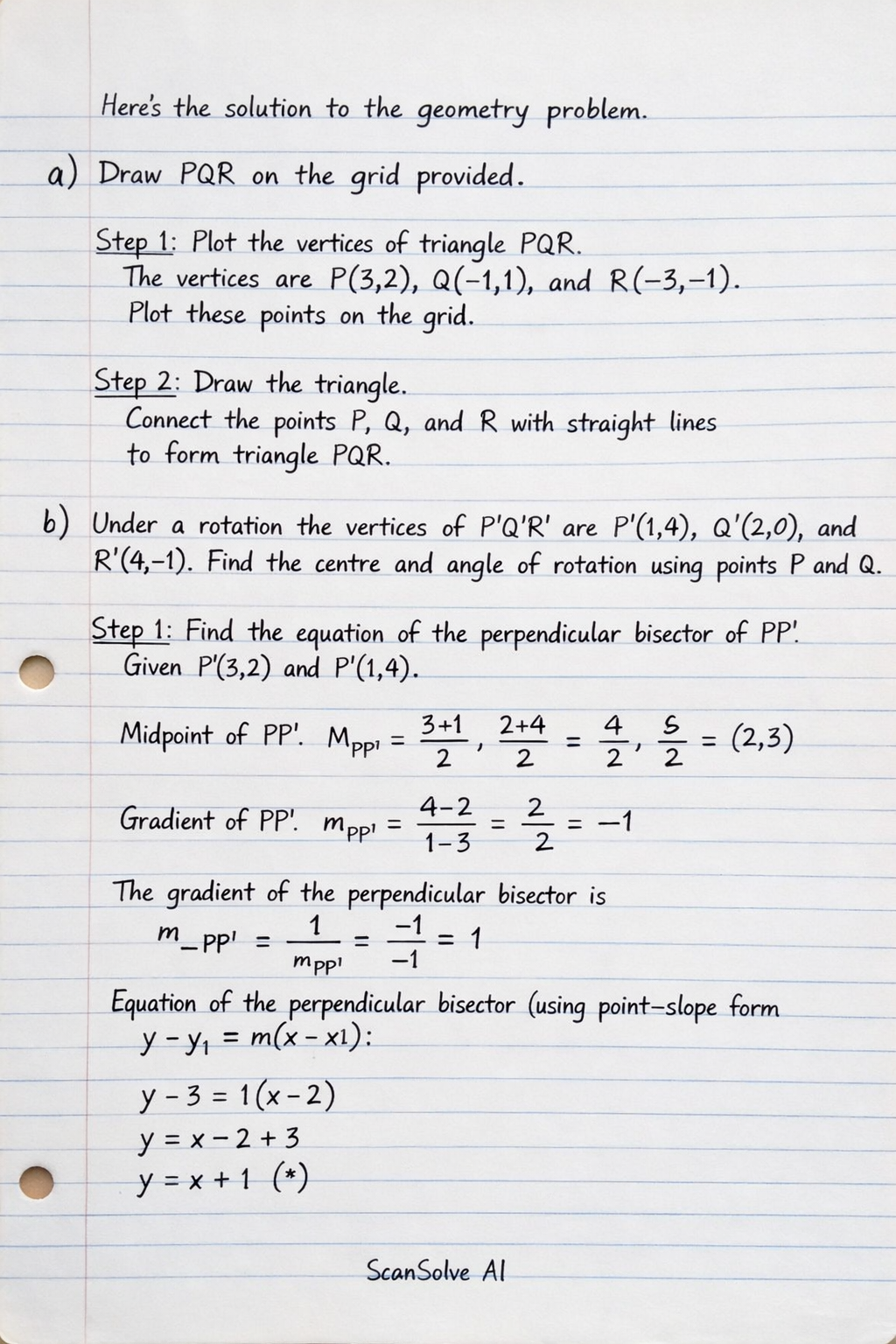
Here's the solution to the geometry problem.

Part a· 2 steps

Draw PQR on the grid provided.

  1. Plot the vertices of triangle PQR.

    The vertices are P(3,2)(3,2), Q(−1,1)(-1,1), and R(−3,−1)(-3,-1).
    Plot these points on the grid.

  2. Draw the triangle.

    Connect the points P, Q, and R with straight lines to form triangle PQR.

Part b(1,2)

Under a rotation the vertices of P'Q'R' are P'(1,4)(1,4), Q'(2,0)(2,0) and R'(4,−1)(4,-1). Find the centre and angle of rotation using points P and Q.

  1. Find the equation of the perpendicular bisector of PP'.

    Given P(3,2)(3,2) and P'(1,4)(1,4).
    Midpoint of PP': MPP′=(3+12,2+42)=(42,62)=(2,3)M_{PP'} = \left(\frac{3+1}{2}, \frac{2+4}{2}\right) = \left(\frac{4}{2}, \frac{6}{2}\right) = (2,3).
    Gradient of PP': mPP′=4−21−3=2−2=−1m_{PP'} = \frac{4-2}{1-3} = \frac{2}{-2} = -1.
    The gradient of the perpendicular bisector is m⊥PP′=−1mPP′=−1−1=1m_{\perp PP'} = -\frac{1}{m_{PP'}} = -\frac{1}{-1} = 1.
    Equation of the perpendicular bisector (using point-slope form y−y1=m(x−x1)y - y_1 = m(x - x_1)):

    y−3=1(x−2)y - 3 = 1(x - 2) y=x−2+3y = x - 2 + 3 y=x+1(∗)y = x + 1 \quad (*)
  2. Find the equation of the perpendicular bisector of QQ'.

    Given Q(−1,1)(-1,1) and Q'(2,0)(2,0).
    Midpoint of QQ': MQQ′=(−1+22,1+02)=(12,12)M_{QQ'} = \left(\frac{-1+2}{2}, \frac{1+0}{2}\right) = \left(\frac{1}{2}, \frac{1}{2}\right).
    Gradient of QQ': mQQ′=0−12−(−1)=−13m_{QQ'} = \frac{0-1}{2-(-1)} = \frac{-1}{3}.
    The gradient of the perpendicular bisector is m⊥QQ′=−1mQQ′=−1−1/3=3m_{\perp QQ'} = -\frac{1}{m_{QQ'}} = -\frac{1}{-1/3} = 3.
    Equation of the perpendicular bisector:

    y−12=3(x−12)y - \frac{1}{2} = 3\left(x - \frac{1}{2}\right) y−12=3x−32y - \frac{1}{2} = 3x - \frac{3}{2} y=3x−32+12y = 3x - \frac{3}{2} + \frac{1}{2} y=3x−1(∗∗)y = 3x - 1 \quad (**)
  3. Find the centre of rotation by solving the system of equations.

    Equate (∗)(*) and (∗∗)(**):

    x+1=3x−1x + 1 = 3x - 1 1+1=3x−x1 + 1 = 3x - x 2=2x2 = 2x x=1x = 1

    Substitute x=1x=1 into y=x+1y = x + 1:

    y=1+1y = 1 + 1 y=2y = 2

    The centre of rotation is (1,2)\boxed{(1,2)}.

  4. Determine the angle of rotation.

    Consider the vector from the centre C(1,2)(1,2) to P(3,2)(3,2): CP⃗=(3−1,2−2)=(2,0)\vec{CP} = (3-1, 2-2) = (2,0).
    Consider the vector from the centre C(1,2)(1,2) to P'(1,4)(1,4): CP′⃗=(1−1,4−2)=(0,2)\vec{CP'} = (1-1, 4-2) = (0,2).
    A rotation that transforms (2,0)(2,0) to (0,2)(0,2) is a 90∘90^\circ counter-clockwise rotation.
    This can be verified using the rotation matrix for 90∘90^\circ counter-clockwise: [0−110][20]=[02]\begin{bmatrix} 0 & -1 \\ 1 & 0 \end{bmatrix} \begin{bmatrix} 2 \\ 0 \end{bmatrix} = \begin{bmatrix} 0 \\ 2 \end{bmatrix}.
    The angle of rotation is 90∘ counter-clockwise\boxed{90^\circ \text{ counter-clockwise}}.

Part c

P2(9,6),Q2(−3,3),R2(−9,−3)P^2(9,6), Q^2(-3,3), R^2(-9,-3)

Triangle PQR is enlarged with scale factor 3 centre $(0,0)$ to give triangle P²Q²R². Draw triangle P²Q²R² and state its co-ordinates.

  1. Calculate the coordinates of P²Q²R².

    For an enlargement with scale factor kk and centre (0,0)(0,0), a point (x,y)(x,y) maps to (kx,ky)(kx, ky).
    P(3,2)→(3,2) \to P²(3×3,2×3)=(9,6)(3 \times 3, 2 \times 3) = (9,6)
    Q(−1,1)→(-1,1) \to Q²(−1×3,1×3)=(−3,3)(-1 \times 3, 1 \times 3) = (-3,3)
    R(−3,−1)→(-3,-1) \to R²(−3×3,−1×3)=(−9,−3)(-3 \times 3, -1 \times 3) = (-9,-3)
    The coordinates are P2(9,6),Q2(−3,3),R2(−9,−3)\boxed{P^2(9,6), Q^2(-3,3), R^2(-9,-3)}.

  2. Draw triangle P²Q²R².

    Plot the points P²(9,6)(9,6), Q²(−3,3)(-3,3), and R²(−9,−3)(-9,-3) on the grid.
    Connect these points with straight lines to form triangle P²Q²R².

Part d

P3(−4,−1),Q3(0,−2),R3(1,−4)P^3(-4,-1), Q^3(0,-2), R^3(1,-4)

Triangle P¹Q¹R¹ undergoes reflection in line y=−xy = -x to give triangle P³Q³R³. Draw P³Q³R³ and state its coordinates.

  1. Calculate the coordinates of P³Q³R³.

    For a reflection in the line y=−xy = -x, a point (x,y)(x,y) maps to (−y,−x)(-y, -x).
    P'(1,4)→(1,4) \to P³(−4,−1)(-4, -1)
    Q'(2,0)→(2,0) \to Q³(−0,−2)=(0,−2)(-0, -2) = (0, -2)
    R'(4,−1)→(4,-1) \to R³(−(−1),−4)=(1,−4)(-(-1), -4) = (1, -4)
    The coordinates are P3(−4,−1),Q3(0,−2),R3(1,−4)\boxed{P^3(-4,-1), Q^3(0,-2), R^3(1,-4)}.

  2. Draw triangle P³Q³R³.

    Plot the points P³(−4,−1)(-4,-1), Q³(0,−2)(0,-2), and R³(1,−4)(1,-4) on the grid.
    Connect these points with straight lines to form triangle P³Q³R³.

Was this helpful?

Try one yourself

A new problem that tests the same skill.

Still stuck on this one?

Ask a follow-up, and the answer starts from this question.

Got a different question?Ask your own question
Handwritten step-by-step solution preview

Handwritten Step-by-Step Solution

Get this as a handwritten image on WhatsApp — like a tutor wrote it for you.

Try on WhatsApp