
We read your photo as:
Sodium chloride is a soluble salt and can conduct electricity in the molten state.
ScanSolve AI Answer
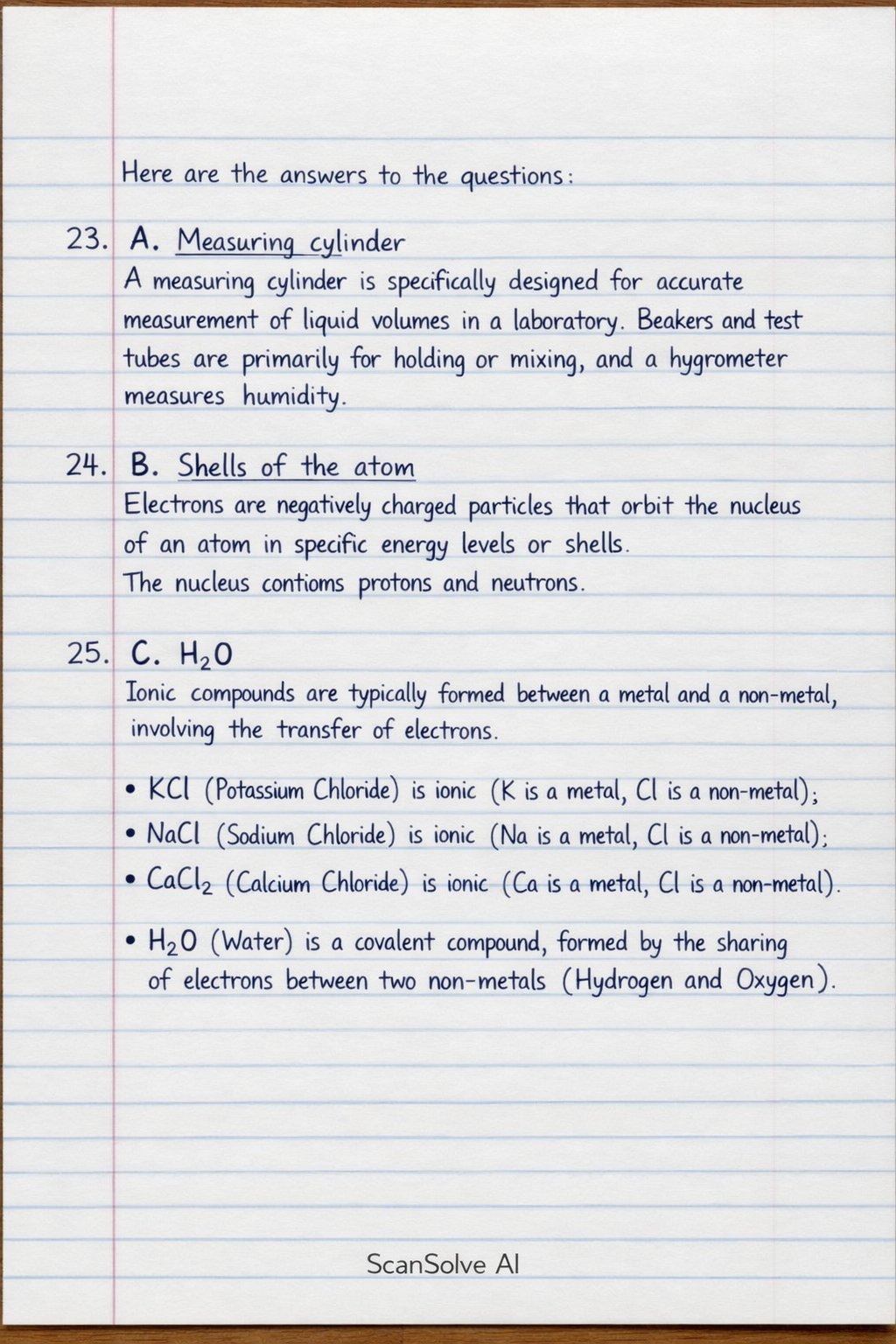
Here are the answers to the questions:
-
A. Measuring cylinder A measuring cylinder is specifically designed for accurate measurement of liquid volumes in a laboratory. Beakers and test tubes are primarily for holding or mixing, and a hygrometer measures humidity.
-
B. Shells of the atom Electrons are negatively charged particles that orbit the nucleus of an atom in specific energy levels or shells. The nucleus contains protons and neutrons.
-
C. H₂O Ionic compounds are typically formed between a metal and a non-metal, involving the transfer of electrons.
- KCl (Potassium Chloride) is ionic (K is a metal, Cl is a non-metal).
- NaCl (Sodium Chloride) is ionic (Na is a metal, Cl is a non-metal).
- CaCl₂ (Calcium Chloride) is ionic (Ca is a metal, Cl is a non-metal).
- H₂O (Water) is a covalent compound, formed by the sharing of electrons between two non-metals (Hydrogen and Oxygen).
-
B. Observe safety guidelines and instructions The most fundamental rule in laboratory safety is to always follow established safety guidelines and instructions to prevent accidents and ensure a safe working environment.
-
B. True Sodium chloride (NaCl) is an ionic compound. When molten, its ions ( and ) are free to move, allowing it to conduct electricity. It is also a soluble salt.
-
C. Pascal
- Mole, Second, and Kelvin are all base SI units (for amount of substance, time, and temperature, respectively).
- Pascal (Pa) is a derived SI unit for pressure, defined as Newtons per square meter (), where Newton itself is a derived unit ().
-
B. Sulphuric acid Sulphuric acid () is a strong acid and is highly corrosive, meaning it can cause severe damage to living tissue and many materials. Vinegar (acetic acid) is a weak acid and mildly corrosive. Water and sugar solutions are not corrosive.
Still stuck on this one?
Ask a follow-up, and the answer starts from this question.
More Chemistry Questions
Handwritten Step-by-Step Solution
Get this as a handwritten image on WhatsApp — like a tutor wrote it for you.
Try on WhatsApp