
We read your photo as:
A) Sustainable agriculture is an approach to farming that aims to produce food, fiber, or other plant or animal products using methods that protect the environment, public health, human communities,
ScanSolve AI Answer
Answer
Step-by-step solution
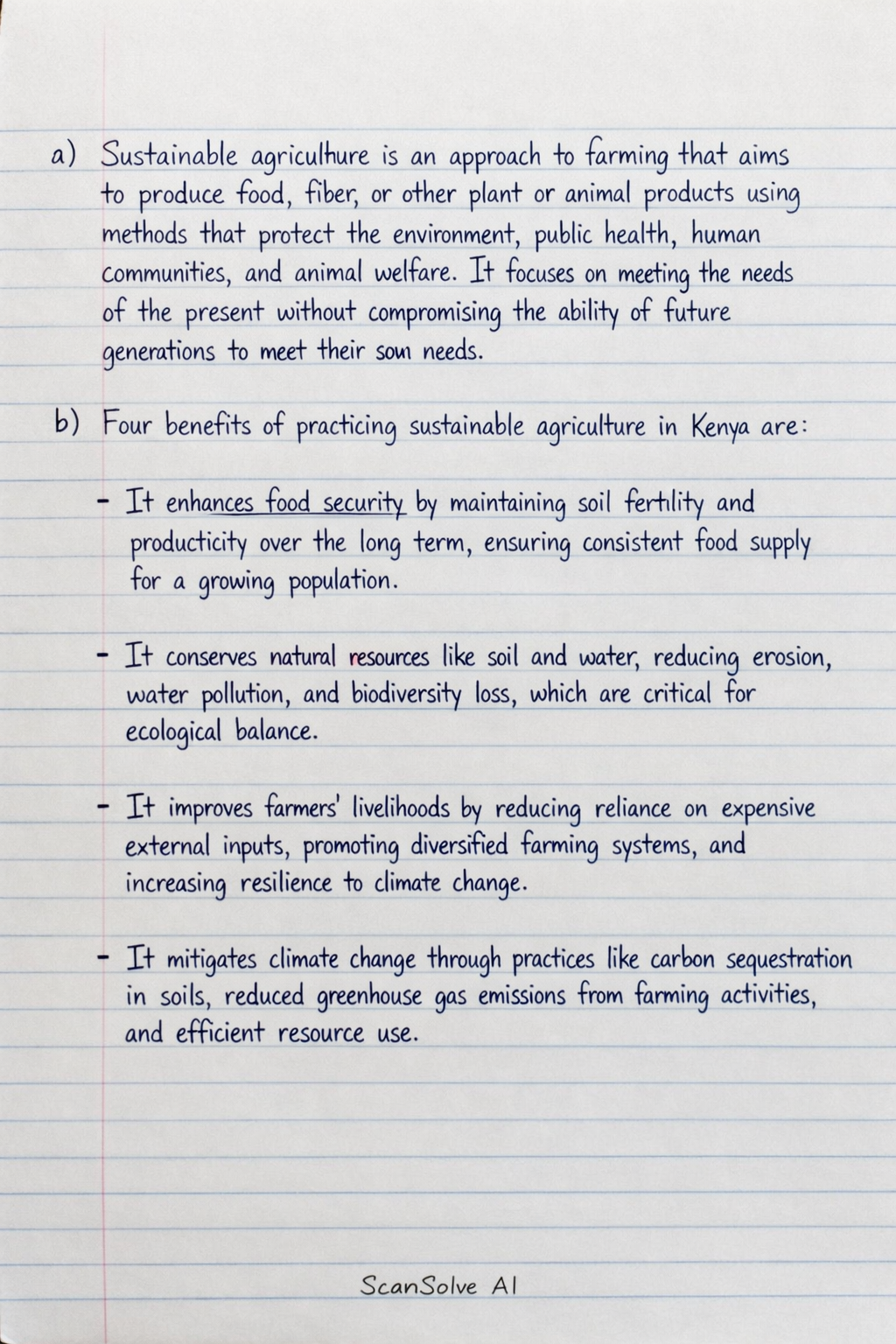
3 stepsa) Sustainable agriculture is an approach to farming that aims to produce food, fiber, or other plant or animal products using methods that protect the environment, public health, human communities, and animal welfare. It focuses on meeting the needs of the present without compromising the ability of future generations to meet their own needs.
Part b
Four benefits of practicing sustainable agriculture in Kenya are
- It enhances food security by maintaining soil fertility and productivity over the long term, ensuring consistent food supply for a growing population.
- It conserves natural resources like soil and water, reducing erosion, water pollution, and biodiversity loss, which are critical for ecological balance.
- It improves farmers' livelihoods by reducing reliance on expensive external inputs, promoting diversified farming systems, and increasing resilience to climate change.
- It mitigates climate change through practices like carbon sequestration in soils, reduced greenhouse gas emissions from farming activities, and efficient resource use.
Part c(i)
The type of fertilizer applied at planting is *DAP
ii) Top dressing is done weeks after planting to supply nutrients, primarily nitrogen, to the crop during its active growth stage. Young plants have limited root systems and may not require large amounts of nitrogen initially. As the plant grows and develops more leaves and stems, its demand for nitrogen increases significantly for vigorous vegetative growth. Applying fertilizer at this later stage ensures the nutrients are available when the plant needs them most, minimizing loss through leaching or runoff.
Part c(iii)
Three precautions observed when applying fertilizers are
- Wear protective gear such as gloves, masks, and appropriate clothing to avoid direct contact with the chemicals, which can cause skin irritation or respiratory issues.
- Apply the correct dosage and at the right time according to soil test recommendations and crop requirements to prevent over-fertilization, which can lead to nutrient imbalance, plant damage, and environmental pollution.
- Store fertilizers properly in a cool, dry place away from direct sunlight, moisture, and children or animals, to maintain their effectiveness and prevent accidents.
Part c(iv)
Identify the fertilizer application rate per acre.
The fertilizer application rate is per acre.
Identify the total area to be fertilized.
The total area is .
Calculate the total fertilizer required.
The total fertilizer required is .
Try one yourself
A new problem that tests the same skill.
Still stuck on this one?
Ask a follow-up, and the answer starts from this question.
More Geography Questions
Handwritten Step-by-Step Solution
Get this as a handwritten image on WhatsApp — like a tutor wrote it for you.
Try on WhatsApp