
We read your photo as:
What is environmental sanitation and what are its causes and effects in Ghana?
ScanSolve AI Answer
Step-by-step solution
4 stepsAnswer Question 1.
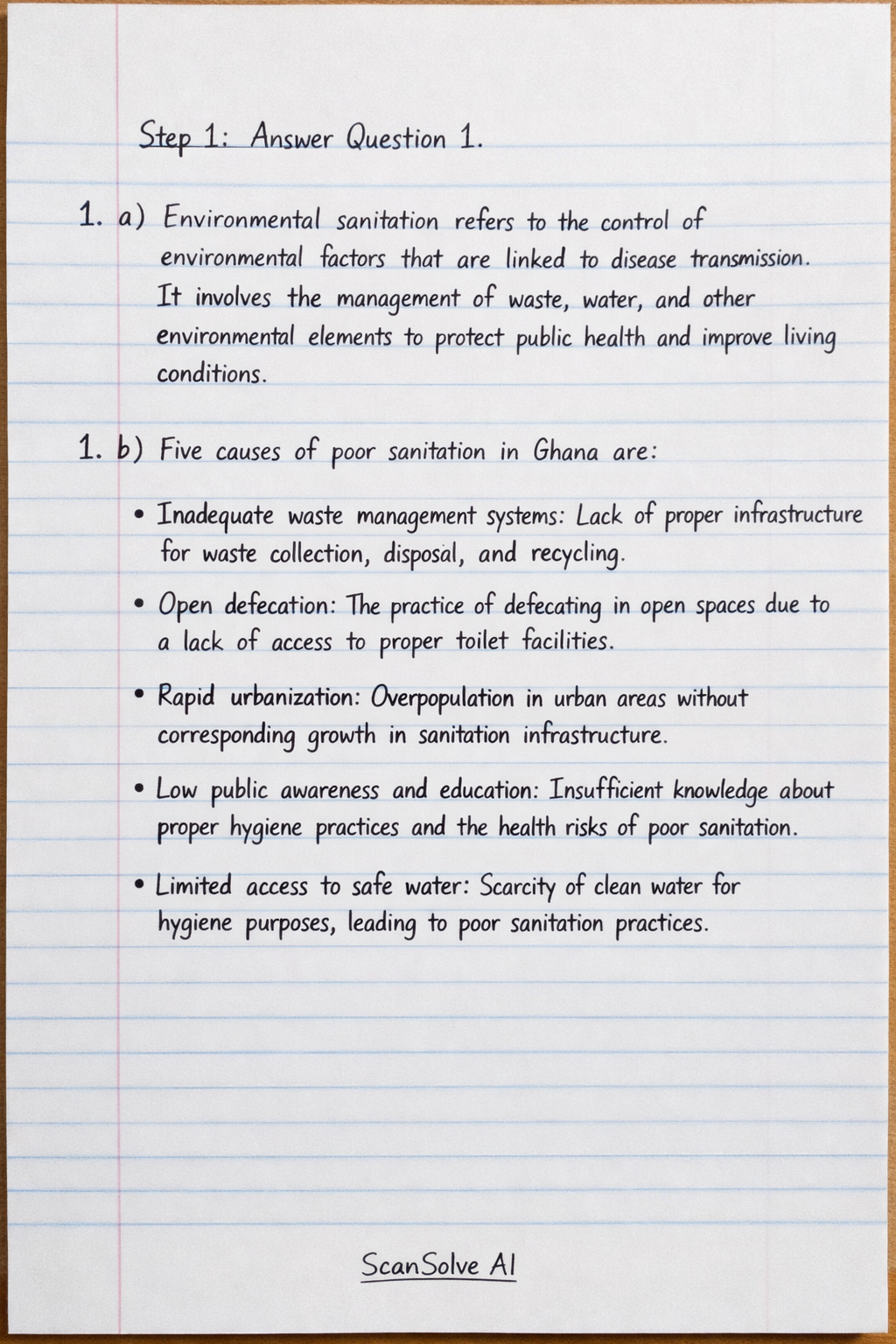
1. a) Environmental sanitation refers to the control of environmental factors that are linked to disease transmission. It involves the management of waste, water, and other environmental elements to protect public health and improve living conditions.
1. b) Five causes of poor sanitation in Ghana are:
- Inadequate waste management systems: Lack of proper infrastructure for waste collection, disposal, and recycling.
- Open defecation: The practice of defecating in open spaces due to a lack of access to proper toilet facilities.
- Rapid urbanization: Overpopulation in urban areas without corresponding growth in sanitation infrastructure.
- Low public awareness and education: Insufficient knowledge about proper hygiene practices and the health risks of poor sanitation.
- Limited access to safe water: Scarcity of clean water for hygiene purposes, leading to poor sanitation practices.
1. c) Five effects of poor sanitation on society are:
- Spread of diseases: Poor sanitation leads to the proliferation of diseases like cholera, typhoid, dysentery, and malaria, increasing morbidity and mortality rates.
- Environmental pollution: Improper waste disposal contaminates land, water bodies, and air, harming ecosystems and natural resources.
- Economic burden: High healthcare costs due to sanitation-related illnesses, loss of productivity, and reduced tourism negatively impact the economy.
- Reduced quality of life: Unpleasant odors, unsightly waste, and disease outbreaks diminish the overall living standards and well-being of communities.
- Social inequality: Vulnerable populations, often in informal settlements, disproportionately suffer from the impacts of poor sanitation, exacerbating social disparities.
1. d) Four ways of improving sanitation in your community are:
- Promoting proper waste disposal: Encourage residents to use designated bins, separate waste, and participate in community clean-up exercises.
- Constructing and maintaining public toilets: Provide accessible and clean toilet facilities to reduce open defecation.
- Educating the public on hygiene: Conduct awareness campaigns on handwashing, safe water storage, and the importance of a clean environment.
- Implementing effective drainage systems: Ensure proper construction and maintenance of drains to prevent stagnant water and flooding, which can spread diseases.
Answer Question 2.
2. a) Independence is the state of a nation, country, or state in which its residents and population exercise self-government and usually sovereignty over its territory. It means being free from external control or influence.
2. b) Four factors that led to Ghana's independence are:
- Rise of nationalism: The emergence of educated African elites who advocated for self-rule and challenged colonial authority.
- World War II: The war weakened colonial powers and exposed their hypocrisy regarding freedom and democracy, inspiring African soldiers who fought for the British to demand their own freedom.
- Pan-Africanism: The movement advocating for the unity and self-determination of African people, championed by leaders like Kwame Nkrumah.
- Economic exploitation: The colonial system's exploitation of Ghana's resources for the benefit of Britain, which fueled resentment and a desire for economic self-control.
2. c) Four benefits of independence to Ghana are:
- Self-governance and sovereignty: Ghana gained the right to govern itself, make its own laws, and control its own destiny without external interference.
- Economic self-determination: The ability to manage its own resources and economy, leading to national development projects and policies aimed at improving the lives of its citizens.
- National identity and pride: Independence fostered a sense of national unity, cultural pride, and a distinct Ghanaian identity.
- International recognition and influence: Ghana became a respected voice on the global stage, playing a significant role in the Pan-African movement and advocating for the liberation of other African nations.
Answer Question 3.
3. a) Conflict is a serious disagreement or argument, typically a protracted one. It can arise between individuals, groups, or nations due to differing interests, values, needs, or perceptions.
3. b) Five causes of conflict in schools or communities are:
- Miscommunication: Lack of clear and effective communication, leading to misunderstandings and misinterpretations.
- Resource scarcity: Competition over limited resources such as land, water, money, or opportunities.
- Differences in values or beliefs: Disagreements stemming from varying cultural, religious, political, or personal values.
- Power imbalances: Unequal distribution of power or authority, leading to resentment and struggles for control.
- Personal grievances or grudges: Unresolved past issues, jealousy, or personal animosity between individuals or groups.
3. c) Four peaceful ways of resolving conflict are:
- Mediation: Involving a neutral third party to facilitate communication and help conflicting parties reach a mutually acceptable solution.
- Negotiation: Direct discussion between the conflicting parties to find common ground and compromise without external intervention.
- Arbitration: Submitting the dispute to a neutral third party who listens to both sides and makes a binding decision.
- Dialogue and communication: Encouraging open and respectful conversation to understand each other's perspectives, express feelings, and identify underlying issues.
Answer Question 4.
4. a) A constitution is a body of fundamental principles or established precedents according to which a state or other organization is acknowledged to be governed. It sets out the framework for government, defines the powers of its branches, and often guarantees the rights of its citizens.
4. b) Four functions of the 1992 Constitution of Ghana are:
- Establishes the framework of government: It defines the structure, powers, and responsibilities of the executive, legislative, and judicial branches of government.
- Guarantees fundamental human rights: It protects the civil, political, economic, social, and cultural rights and freedoms of all Ghanaian citizens.
- Ensures rule of law: It establishes that all persons, institutions, and entities are accountable to laws that are publicly promulgated, equally enforced, and independently adjudicated.
- Provides for national unity and stability: It outlines principles for national integration, promotes democratic governance, and provides mechanisms for peaceful resolution of disputes.
4. c) The question is cut off, but based on "Explain four re...", it likely asks for reasons or requirements. Without the full question, I cannot provide a complete answer.
Still stuck on this one?
Ask a follow-up, and the answer starts from this question.
More Geography Questions
Handwritten Step-by-Step Solution
Get this as a handwritten image on WhatsApp — like a tutor wrote it for you.
Try on WhatsApp