
We read your photo as:
Explain the features of a topographical map, including its scale, settlement patterns, relief, and vegetation representation, and list marginal information.
ScanSolve AI Answer
Answer
Step-by-step solution
3 stepsPart a(i)
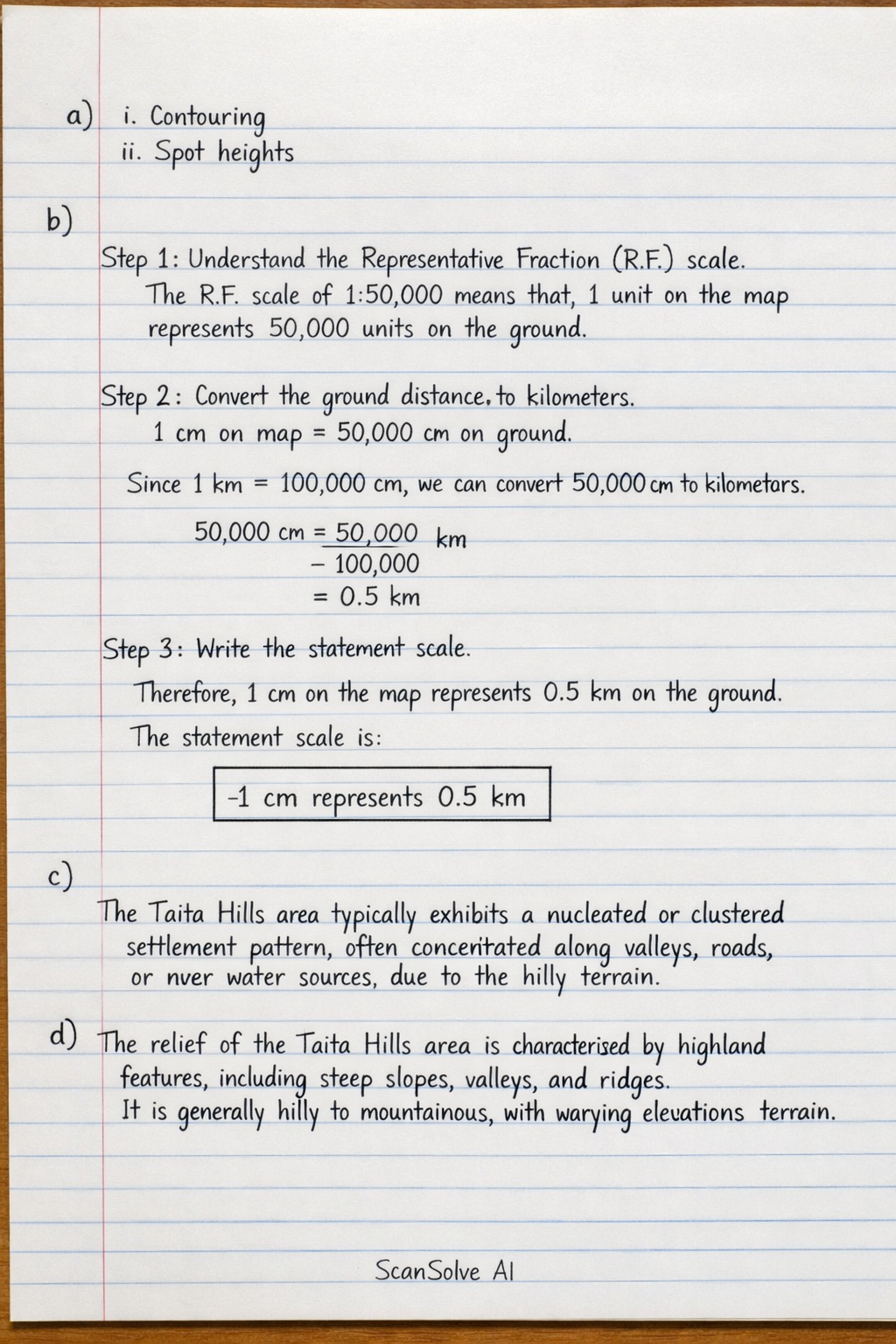
Contouring
Part a(ii)
Spot heights
Part b
Understand the Representative Fraction (R.F.) scale.
The R.F. scale of 1:50,000 means that 1 unit on the map represents 50,000 units on the ground.
Convert the ground distance to kilometers.
Since , we can convert to kilometers.
Write the statement scale.
Therefore, 1 cm on the map represents 0.5 km on the ground.
The statement scale is:
Part c
The Taita Hills area typically exhibits a nucleated or clustered settlement pattern, often concentrated along valleys, roads, or near water sources due to the hilly terrain.
Part d
The relief of the Taita Hills area is characterized by highland features, including steep slopes, valleys, and ridges. It is generally hilly to mountainous, with varying elevations and dissected terrain.
Part e
Four marginal information found on a topographical map are:
- Map title
- Scale (Representative Fraction, Statement, and Linear)
- Key/Legend
- North arrow/Grid North
Part f
Vegetation on a topographical map can be represented in three ways:
- Symbols: Specific conventional symbols are used to denote different types of vegetation, such as scattered trees, forests, swamps, or scrubland.
- Colours: Different shades or hues of green are often used to distinguish between various types of vegetation, with darker greens typically indicating denser forests and lighter greens for grasslands or cultivated areas.
- Labels/Names: The names of specific vegetation types, such as "Forest", "Mangrove", or "Tea Plantation", may be written directly on the map to identify the vegetation cover.
Part g
Based on relief, drainage, and vegetation, three economic activities that can be carried out in the mapped area are:
- Agriculture: The presence of valleys and potentially fertile soils in the hilly terrain, combined with adequate drainage (rivers/streams), suggests that cash crops like tea and coffee, which thrive in highland areas, can be cultivated. Terracing might be evident on steep slopes.
- Tourism: The hilly relief and natural vegetation (forests) indicate potential for eco-tourism, including hiking, bird watching, and scenic drives. Water features like rivers or waterfalls could also attract tourists.
- Forestry/Logging: Extensive natural vegetation, particularly forests, suggests that timber extraction, charcoal production, or sustainable forestry practices could be viable economic activities.
Try one yourself
A new problem that tests the same skill.
Still stuck on this one?
Ask a follow-up, and the answer starts from this question.
More Geography Questions
Handwritten Step-by-Step Solution
Get this as a handwritten image on WhatsApp — like a tutor wrote it for you.
Try on WhatsApp