
We read your photo as:
Explain the following types of Surveying: Plane, Geodetic, Topographical, Cadastral, Traverse, and Engineering surveys.
Geography
ScanSolve AI Answer
This answer stops before the end.
It was cut off when it was first written. Ask ScanSolve this question again for the full working.
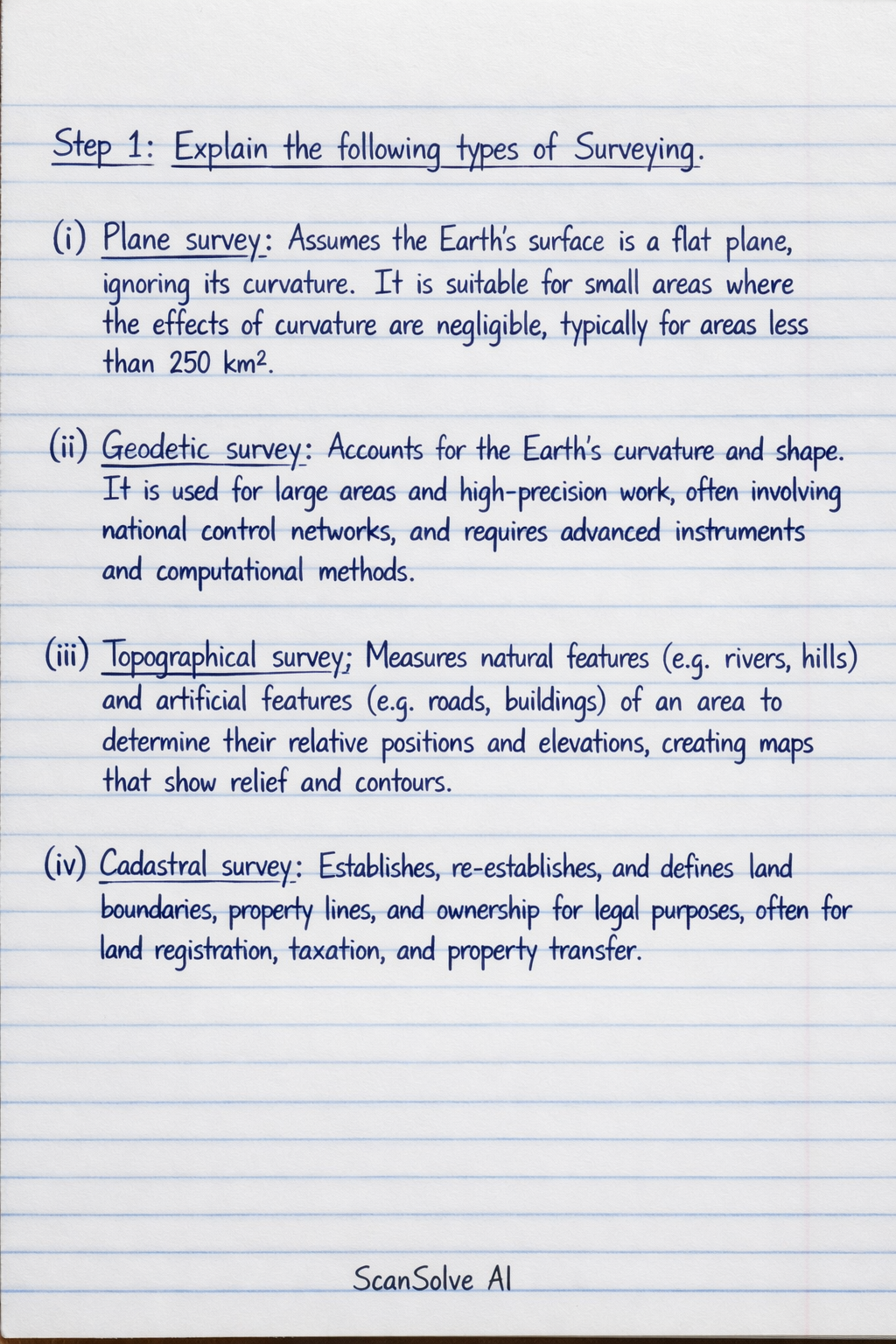
Step 1: Explain the following types of Surveying.
- i) Plane survey: Assumes the Earth's surface is a flat plane, ignoring its curvature. It is suitable for small areas where the effects of curvature are negligible, typically for areas less than 250 km².
- ii) Geodetic survey: Accounts for the Earth's curvature and shape. It is used for large areas and high-precision work, often involving national control networks, and requires advanced instruments and computational methods.
- iii) Topographical survey: Measures natural features (e.g., rivers, hills) and artificial features (e.g., roads, buildings) of an area to determine their relative positions and elevations, creating maps that show relief and contours.
- iv) Cadastral survey: Establishes, re-establishes, and defines land boundaries, property lines, and ownership for legal purposes, often for land registration, taxation, and property transfer.
- v) Traverse survey: A method where a series of connected survey lines form a framework. Distances and angles between consecutive points (stations) are measured to determine their relative positions. It can be open or closed.
- vi) Engineering Survey: Involves surveys required for the planning, design, and construction of engineering projects such as roads, railways, bridges, dams, and buildings. It includes setting out, monitoring, and as-built surveys.
Was this helpful?
Still stuck on this one?
Ask a follow-up, and the answer starts from this question.
Got a different question?Ask your own question
More Geography Questions
QDefine and differentiate between Plane, Geodetic, Topographical, and Cadastral surveys.QA) Explain the concept of Photogrammetry b) Describe Three (3) processes of surveying c) Explain…QExplain the differences between open and closed traverse systems in land surveying, including their…QDescribe how to plot a traverse, and explain what a closing error is in surveying.QQ2. Explain any three types of land survey and their relevance to urban and rural development.
Handwritten Step-by-Step Solution
Get this as a handwritten image on WhatsApp — like a tutor wrote it for you.
Try on WhatsApp