ScanSolve logoScanSolve
Toggle sidebar
  • Homework
  • Tutor
  • Humanizer
  • AI Detector
  • Questions
  • Blog
  • History
  • Mobile App

  • Homework
  • Tutor
  • Humanizer
  • AI Detector

  • Questions
  • Math homework helpMath
    Physics homework helpPhysics
    Chemistry homework helpChemistry
    Biology homework helpBiology
    Computer Science homework helpComputer Science
    History homework helpHistory
    More homework helpMore
  • Blog
  • History

  • Mobile App
ScanSolvePLUS
  • Unlimited answers
  • ScanSolve AI Pro
Start Free Trial →
Try on WhatsApp
Geography: for the most effective strategies for mitigating climate change. Let's evaluate... — Step-by-Step Solution | ScanSolve
Home > Geography Homework Help > Solution

for the most effective strategies for mitigating climate change. Let's evaluate each statement:

Asked on March 26, 2026|Geography

This geography problem is solved step by step below, with detailed explanations to help you understand the method and arrive at the correct answer.

ScanSolve AI AnswerAnswered on March 26, 2026
The question asks for the most effective strategies for mitigating climate change. Let's evaluate each statement: a) It involves attempts to stabilise and reduce the human production of greenhouse gases. This is a primary and highly effective strategy for mitigating climate change, as greenhouse gas emissions are the main driver of global warming. b) It is associated with the erosion of the ozone layer. The erosion of the ozone layer is a separate environmental issue, primarily caused by ozone-depleting substances (like CFCs), not directly by climate change or its mitigation strategies. Therefore, this is not an effective strategy for mitigating climate change. c) It may include the establishment of carbon taxes. Carbon taxes are an economic tool designed to reduce greenhouse gas emissions by making activities that produce them more expensive, thereby incentivizing cleaner alternatives. This is an effective mitigation strategy. d) The abolition of international climate change agreements. International agreements (such as the Paris Agreement) are crucial for coordinating global efforts to mitigate climate change. Abolishing them would hinder, not help, mitigation efforts. Therefore, this is not an effective strategy; in fact, it is counterproductive. Based on this analysis, statements 'a' and 'c' are effective strategies for mitigating climate change. Statements 'b' and 'd' are incorrect in this context. Now, let's examine the given options: 1. a, b, c, and d 2. a, c, and d 3. a, b, and c 4. b, c, and d The ideal answer would be "a and c". Since this option is not available, we must choose the "least incorrect" option among the choices provided. Options 1, 2, and 4 include statement 'd', which describes an action that would actively undermine climate change mitigation. Option 3 includes statements 'a' and 'c' (which are correct strategies) and statement 'b' (which is incorrect but less directly counterproductive than 'd'). Comparing the incorrect statements 'b' and 'd', 'd' represents an action that would actively work against climate change mitigation. Statement 'b' is factually incorrect in the context of mitigation strategies but does not propose a harmful action. Therefore, option 3, which contains the two correct strategies ('a' and 'c') and the less severely incorrect statement ('b'), is the most plausible choice. The final answer is $\boxed{\text{3}}$

Related Geography Questions

  • What are fossil fuel
  • Explain how oxygen from the atmosphere enters the blood stream
  • **1. South Africa's energy crisis is recurring, which poses a threat to energy management. Outline the causes, impacts,...
  • How Volcano erupts
  • Write for me cv using following details Name ; Elizabeth ruguru mwangangi Email : elizabethmwangangi03@gmail.com 0117 42...
  • to identify critical indicators of climate change's impact on the cryosphere. The cryosphere includes all frozen water o...
See all Geography questions

This step-by-step solution was generated by ScanSolve AI. Need help with more geography problems? Browse Geography solutions or ask your own question.

Home›Geography Homework Help›for the most effective strategies for mitigating climate cha…
Q

for the most effective strategies for mitigating climate change. Let's evaluate each statement:

March 26, 2026|Geography
for the most effective strategies for mitigating climate change. Let's evaluate each statement:

for the most effective strategies for mitigating climate change. Let's evaluate each statement:

ScanSolve AI

ScanSolve AI Answer

Answered on March 26, 2026

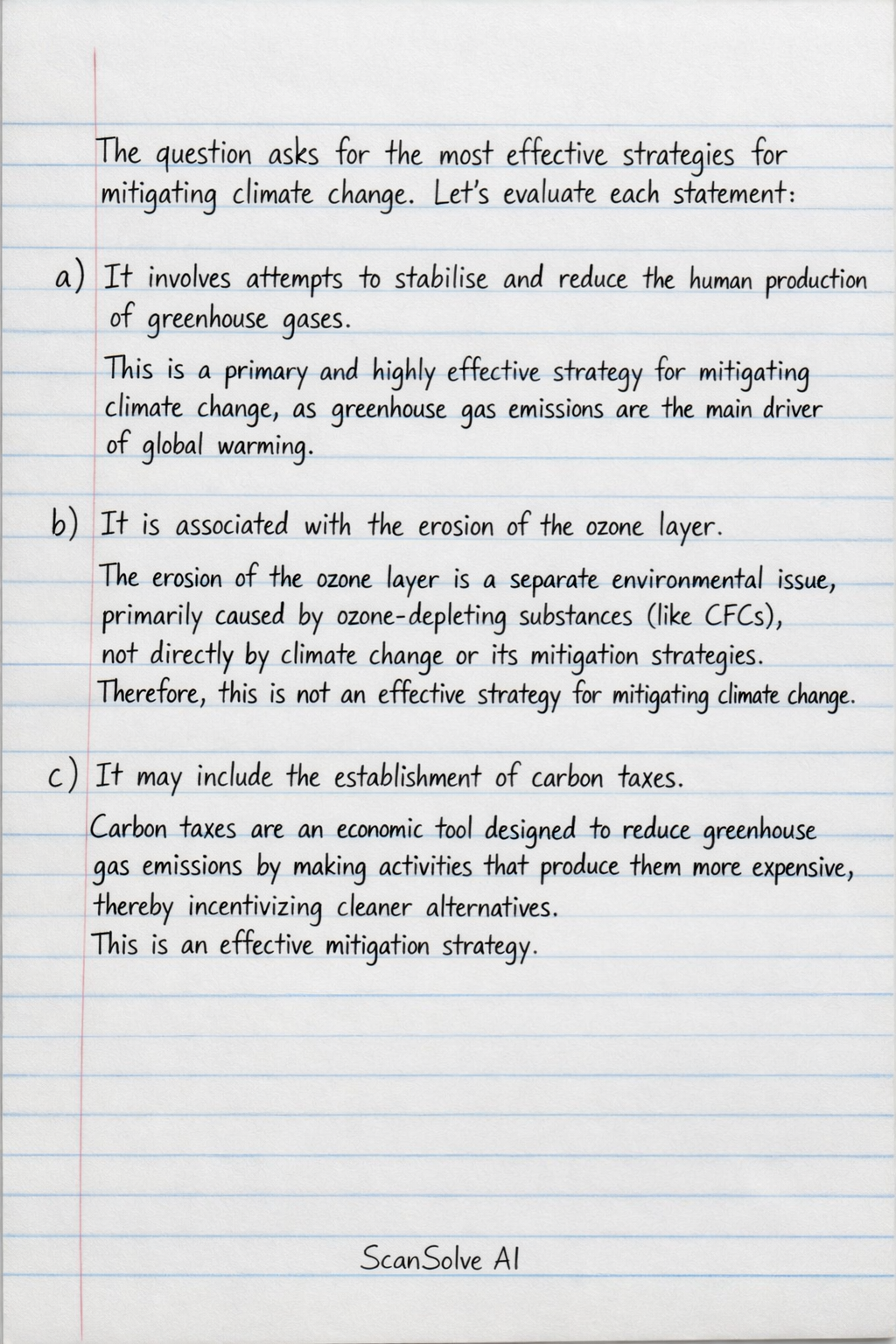
The question asks for the most effective strategies for mitigating climate change. Let's evaluate each statement:

  • a) It involves attempts to stabilise and reduce the human production of greenhouse gases. This is a primary and highly effective strategy for mitigating climate change, as greenhouse gas emissions are the main driver of global warming.
  • b) It is associated with the erosion of the ozone layer. The erosion of the ozone layer is a separate environmental issue, primarily caused by ozone-depleting substances (like CFCs), not directly by climate change or its mitigation strategies. Therefore, this is not an effective strategy for mitigating climate change.
  • c) It may include the establishment of carbon taxes. Carbon taxes are an economic tool designed to reduce greenhouse gas emissions by making activities that produce them more expensive, thereby incentivizing cleaner alternatives. This is an effective mitigation strategy.
  • d) The abolition of international climate change agreements. International agreements (such as the Paris Agreement) are crucial for coordinating global efforts to mitigate climate change. Abolishing them would hinder, not help, mitigation efforts. Therefore, this is not an effective strategy; in fact, it is counterproductive.

Based on this analysis, statements 'a' and 'c' are effective strategies for mitigating climate change. Statements 'b' and 'd' are incorrect in this context.

Now, let's examine the given options:

  1. a, b, c, and d
  2. a, c, and d
  3. a, b, and c
  4. b, c, and d

The ideal answer would be "a and c". Since this option is not available, we must choose the "least incorrect" option among the choices provided.

  • Options 1, 2, and 4 include statement 'd', which describes an action that would actively undermine climate change mitigation.
  • Option 3 includes statements 'a' and 'c' (which are correct strategies) and statement 'b' (which is incorrect but less directly counterproductive than 'd').

Comparing the incorrect statements 'b' and 'd', 'd' represents an action that would actively work against climate change mitigation. Statement 'b' is factually incorrect in the context of mitigation strategies but does not propose a harmful action. Therefore, option 3, which contains the two correct strategies ('a' and 'c') and the less severely incorrect statement ('b'), is the most plausible choice.

The final answer is 3\boxed{3}3​

Need help with your own homework?

Get instant step-by-step solutions to any question. Free to start.

Ask Your Question
Handwritten step-by-step solution

Handwritten Step-by-Step Solution

Get this solution as a handwritten image on WhatsApp — just like a tutor wrote it for you.

Try on WhatsApp

More Geography Questions

What are fossil fuelExplain how oxygen from the atmosphere enters the blood stream**1. South Africa's energy crisis is recurring, which poses a threat to energy management. Outline t…How Volcano eruptsWrite for me cv using following details Name ; Elizabeth ruguru mwangangi Email : elizabethmwangangi…to identify critical indicators of climate change's impact on the cryosphere. The cryosphere include…
See all Geographyquestions →