
We read your photo as:
What are four skills for good relations, five factors for healthy relationships in a multicultural society, factors for peaceful coexistence, and benefits of peaceful coexistence?
ScanSolve AI Answer
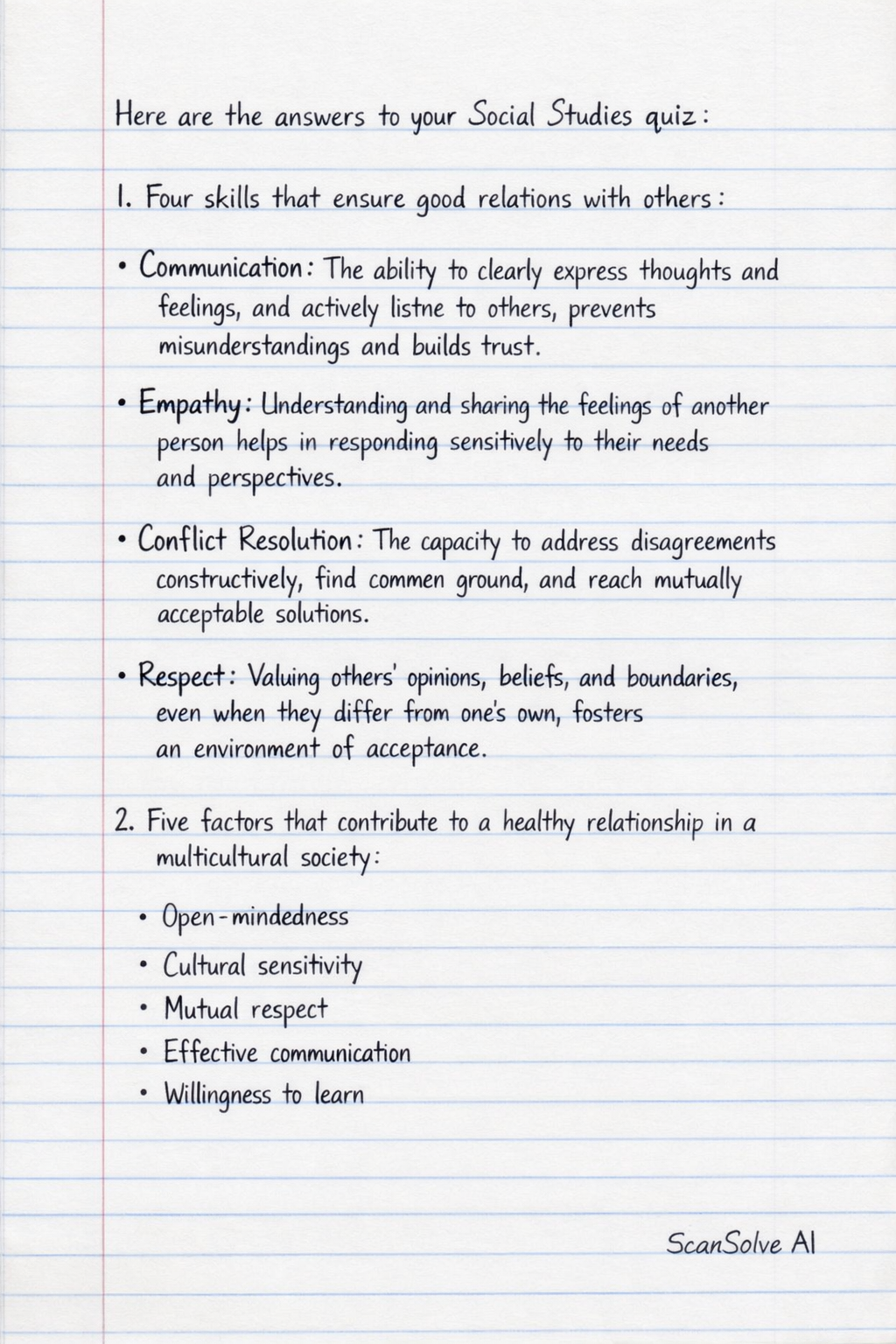
Here are the answers to your Social Studies quiz:
-
Four skills that ensure good relations with others:
- Communication: The ability to clearly express thoughts and feelings, and actively listen to others, prevents misunderstandings and builds trust.
- Empathy: Understanding and sharing the feelings of another person helps in responding sensitively to their needs and perspectives.
- Conflict Resolution: The capacity to address disagreements constructively, find common ground, and reach mutually acceptable solutions.
- Respect: Valuing others' opinions, beliefs, and boundaries, even when they differ from one's own, fosters an environment of acceptance.
-
Five factors that contribute to a healthy relationship in a multicultural society:
- Open-mindedness
- Cultural sensitivity
- Mutual respect
- Effective communication
- Willingness to learn
-
Factors that can contribute to peaceful coexistence in society:
- Tolerance and acceptance of differences
- Justice and equality for all groups
- Dialogue and communication across communities
- Shared values and common goals
- Education promoting understanding and empathy
- Strong legal frameworks protecting rights
-
Four benefits of enjoying peaceful coexistence:
- Social stability and harmony
- Economic growth and development
- Enhanced cultural exchange and enrichment
- Improved quality of life and well-being
Four reasons for the introduction of currency trade:
- Facilitation of exchange: Currency provides a universally accepted medium for buying and selling goods and services, replacing inefficient bartering.
- Store of value: Currency allows individuals to save wealth and defer consumption, as it retains its value over time.
- Unit of account: Currency provides a common measure for valuing goods, services, and debts, simplifying economic calculations.
- Portability and divisibility: Currency is easy to carry and can be divided into smaller units, making transactions of varying sizes convenient.
-
Define:
- i) Human diversity: The range of differences that exist among people, including variations in race, ethnicity, gender, age, religion, socioeconomic status, sexual orientation, physical abilities, and other attributes.
- ii) Personal attributes: The inherent characteristics, qualities, or traits that define an individual's personality, behavior, and capabilities.
- iii) Desirable and undesirable qualities: Desirable qualities are positive traits or characteristics that are generally valued and contribute to an individual's success and positive social interactions (e.g., honesty, kindness). Undesirable qualities are negative traits or characteristics that are generally frowned upon and can hinder personal growth or lead to negative social outcomes (e.g., dishonesty, aggression).
-
a) Four examples of human diversity:
- Racial and ethnic diversity
- Gender and sexual orientation diversity
- Religious and spiritual diversity
- Socioeconomic diversity
b) Three factors that determine diversity in society:
- Historical migration patterns: Movements of people across regions and continents over time lead to a mix of cultures and ethnicities.
- Geographical location: Different environments can foster distinct cultural practices, languages, and ways of life.
- Socioeconomic factors: Disparities in wealth, education, and access to resources create diverse social classes and opportunities within a society.
-
Define:
- i) Community: A group of people living in the same place or having a particular characteristic in common, often sharing common interests, values, or a sense of identity.
- ii) Community service: Voluntary work intended to help people in a particular area, often without payment, to improve the quality of life for others or to contribute to the well-being of the community.
-
a) Importance of community service learning (CSL):
- Enhances academic learning: CSL provides real-world application for classroom knowledge, making learning more relevant and engaging.
- Develops civic responsibility: It fosters a sense of duty towards the community and encourages active participation in addressing social issues.
- Promotes personal growth: Students develop critical thinking, problem-solving, leadership, and communication skills.
- Strengthens communities: CSL projects address genuine community needs, providing valuable support and resources.
- Increases empathy and understanding: Direct interaction with diverse community members helps students understand different perspectives and challenges.
b) Full meaning of CSL:
- CSL stands for Community Service Learning.
-
Key terms used in a CSL project:
- Reflection
- Partnership
- Community needs
- Learning objectives
-
Challenges, problems, or gaps one is likely to face when carrying out CSL practice in the community:
- Lack of resources: Insufficient funding, materials, or personnel to effectively implement projects.
- Logistical challenges: Difficulties with transportation, scheduling, or coordinating with community partners.
- Resistance from community members: Lack of trust, understanding, or willingness to participate from the target community.
- Safety and ethical concerns: Ensuring the well-being of participants and addressing potential ethical dilemmas.
- Sustainability issues: Difficulty in maintaining the project's impact or continuing services after the initial CSL period.
- Mismatch between student skills and community needs: Projects may not fully align with the abilities of the students or the actual needs of the community.
Still stuck on this one?
Ask a follow-up, and the answer starts from this question.
More Geography Questions
Handwritten Step-by-Step Solution
Get this as a handwritten image on WhatsApp — like a tutor wrote it for you.
Try on WhatsApp