
We read your photo as:
A) State five factors that promote national unity in Kenya. b) Explain five methods of conflict resolution.
ScanSolve AI Answer
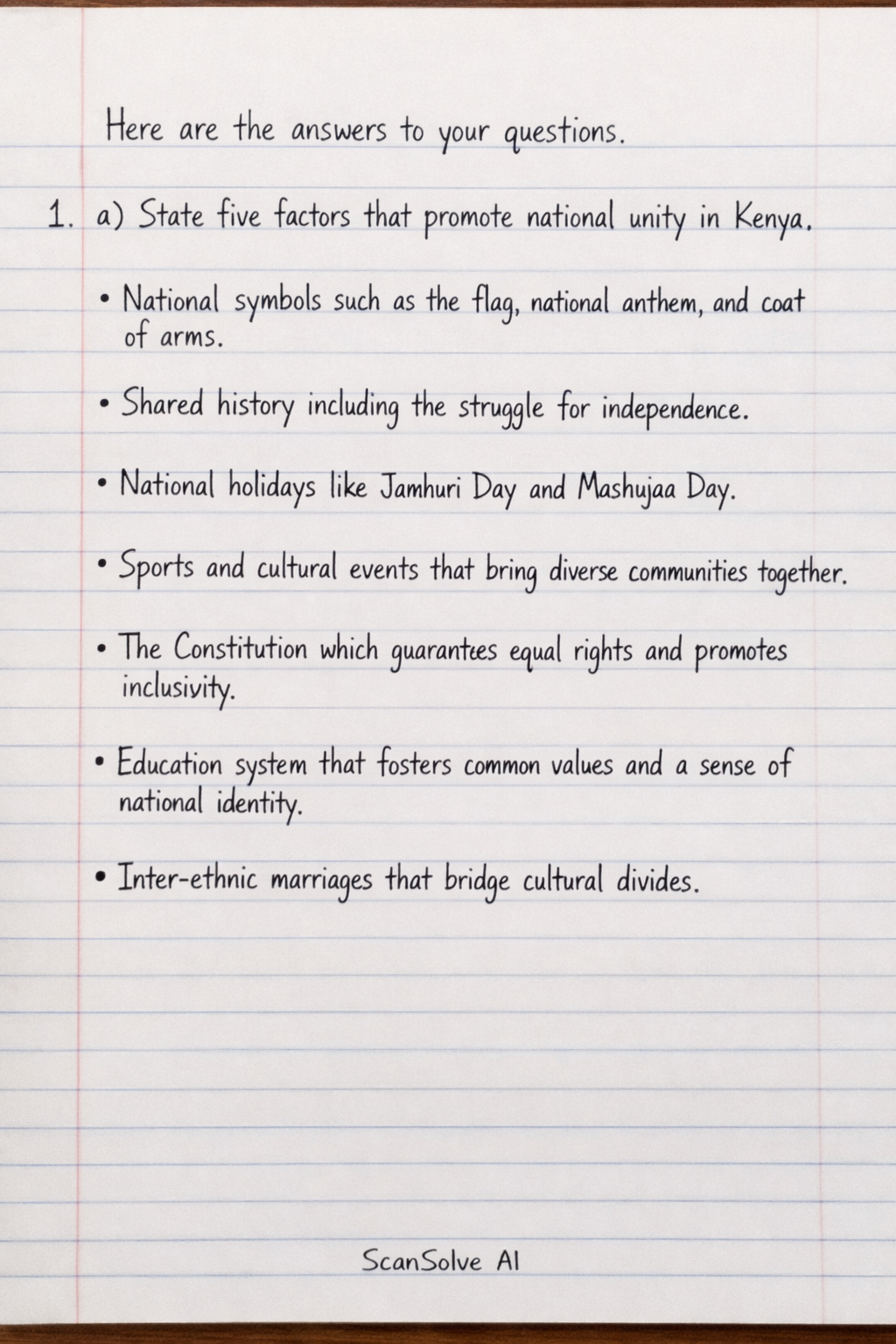
Here are the answers to your questions.
1. a) State five factors that promote national unity in Kenya.
- National symbols such as the flag, national anthem, and coat of arms.
- Shared history including the struggle for independence.
- National holidays like Jamhuri Day and Mashujaa Day.
- Sports and cultural events that bring diverse communities together.
- The Constitution which guarantees equal rights and promotes inclusivity.
- Education system that fosters common values and a sense of national identity.
- Inter-ethnic marriages that bridge cultural divides.
b) Explain five methods of conflict resolution.
- Negotiation: Direct discussion between conflicting parties to reach a mutually acceptable agreement without the involvement of a third party.
- Mediation: A neutral third party facilitates communication and helps the conflicting parties explore options and reach a voluntary agreement. The mediator does not impose a solution.
- Arbitration: A neutral third party hears arguments from all sides and then makes a binding decision or award to resolve the conflict. The parties agree to abide by the arbitrator's decision.
- Conciliation: A neutral third party attempts to build a positive relationship between the conflicting parties, improve communication, and reduce tensions, often leading to negotiation.
- Litigation: Resolving disputes through the formal court system, where a judge or jury makes a binding decision based on legal principles and evidence presented.
2. What is conflict resolution?
Conflict resolution is the process of resolving disagreements or disputes between two or more parties, aiming to find a peaceful and mutually acceptable solution.
3. Give the main reason why Kenya's celebrate Kenyatta day as a national holiday.
Kenyatta Day (now Mashujaa Day) was primarily celebrated to honor the heroes who fought for Kenya's independence, including Mzee Jomo Kenyatta.
4. Give one way in which the institution of the presidency promotes National Unity.
The presidency promotes national unity by acting as a symbol of national cohesion and representing all Kenyans, regardless of their ethnic or political affiliations.
5. State one way in which the Kenyan constitution promotes national unity.
The Kenyan Constitution promotes national unity by guaranteeing equal rights and freedoms for all citizens, fostering a sense of belonging and shared identity.
6. One way in which the constitution promotes national unity.
The Constitution promotes national unity by establishing institutions that are representative of all communities and ensuring equitable distribution of resources across the country.
7. Explain five reasons why national integration is important.
- Promotes peace and stability: When different groups feel integrated, it reduces ethnic tensions and conflicts, leading to a more peaceful society.
- Fosters economic development: A united nation can focus its energies on economic growth, as resources are not diverted to managing internal conflicts.
- Enhances national identity: Integration helps citizens identify as Kenyans first, rather than primarily by their ethnic or regional affiliations, strengthening patriotism.
- Ensures equitable resource distribution: Integration encourages fair allocation of resources and opportunities across all regions and communities, reducing feelings of marginalization.
- Strengthens democracy: A cohesive nation is better positioned to uphold democratic principles, as citizens participate collectively in governance and decision-making.
8. Why is it important to have cultural activities in Kenya today.
It is important to have cultural activities in Kenya today because they promote national cohesion, preserve heritage, and foster understanding and appreciation among diverse communities.
9. Give the major historical significance of first June in Kenya.
The major historical significance of June 1st in Kenya is that it marks Madaraka Day, commemorating the day Kenya attained internal self-rule in 1963.
10. State one way in which the Kenyan constitution promotes national unity.
The Kenyan Constitution promotes national unity by outlawing discrimination based on ethnicity, religion, or any other ground, thereby ensuring equality for all citizens.
11. Give two ways through which conflicts can be resolved peacefully.
- Dialogue and negotiation between the conflicting parties.
- Mediation by a neutral third party to facilitate communication and agreement.
12. a) Identify five symbols of national unity in Kenya.
- The National Flag
- The National Anthem
- The Coat of Arms
- The President (as a symbol of national leadership)
- The Constitution
- The National Language (Kiswahili)
- The Parliament
b) Discuss the steps that have been taken by the Kenyan government to promote national integration since independence.
- Establishment of national institutions: Creating bodies like the National Cohesion and Integration Commission (NCIC) to address ethnic divisions and promote unity.
- Promotion of Kiswahili: Designating Kiswahili as the national language to foster a common means of communication and identity.
- Equitable resource distribution: Implementing policies aimed at fair allocation of national resources and development projects across all regions to reduce marginalization.
- National education system: Developing a standardized curriculum that promotes common values, history, and a sense of national identity among students from diverse backgrounds.
- Inter-ethnic appointments: Appointing individuals from various ethnic groups to key government positions to ensure representation and inclusivity.
- National holidays and events: Celebrating national holidays like Jamhuri Day and Mashujaa Day, and organizing national events that bring Kenyans together.
- Sports and cultural exchange programs: Supporting national sports teams and cultural festivals that unite Kenyans and showcase their diversity.
13. (a) State five ways in which conflicts can be prevented in Kenya.
- Promoting equitable distribution of resources to reduce feelings of marginalization and injustice.
- Strengthening institutions of governance to ensure fairness, transparency, and accountability.
- Fostering inter-ethnic dialogue and understanding through community forums and peace initiatives.
- Implementing civic education programs to promote tolerance, respect for diversity, and national values.
- Addressing historical injustices through truth and reconciliation processes.
- Enforcing laws against hate speech and incitement to prevent ethnic polarization.
14. Describe six steps that can ensure a successful and peaceful resolution of conflicts.
- Identify the root causes: Thoroughly investigate and understand the underlying issues, grievances, and interests of all parties involved in the conflict.
- Open communication and dialogue: Create a safe space for all parties to express their perspectives, feelings, and needs without fear of reprisal.
- Involve neutral third parties: Engage mediators or conciliators to facilitate discussions, build trust, and guide parties towards common ground.
- Explore various options and solutions: Brainstorm and evaluate multiple potential solutions that address the interests of all parties, moving beyond fixed positions.
- Negotiate and reach an agreement: Work towards a mutually acceptable agreement that is fair, sustainable, and clearly outlines responsibilities and commitments.
- Implement and monitor the agreement: Ensure that the agreed-upon solutions are put into practice effectively and regularly monitored to address any emerging challenges or non-compliance.
Still stuck on this one?
Ask a follow-up, and the answer starts from this question.
More History Questions
Handwritten Step-by-Step Solution
Get this as a handwritten image on WhatsApp — like a tutor wrote it for you.
Try on WhatsApp