
We read your photo as:
Discuss the steps that have been taken by the Kenyan government to promote national integration since independence.
ScanSolve AI Answer
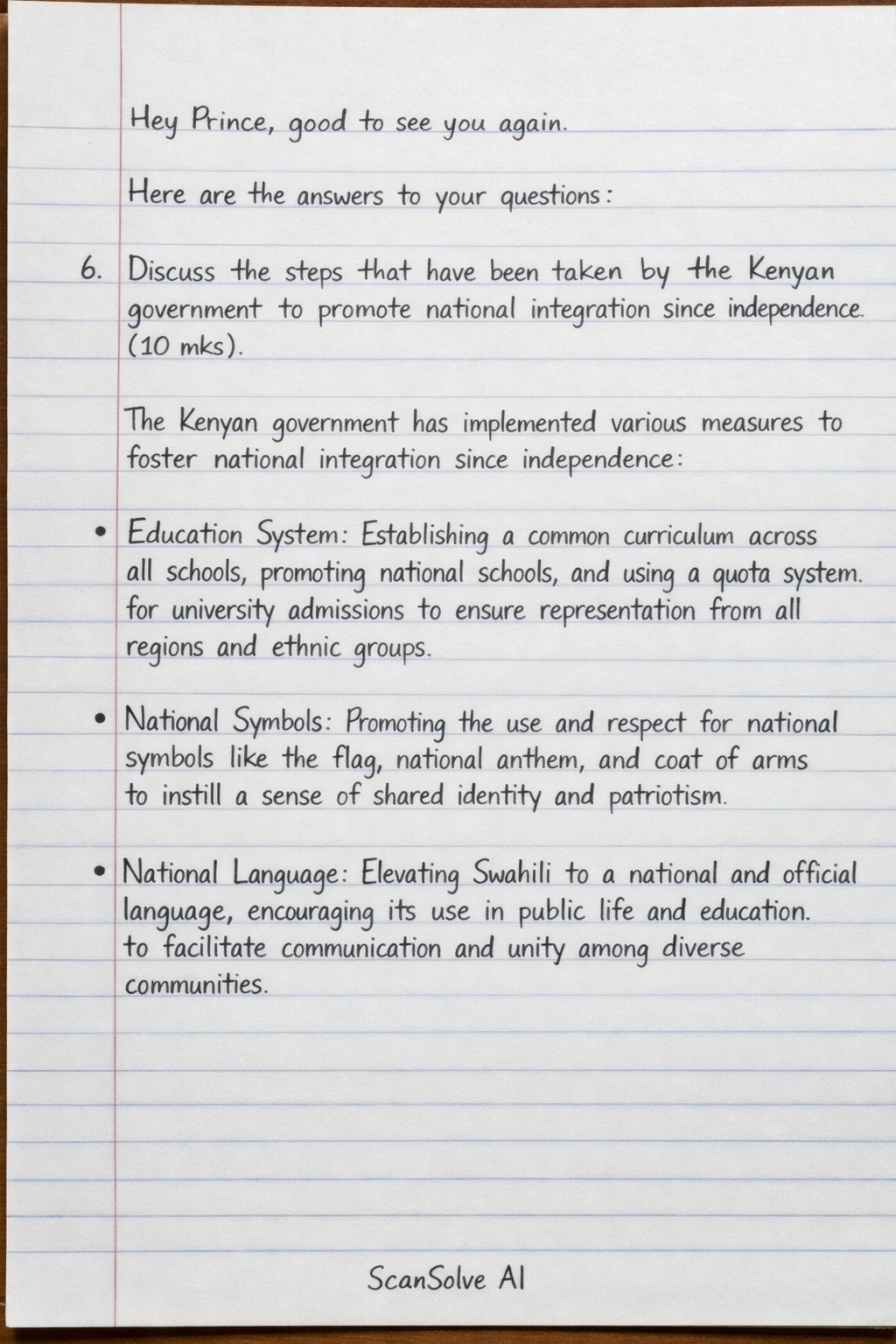
Here are the answers to your questions:
6. Discuss the steps that have been taken by the Kenyan government to promote national integration since independence (10 mks)
The Kenyan government has implemented various measures to foster national integration since independence:
- Education System: Establishing a common curriculum across all schools, promoting national schools, and implementing a quota system for university admissions to ensure representation from all regions and ethnic groups.
- National Symbols: Promoting the use and respect for national symbols like the flag, national anthem, and coat of arms to instill a sense of shared identity and patriotism.
- National Language: Elevating Swahili to a national and official language, encouraging its use in public life and education to facilitate communication and unity among diverse communities.
- Sports and Culture: Supporting national sports teams and organizing national cultural festivals to bring Kenyans from different backgrounds together and celebrate shared heritage.
- Devolution: Implementing a devolved system of government through the 2010 Constitution, which aims to ensure equitable distribution of resources and power, reducing feelings of marginalization.
- National Cohesion and Integration Commission (NCIC): Establishing institutions like the NCIC to address ethnic discrimination, promote peaceful coexistence, and investigate hate speech.
- Economic Policies: Implementing policies aimed at equitable distribution of national resources and development projects across all regions to reduce economic disparities that could fuel disunity.
- Security Forces: Ensuring that national security organs like the police and military are representative of Kenya's diverse ethnic composition, fostering a sense of national ownership.
- Constitutional Reforms: Enacting a new constitution in 2010 that emphasizes human rights, equality, and inclusivity, providing a framework for a more integrated society.
- National Service/Youth Programs: Initiatives like the National Youth Service (NYS) bring young people from different backgrounds together for training and community service, fostering national unity.
13. State five ways in which conflict can be prevented in Kenya (5 mks)
Five ways to prevent conflict in Kenya include:
- Equitable Distribution of Resources: Ensuring fair allocation of land, water, and other resources across all regions and communities.
- Promoting Good Governance and Rule of Law: Upholding justice, accountability, and transparency in all government operations to build public trust.
- Civic Education and Peacebuilding: Educating citizens on the importance of peace, tolerance, and respect for diversity.
- Strengthening National Cohesion Institutions: Empowering bodies like the NCIC to mediate disputes and address ethnic grievances proactively.
- Addressing Historical Injustices: Acknowledging and finding solutions for past grievances, especially those related to land and political marginalization.
14. Describe six steps that can ensure a successful and peaceful resolution of conflicts (12 mks)
Six steps for successful and peaceful conflict resolution are:
- Step 1: Acknowledging the Conflict: The first step is for all parties to recognize that a conflict exists and to be willing to address it. This involves identifying the core issues, the parties involved, and their respective interests and concerns.
- Step 2: Open Communication and Dialogue: Establishing safe and open channels for communication where all parties can express their perspectives, feelings, and needs without fear of reprisal. This helps in understanding each other's viewpoints.
- Step 3: Identifying Common Ground and Shared Interests: Facilitating discussions to find areas where parties agree or have shared goals, even amidst their differences. This helps build rapport and a foundation for cooperation.
- Step 4: Negotiation and Brainstorming Solutions: Parties engage in negotiation, either directly or with a mediator, to explore various options and brainstorm creative solutions that address the underlying issues. The focus is on finding mutually beneficial outcomes.
- Step 5: Reaching a Mutually Acceptable Agreement: Once potential solutions are identified, the parties work towards formalizing an agreement that is fair, practical, and acceptable to everyone involved. This often requires compromise from all sides.
- Step 6: Implementation, Monitoring, and Follow-up: The agreed-upon solution is put into action. It is crucial to establish mechanisms for monitoring its implementation and to have follow-up meetings to ensure compliance and address any new issues that may arise, preventing recurrence.
Still stuck on this one?
Ask a follow-up, and the answer starts from this question.
More History Questions
Handwritten Step-by-Step Solution
Get this as a handwritten image on WhatsApp — like a tutor wrote it for you.
Try on WhatsApp