
We read your photo as:
Indicate residential areas on the aerial photograph below:
ScanSolve AI Answer
Answer
Step-by-step solution
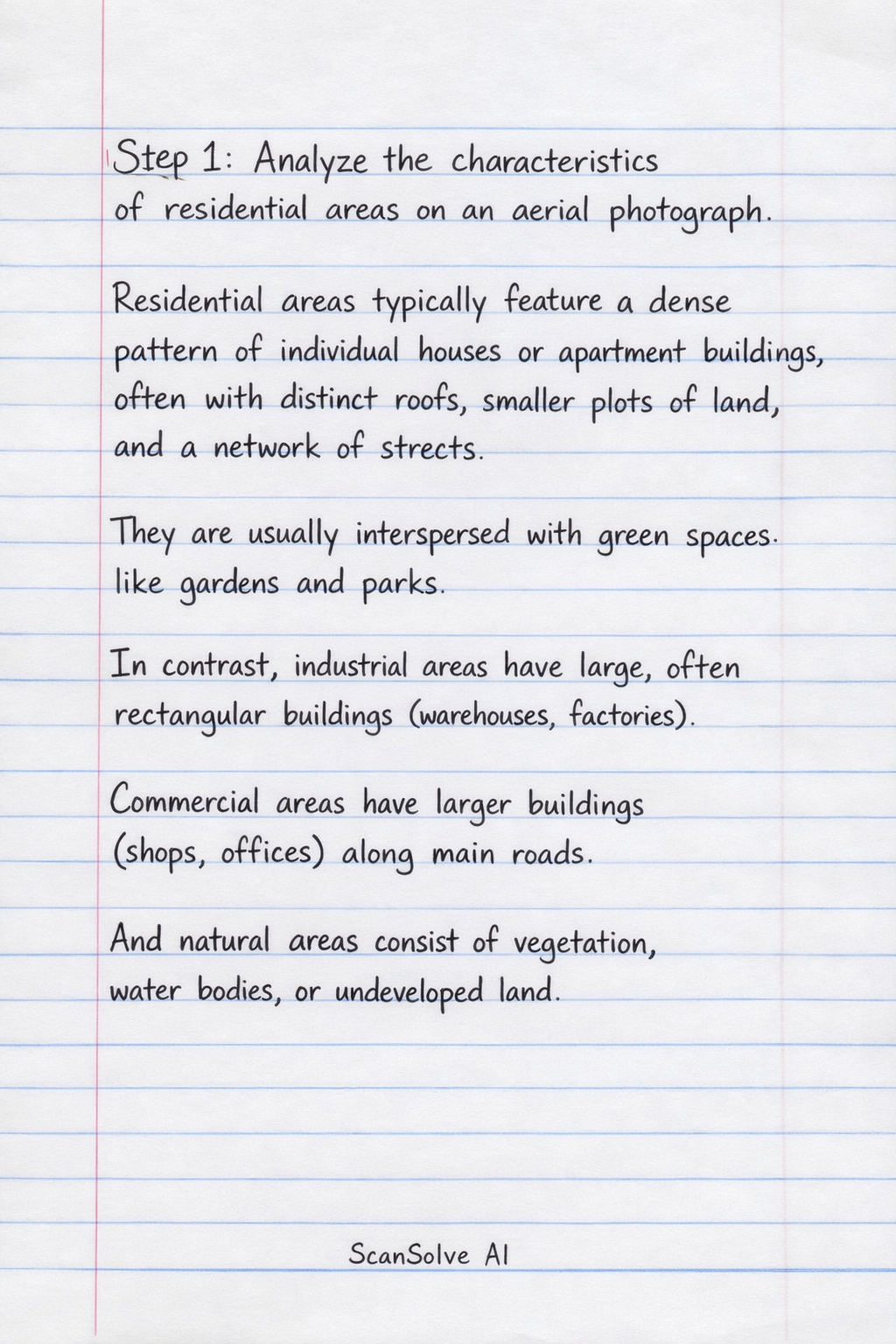
3 stepsAnalyze the characteristics of residential areas on an aerial photograph.
Residential areas typically feature a dense pattern of individual houses or apartment buildings, often with distinct roofs, smaller plots of land, and a network of streets. They are usually interspersed with green spaces like gardens and parks. In contrast, industrial areas have large, often rectangular buildings (warehouses, factories), commercial areas have larger buildings (shops, offices) along main roads, and natural areas consist of vegetation, water bodies, or undeveloped land.
Examine each labeled area on the aerial photograph.
- A: This appears to be a river or estuary, a natural water body.
- B: This is the coastline, consisting of a beach and the ocean.
- C: This area shows large, uniformly shaped buildings with extensive parking lots or open spaces, characteristic of industrial or large commercial complexes.
- D: This area displays a high density of smaller, individual structures with varied rooflines, arranged along a clear street grid, and surrounded by trees and green patches. This pattern is typical of a residential neighborhood.
- F: This area features large, manicured green spaces with specific layouts, indicative of a golf course or large park, possibly with some larger institutional buildings.
- G: This is the open ocean.
Identify the area that best fits the description of a residential area.
Based on the visual characteristics, area D clearly shows the typical layout and building density of a residential neighborhood.
The residential area on the aerial photograph is indicated by:
Try one yourself
A new problem that tests the same skill.
Still stuck on this one?
Ask a follow-up, and the answer starts from this question.
More Geography Questions
Handwritten Step-by-Step Solution
Get this as a handwritten image on WhatsApp — like a tutor wrote it for you.
Try on WhatsApp