

This geography problem is solved step by step below, with detailed explanations to help you understand the method and arrive at the correct answer.
ScanSolve AI Answer
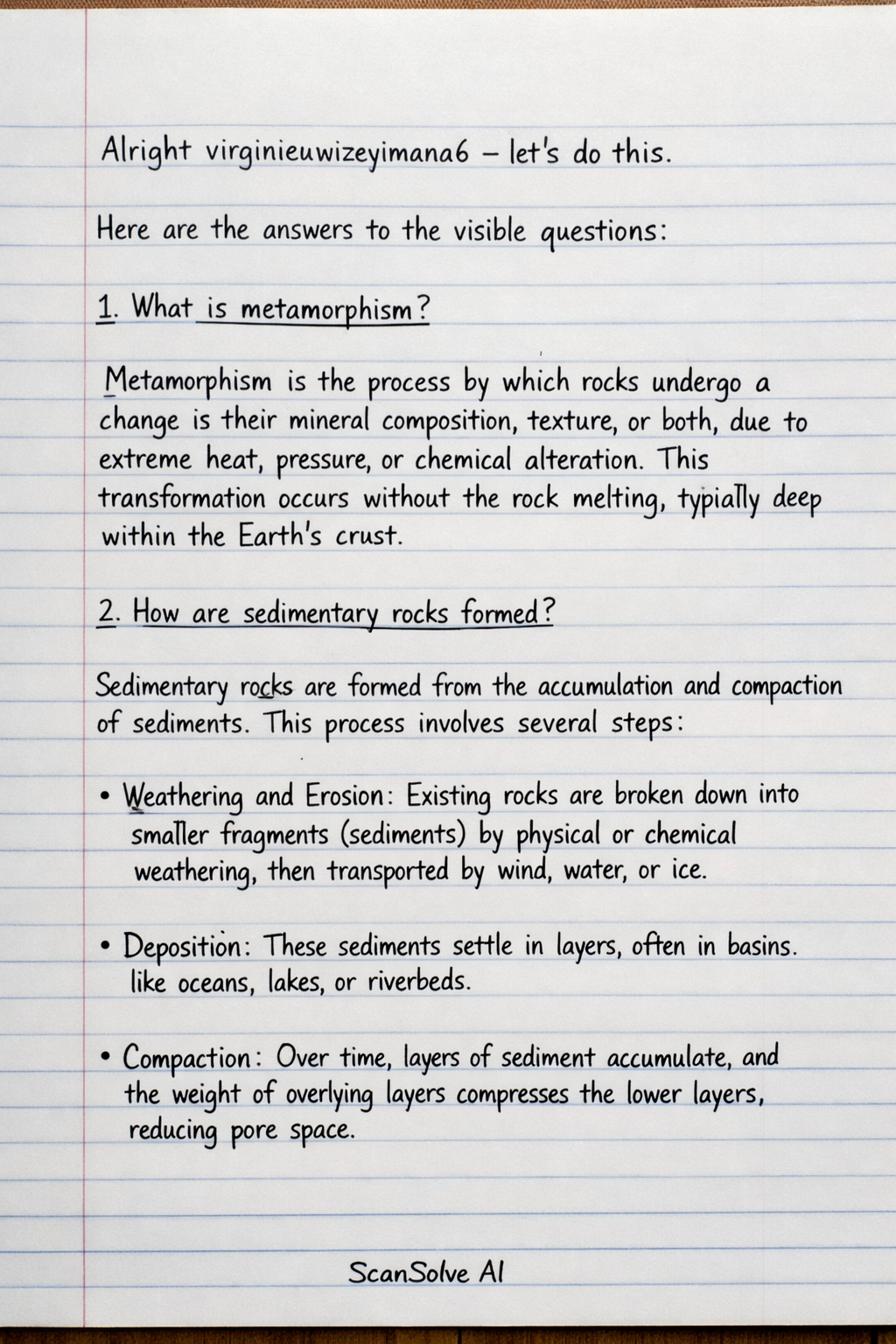
Here are the answers to the visible questions: 1. What is metamorphism? Metamorphism is the process by which rocks undergo a change in their mineral composition, texture, or both, due to extreme heat, pressure, or chemical alteration. This transformation occurs without the rock melting, typically deep within the Earth's crust. 2. How are sedimentary rocks formed? Sedimentary rocks are formed from the accumulation and compaction of sediments. This process involves several steps: Weathering and Erosion: Existing rocks are broken down into smaller fragments (sediments) by physical or chemical weathering, then transported by wind, water, or ice. Deposition: These sediments settle in layers, often in basins like oceans, lakes, or riverbeds. Compaction: Over time, layers of sediment accumulate, and the weight of overlying layers compresses the lower layers, reducing pore space. Cementation: Minerals dissolved in water (like calcite, silica, or iron oxides) precipitate in the pore spaces between sediment grains, acting as a natural glue to bind the sediments together, forming solid rock. 3. Identify the main physical feature shown in the photograph. Based on questions 5 and 6, the main physical feature is a Lake. (Note: The photograph itself is not provided, so this is an inference from subsequent questions). 4. Explain how this feature was formed. Lakes can be formed through various geological processes. Common ways include: Tectonic Activity: Movement of Earth's crust can create depressions (rift valleys) that fill with water. Volcanic Activity: Craters of extinct volcanoes can fill with water, or lava flows can block rivers. Glacial Activity: Glaciers can carve out depressions (cirques or troughs) that later fill with meltwater, or deposit moraines that dam valleys. River Activity: Meandering rivers can cut off oxbow lakes. Solution: Dissolution of soluble rocks (like limestone) can create sinkholes that fill with water. 5. State any two economic importance of this feature: Lake. Two economic importances of a lake are: Source of Water: Provides fresh water for domestic use, agriculture (irrigation), and industrial purposes. Fisheries: Supports fishing industries, providing food and livelihoods. Tourism and Recreation: Attracts tourists for activities like boating, swimming, and fishing, boosting local economies. Hydroelectric Power: Can be used to generate electricity through dams. Transportation: Serves as a waterway for transport of goods and people. 6. Give three reasons why settlement might be limited near this feature. Three reasons why settlement might be limited near a lake are: Flooding Risk: Areas immediately adjacent to lakes, especially those with fluctuating water levels, are prone to flooding. Unstable Ground: Lake shores can have soft, marshy, or unstable soil, making construction difficult and expensive. Disease Vectors: Stagnant or slow-moving water bodies can be breeding grounds for mosquitoes and other disease-carrying insects. Limited Arable Land: The land around lakes might be too wet or infertile for agriculture. Conservation Zones: Many lake areas are protected for ecological reasons, limiting development. Multiple Choice Questions (16, 17, 18): The specific questions for options 16, 17, and 18 are not visible in the image. Therefore, I cannot provide answers for them. What's next? Send 'em!