
We read your photo as:
Prepare a fieldwork report on population distribution and density in your local area, including topic, objectives, methodology, and data presentation.
ScanSolve AI Answer
here is a consolidated fieldwork report addressing all parts of your question, drawing from our previous discussions.
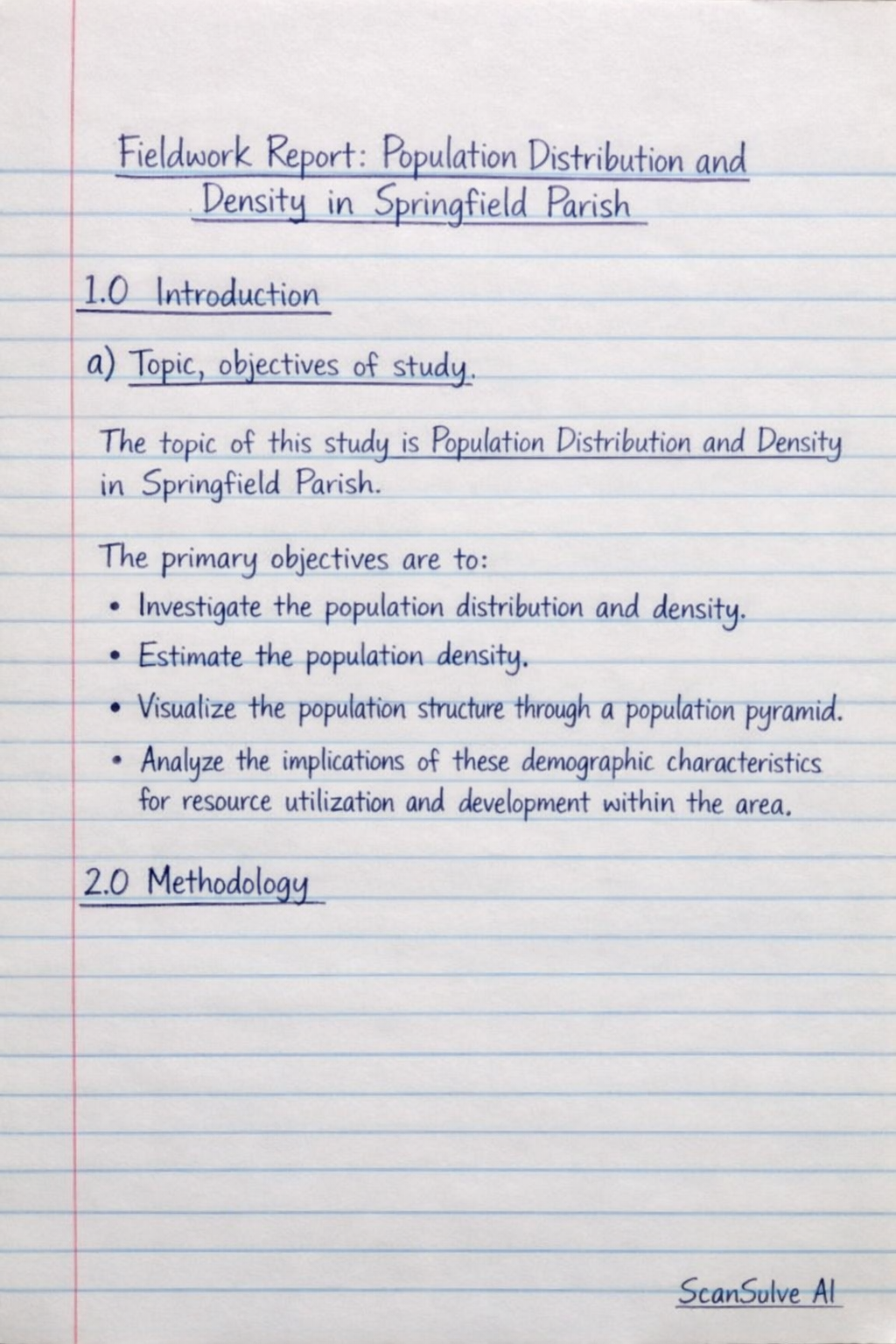
Fieldwork Report: Population Distribution and Density in [Your Local Area/Village/Parish]
1.0 Introduction
a) Topic, objectives of study
The topic of this study is Population Distribution and Density in [Your Local Area/Village/Parish]. The primary objectives are to investigate the population distribution and density, estimate the population density, visualize the population structure through a population pyramid, and analyze the implications of these demographic characteristics for resource utilization and development within the area.
2.0 Methodology
b) How the data was gathered?
Data was gathered through a field study involving a household count within the designated study area. The total number of households was recorded, and the estimated population was derived by multiplying the number of households by an assumed average household size (e.g., 5 people per household). Population density was then calculated by dividing the estimated total population by the known land area of the study site. Additional insights into population characteristics could be gathered through direct observation and informal interviews with residents.
3.0 Data Presentation and Analysis
3.1 Household Numbers and Population Density
Based on hypothetical data for a study area of and an average household size of 5 people:
| Zone/Area | Number of Households | Estimated Population (Households 5) | Population Density (people/km) |
|---|---|---|---|
| Zone A | 150 | 750 | |
| Zone B | 200 | 1000 | |
| Zone C | 100 | 500 | |
| Total | 450 | 2250 |
3.2 Description of the Population Pyramid
A population pyramid for this area, based on typical data for a developing region, would likely exhibit a broad base, indicating a high proportion of young people (0-14 years). The bars representing the youngest age groups (e.g., 0-4, 5-9) would be the longest, reflecting high birth rates. As age increases, the bars would gradually shorten, forming a triangular shape, which signifies a decreasing number of individuals in older age cohorts due to mortality. There might be a slight tendency for females to show higher percentages in older age groups, suggesting greater female longevity. This overall shape is characteristic of a young and expanding population.
4.0 Impact on Development
c) Your observations on how the population of the area visited impact development.
Observations would likely reveal that areas with high population density experience significant pressure on resources and infrastructure. This includes increased demand for housing, food, water, sanitation, and social services such as schools and healthcare facilities. Such high demand can lead to overcrowding, environmental degradation (e.g., deforestation, pollution), and strain on public services, potentially hindering sustainable development. Conversely, areas with low population density might face challenges like labor shortages, underutilization of available land and resources, and slower economic growth due to limited local markets and dispersed populations making service provision costly. The age structure, as depicted by the population pyramid, directly influences the dependency ratio, affecting the economic productivity and social welfare burden on the working-age population.
5.0 Recommendations for Development Planning
d) How the development planner can make use of the population in the areas visited for development?
Development planners can leverage population data to:
- Resource Allocation: Plan for the efficient provision of essential services (e.g., education, health, water) by aligning them with population size, distribution, and specific demographic needs.
- Infrastructure Development: Guide the design and implementation of infrastructure projects (e.g., roads, housing, utilities) to meet current and projected population demands, particularly in areas experiencing rapid growth or high density.
- Economic Planning: Identify the potential labor force, market size, and suitable economic activities for the area, facilitating targeted investments and job creation initiatives.
- Environmental Management: Formulate and implement policies for sustainable resource use, waste management, and conservation, especially crucial in densely populated areas to mitigate environmental impact.
- Social Program Design: Develop tailored social programs (e.g., maternal and child health, youth empowerment, elderly care) that address the specific demographic characteristics and vulnerabilities of different population groups within the community.
Still stuck on this one?
Ask a follow-up, and the answer starts from this question.
More Geography Questions
Handwritten Step-by-Step Solution
Get this as a handwritten image on WhatsApp — like a tutor wrote it for you.
Try on WhatsApp