
We read your photo as:
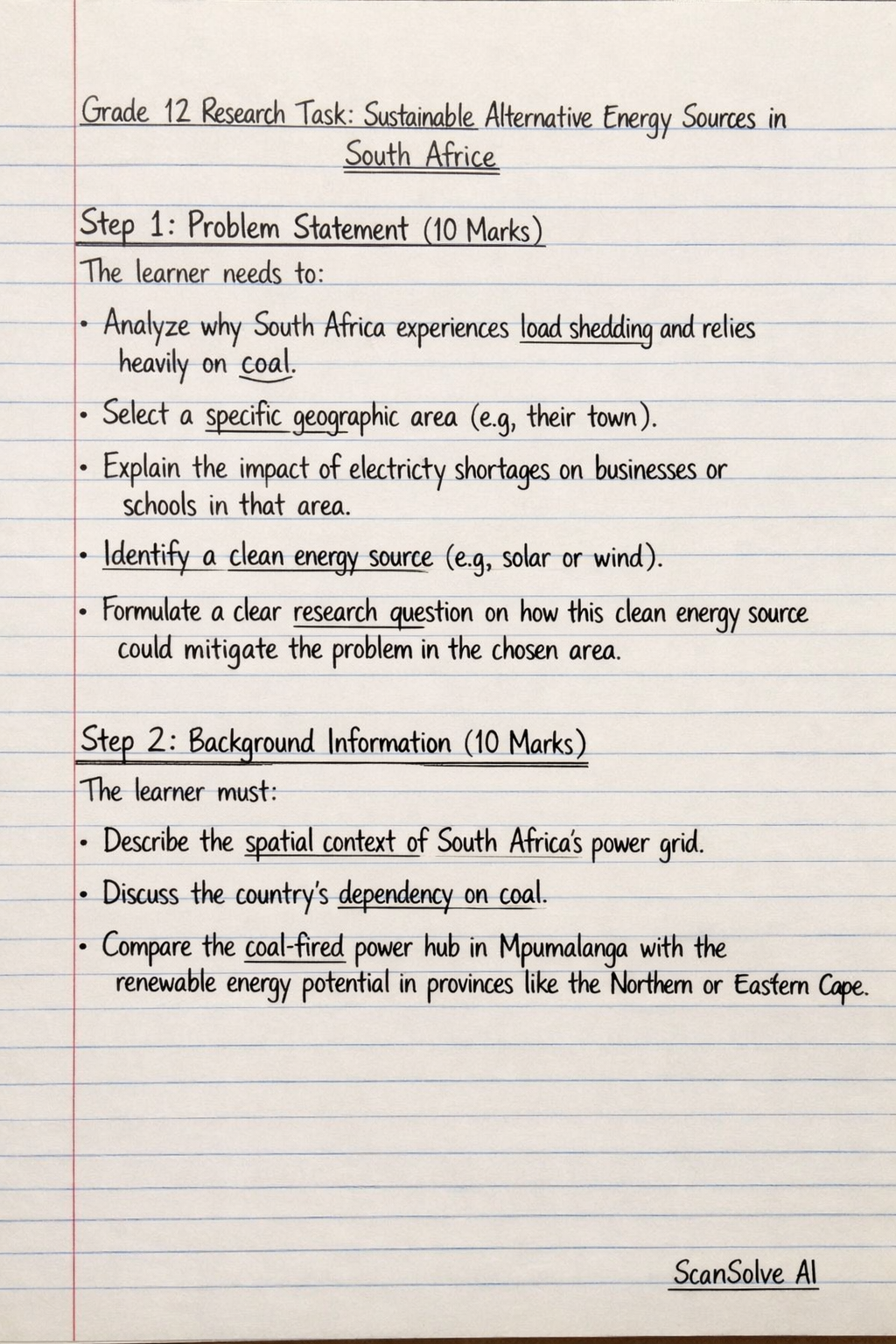
Research task on sustainable alternative energy sources in South Africa for Grade 12, covering problem statement, background, mapping, and data collection.
Geography
ScanSolve AI Answer
Step-by-step solution
4 stepsThis document outlines a research task for Grade 12 on sustainable alternative energy sources in South Africa. Here are the requirements for each step:
Problem Statement (10 Marks)
The learner needs to:
- Analyze why South Africa experiences load shedding and relies heavily on coal.
- Select a specific geographic area (e.g., their town).
- Explain the impact of electricity shortages on businesses or schools in that area.
- Identify a clean energy source (e.g., solar or wind).
- Formulate a clear research question on how this clean energy source could mitigate the problem in the chosen area.
Background Information (10 Marks)
The learner must:
- Describe the spatial context of South Africa's power grid.
- Discuss the country's dependency on coal.
- Compare the coal-fired power hub in Mpumalanga with the renewable energy potential in provinces like the Northern or Eastern Cape.
Mapping (10 Marks)
The learner is required to:
- Create an accurate Study Area Map.
- Correctly identify all nine provinces.
- Specifically highlight Mpumalanga as the coal-fired power hub.
- Ensure the map includes a Title, North Point, Scale, and Legend.
Data Collection Methods (10 Marks)
The learner must use at least three data collection methods, incorporating both primary and secondary sources.
- Primary Sources:
- Questionnaires/Interviews: Conduct surveys with local residents or business owners to gather firsthand information on load shedding impacts and willingness to adopt alternative energy sources.
- Field Observations: Assess the physical environment to identify suitable locations for renewable infrastructure, considering factors like unobstructed sunlight, high-altitude wind potential, or proximity to Eskom substations.
- Photographs and Site Maps: Visually document the current energy landscape, including aging infrastructure or existing solar installations, and show potential for green development.
- Secondary Sources:
- Literature and Map Analysis: Research existing data from the Integrated Resource Plan (IRP), Eskom's transmission reports, and official Solar/Wind Atlases to provide a scientific foundation for the investigation.
- Primary Sources:
Was this helpful?
Still stuck on this one?
Ask a follow-up, and the answer starts from this question.
Got a different question?Ask your own question
More Geography Questions
QOutline Step 1 of your research task: defining the problem statement for a South African energy…QFormulate a hypothesis and create a map for a Grade 11 Geography research task about conventional…QSouth Africa's energy crisis is recurring, which poses a threat to energy management. Outline the…QOutline the steps for an assignment on "Water Shortage in South Africa" for Grade 10.QThis is a Geography Research assignment for Grade 12.
Handwritten Step-by-Step Solution
Get this as a handwritten image on WhatsApp — like a tutor wrote it for you.
Try on WhatsApp